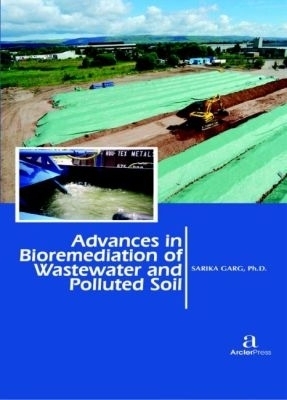
Advances in Bioremediation of Wastewater and Polluted Soil
Arcler Education Inc (Verlag)
978-1-68094-470-9 (ISBN)
- Titel z.Zt. nicht lieferbar
- Versandkostenfrei
- Auch auf Rechnung
- Artikel merken
The deterioration of an environment due to industrial effluents is a worldwide challenge. There are several different types of toxic inorganic and organic pollutants, namely pesticides, heavy metals, petroleum hydrocarbons, lubricants, chlorophenols, plastic, drugs, phenol, and radionuclides. These pollutants have deleterious effects on human beings and animals. The monumental benefits obtained from the use of pesticides, herbicides, and chemical fertilizers in agriculture and forestry sectors come with environmental costs. These man-made chemicals destroy soil fertility and drain into the waterways thus polluting rivers, ponds, lakes and coastal areas. Similarly, the industrial waste containing several hazardous chemicals is detrimental to an environment. Therefore, the remediation of such toxic pollutants is imperative for the benefits of human health and environment.
Bioremediation is the process of using organisms to nullify or degrade the environmental pollutants in contaminated soil and water. Microorganisms can be used to cure several types of pollution including wastewater problems, oil spillage, and soil pollution. Naturally occurring microbes eat and digest organic substances for nutrients and energy. However, microorganisms cannot remediate all types of contaminants with ease. Under such circumstances, phytoremediation- a process that uses plants to accumulate toxic substances is taken into consideration.
This book gathers the recent published works related to biodegradation and bioremediation of wastewater and polluted soil with the hope that it will help students in understanding the basics and applied effects of bioremediation. The first Chapter highlights the bioremediation of pesticides. The second Chapter features the beneficial use of microbial biofilms in bioremediation. In Chapters 3-7, discussion is on the bioremediation of heavy metals. Biodegradation of petroleum hydrocarbon is described in Chapter 8. Cleaning up oil spills through bioremediation is discussed in Chapters 9-11. In Chapters 12 and 13, degradation of chlorophenols is described. Managing waste plastic materials with no adverse impacts through bioremediation is discussed in Chapter 14. Removal of phenol, a toxic substance, from an industrial effluent is illustrated in Chapter 15. Remediation of radionuclides is described in Chapters 16 and 17. Exploiting bioremediation process for degrading anti-inflammatory drugs is discussed in the last three Chapters of the book.
I hope that this book will be advantageous for students, researchers, teachers, and industrial experts.
Sarika Garg procured her doctoral degree at the Max Planck Unit For Structural Molecular Biology, University of Hamburg, Germany in 2011. This was followed by Postdoctoral Scientist position at University of Saskatchewan, Canada. Later, she moved to CRCHUM, University of Montreal for her second Postdoc. She has diverse research interests and has contributed immensely in many research fields viz. Enzyme Technology, Environmental Science, and Neuroscience. She has numerous research papers and review articles to her credit. She has coauthored two books Enzymes & Enzyme Technology and Biochemical Tests: Principles and Protocols. She has also contributed several chapters in various books including a chapter on Regulation of Gene Expression in Encyclopedia of Molecular Cell Biology and Molecular Medicine. She is a recipient of 2012 SHRF Postdoctoral Fellowship Award and 2012 Laura E. Chapman Research Award. She is currently working as a Career Counselor in her very own venture ‘higherstudiescounseling.com’, Montreal, Canada and as a freelancer science writer.
| Erscheinungsdatum | 20.03.2018 |
|---|---|
| Sprache | englisch |
| Maße | 152 x 229 mm |
| Gewicht | 880 g |
| Themenwelt | Naturwissenschaften ► Biologie ► Ökologie / Naturschutz |
| Naturwissenschaften ► Geowissenschaften ► Geologie | |
| Technik ► Umwelttechnik / Biotechnologie | |
| ISBN-10 | 1-68094-470-3 / 1680944703 |
| ISBN-13 | 978-1-68094-470-9 / 9781680944709 |
| Zustand | Neuware |
| Informationen gemäß Produktsicherheitsverordnung (GPSR) | |
| Haben Sie eine Frage zum Produkt? |
aus dem Bereich