


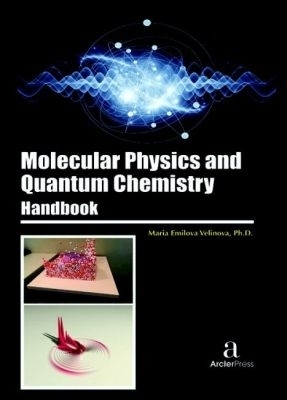
Molecular Physics and Quantum Chemistry Handbook
Seiten
2016
Arcler Education Inc (Verlag)
9781680944280 (ISBN)
Arcler Education Inc (Verlag)
9781680944280 (ISBN)
- Titel z.Zt. nicht lieferbar
- Versandkostenfrei
- Auch auf Rechnung
- Artikel merken
Reports on recent advances and applications in the field of the molecular physics and quantum chemistry. The study of molecular physics and quantum chemistry helps to predict and clarify the structure, the properties and the dynamics of atoms and molecules. This book includes theoretical and experimental techniques and their application to systems at different level of complexity.
This book aims to report recent advances and applications in the field of the molecular physics and quantum chemistry. The molecular physics and quantum chemistry study how to predict and clarify the structure, the properties and the dynamics of atoms and molecules. Selections of theoretical and experimental techniques are included beside their application to systems at different level of complexity and nature.
The fundamental equation in the quantum chemistry is the Schrödinger equation that is unbearable to be solved exactly for real systems. For this reason, the development of proper models for the description of the effects of electron correlation is key component of the theory. The methods in the quantum chemistry can be divided into those that aim at solving the Schrödinger equation by assuming a certain mathematical form for a wave function (i.e. Hartree-Fock methods) and those that do not engage a wave function explicitly (i.e. DFT, Density Functional Theory). These methods and their applications in different fields are discussed in the first section of the book with a broader discussion given to DFT methods - the most prominent approaches of the modern quantum chemistry. The second part of the book looks at experimental aspects of the molecular physics including various types of spectroscopy. This latter studies the interaction between electromagnetic radiation in all its forms and matter. The interaction can induce electronic excitations, molecular vibrations or nuclear spin orientations. The calculations of the spectrum of the molecules by theoretical methods are also discussed. The remaining content of this book focuses on methods that follow the laws of classical mechanics as the Molecular Dynamics (MD) method and Monte Carlo (MC) simulations. The MD method is a numerical technique of statistical mechanics for integration of the equations of motion for a many-particles system. On the other hand, the objective of a Monte Carlo simulation is to generate an ensemble of representative configurations under specific thermodynamics conditions for a complex macromolecular system applying random perturbations to the system. Both of the methods produce trajectories which can be used to evaluate various structural, transport, and thermodynamic properties of the system.
The exposition in the book is made from first principles to classical methods to support a better understanding of the potentialities, restrictions and applications of the methods used in molecular physics and quantum chemistry. Crossing the boundaries between several computational and experimental techniques, this book aims to be of interest to a broad auditory, including experimental and theoretical physicists, chemists and biologist.
This book aims to report recent advances and applications in the field of the molecular physics and quantum chemistry. The molecular physics and quantum chemistry study how to predict and clarify the structure, the properties and the dynamics of atoms and molecules. Selections of theoretical and experimental techniques are included beside their application to systems at different level of complexity and nature.
The fundamental equation in the quantum chemistry is the Schrödinger equation that is unbearable to be solved exactly for real systems. For this reason, the development of proper models for the description of the effects of electron correlation is key component of the theory. The methods in the quantum chemistry can be divided into those that aim at solving the Schrödinger equation by assuming a certain mathematical form for a wave function (i.e. Hartree-Fock methods) and those that do not engage a wave function explicitly (i.e. DFT, Density Functional Theory). These methods and their applications in different fields are discussed in the first section of the book with a broader discussion given to DFT methods - the most prominent approaches of the modern quantum chemistry. The second part of the book looks at experimental aspects of the molecular physics including various types of spectroscopy. This latter studies the interaction between electromagnetic radiation in all its forms and matter. The interaction can induce electronic excitations, molecular vibrations or nuclear spin orientations. The calculations of the spectrum of the molecules by theoretical methods are also discussed. The remaining content of this book focuses on methods that follow the laws of classical mechanics as the Molecular Dynamics (MD) method and Monte Carlo (MC) simulations. The MD method is a numerical technique of statistical mechanics for integration of the equations of motion for a many-particles system. On the other hand, the objective of a Monte Carlo simulation is to generate an ensemble of representative configurations under specific thermodynamics conditions for a complex macromolecular system applying random perturbations to the system. Both of the methods produce trajectories which can be used to evaluate various structural, transport, and thermodynamic properties of the system.
The exposition in the book is made from first principles to classical methods to support a better understanding of the potentialities, restrictions and applications of the methods used in molecular physics and quantum chemistry. Crossing the boundaries between several computational and experimental techniques, this book aims to be of interest to a broad auditory, including experimental and theoretical physicists, chemists and biologist.
Maria Velinova is Ph.D. holder in Quantum chemistry at the University of Sofia since April 2012. Her major research experience is in the field of Computational Chemistry, especially in statistical mechanics methods applied to different sorts of biomolecules. She is a member of the Laboratory of Quantum and Computational Chemistry at the University of Sofia.
| Erscheinungsdatum | 20.03.2018 |
|---|---|
| Sprache | englisch |
| Maße | 152 x 229 mm |
| Gewicht | 1180 g |
| Themenwelt | Naturwissenschaften ► Chemie ► Physikalische Chemie |
| Naturwissenschaften ► Physik / Astronomie ► Atom- / Kern- / Molekularphysik | |
| ISBN-13 | 9781680944280 / 9781680944280 |
| Zustand | Neuware |
| Informationen gemäß Produktsicherheitsverordnung (GPSR) | |
| Haben Sie eine Frage zum Produkt? |
Mehr entdecken
aus dem Bereich


aus dem Bereich
Quantenmechanik | Spektroskopie | Statistische Thermodynamik
Buch | Softcover (2024)
De Gruyter (Verlag)
CHF 83,90
200 Aufgaben zum sicheren Umgang mit Quellen ionisierender Strahlung
Buch | Hardcover (2023)
Hanser, Carl (Verlag)
CHF 48,95


