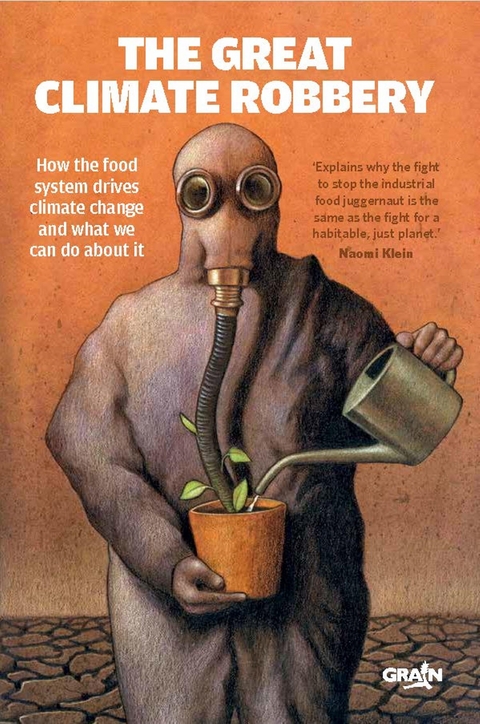
The Great Climate Robbery (eBook)
224 Seiten
New Internationalist (Verlag)
978-1-78026-340-3 (ISBN)
In The Great Climate Robbery highly respected non-profit Grain connects analysis of the food system to larger issues affecting the planet, and links peoples' struggles over food to climate change.
The collected articles in this book will help readers to understand the ways in which corporations seek to control the food system, and give information and analysis to challenge this control. This book features endorsements from Naomi Klein, Bill McKibben, and Vandana Shiva.
Henk Hobbelink is a member of the Grain collective, an international non-profit that works to support small farmers and social movements in their struggles for community-controlled and biodiversity-based food systems.
1. Food and climate change: the forgotten link
1.1 How the industrial food system contributes to the climate crisis
1.2 Food sovereignty: five steps to cool the planet
1.3 The Exxons of agriculture
1.4 How REDD+ projects undermine peasant farming and real solutions to climate change
1.5 Trade deals boosting climate change: the food factor
Hungry for land
2.1 The solution to climate change is in our lands
2.2 Family farm stories are not the fairy tales we’re being told
2.3 Hungry for land: small farmers feed the world with less than one–quarter of all farmland
2.4 Squeezing Africa dry: behind every land grab is a water grab
2.5 Asia’s agrarian reform in reverse: laws taking land out of small farmers’ hands
2.6 The landgrabbers of the Nacala Corridor
2.7 Socially responsible farmland investment: a growing trap
The struggle for seeds
3.1 Seed laws that criminalise farmers
3.2 Trade deals and farmers’ seeds
3.3 GMOs: Feeding or fooling the world?
3.4 Yvapuruvu Declaration: seed laws – resisting dispossession
Controlling the food system
4.1 Corporations replace peasants in China’s new food security agenda
4.2 Defending people’s milk in India
4.3 Food sovereignty for sale: supermarkets and dwindling people’s power over food and farming in Asia
4.4 How does the Gates Foundation spend its money to feed the world?
4.5 Planet palm oil: peasants pay the price for cheap vegetable oil
4.6 Free trade and Mexico’s junk food epidemic
| Erscheint lt. Verlag | 22.8.2016 |
|---|---|
| Sprache | englisch |
| Themenwelt | Naturwissenschaften ► Biologie ► Ökologie / Naturschutz |
| Naturwissenschaften ► Geowissenschaften | |
| Sozialwissenschaften ► Politik / Verwaltung | |
| Wirtschaft | |
| Weitere Fachgebiete ► Land- / Forstwirtschaft / Fischerei | |
| ISBN-10 | 1-78026-340-6 / 1780263406 |
| ISBN-13 | 978-1-78026-340-3 / 9781780263403 |
| Informationen gemäß Produktsicherheitsverordnung (GPSR) | |
| Haben Sie eine Frage zum Produkt? |
 EPUB (Adobe DRM)
Kopierschutz: Adobe-DRM
Adobe-DRM ist ein Kopierschutz, der das eBook vor Mißbrauch schützen soll. Dabei wird das eBook bereits beim Download auf Ihre persönliche Adobe-ID autorisiert. Lesen können Sie das eBook dann nur auf den Geräten, welche ebenfalls auf Ihre Adobe-ID registriert sind.
Details zum Adobe-DRM
Dateiformat: EPUB (Electronic Publication)
EPUB ist ein offener Standard für eBooks und eignet sich besonders zur Darstellung von Belletristik und Sachbüchern. Der Fließtext wird dynamisch an die Display- und Schriftgröße angepasst. Auch für mobile Lesegeräte ist EPUB daher gut geeignet.
Systemvoraussetzungen:
PC/Mac: Mit einem PC oder Mac können Sie dieses eBook lesen. Sie benötigen eine
eReader: Dieses eBook kann mit (fast) allen eBook-Readern gelesen werden. Mit dem amazon-Kindle ist es aber nicht kompatibel.
Smartphone/Tablet: Egal ob Apple oder Android, dieses eBook können Sie lesen. Sie benötigen eine
Geräteliste und zusätzliche Hinweise
Buying eBooks from abroad
For tax law reasons we can sell eBooks just within Germany and Switzerland. Regrettably we cannot fulfill eBook-orders from other countries.
aus dem Bereich