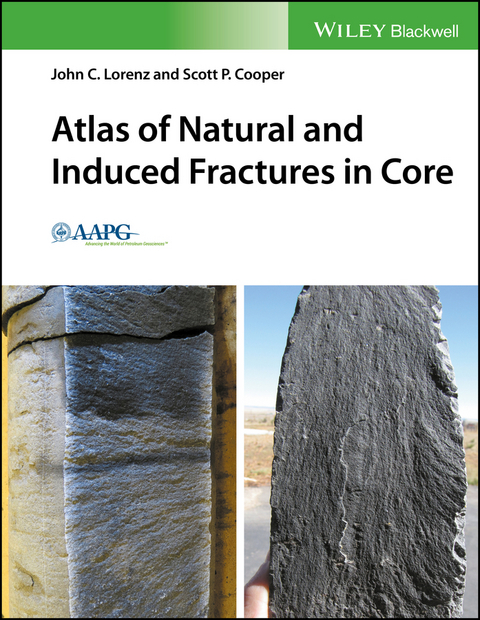
Atlas of Natural and Induced Fractures in Core (eBook)
John Wiley & Sons (Verlag)
978-1-119-16002-1 (ISBN)
An invaluable reference that helps geologists recognize and differentiate the many types of natural fractures, induced fractures and artefacts found in cores
Atlas of Natural and Induced Fractures in Core offers a reference for the interpretation of natural and induced fractures in cores. The natural and induced fracture data contained in cores provides a wealth of information once they are recognized and properly interpreted. Written by two experts in the field, this resource provides a much-needed tool to help with the accurate interpretation of these cores.
The authorsinclude the information needed to identify different fracture types as well as the criteria for distinguishing between the types of fractures. The atlas shows how to recognize non-fracture artefacts in a core since many of them provide other types of useful information. In addition, the text's illustrated structures combined with their basic interpretations are designed to be primary building blocks of a complete fracture assessment and analysis. The authors show how to recognize and correctly interpret these building blocks to ensure that subsequent analyses, interpretations, and modeling efforts regarding fracture-controlled reservoir permeability are valid.
Presented in full color throughout, this comprehensive reference is written for geologists charged with interpreting fracture-controlled permeability systems in reservoirs as well as for students or other scientists who need to develop the skills to accurately interpret the natural and induced fractures in cores.
John C. Lorenz and Scott P. Cooper are Senior Geologists with FractureStudies LLC in Edgewood, New Mexico.
An invaluable reference that helps geologists recognize and differentiate the many types of natural fractures, induced fractures and artefacts found in cores Atlas of Natural and Induced Fractures in Core offers a reference for the interpretation of natural and induced fractures in cores. The natural and induced fracture data contained in cores provides a wealth of information once they are recognized and properly interpreted. Written by two experts in the field, this resource provides a much-needed tool to help with the accurate interpretation of these cores. The authorsinclude the information needed to identify different fracture types as well as the criteria for distinguishing between the types of fractures. The atlas shows how to recognize non-fracture artefacts in a core since many of them provide other types of useful information. In addition, the text s illustrated structures combined with their basic interpretations are designed to be primary building blocks of a complete fracture assessment and analysis. The authors show how to recognize and correctly interpret these building blocks to ensure that subsequent analyses, interpretations, and modeling efforts regarding fracture-controlled reservoir permeability are valid. Presented in full color throughout, this comprehensive reference is written for geologists charged with interpreting fracture-controlled permeability systems in reservoirs as well as for students or other scientists who need to develop the skills to accurately interpret the natural and induced fractures in cores.
John C. Lorenz and Scott P. Cooper are Senior Geologists with FractureStudies LLC in Edgewood, New Mexico.
Foreword xi
Preface xiii
Acknowledgments xv
Introduction 1
Part 1 Natural Fractures 9
Section A Extension Fractures 11
A1 High-Angle Extension Fractures 13
A1a Introduction 13
A1b Fractography of High-Angle Extension Fractures 14
A1c Extension Fracture Dimensions 21
A1d Extension Fracture Variations and Lithologic Influences 33
A1e High-Angle Extension Fracture Intersections 43
A1f High- Angle Extension Fractures in Deviated Core 47
A2 Inclined Extension Fractures 51
A2a Inclined Extension Fractures in Horizontally Bedded Strata 51
A2b Inclined Extension Fractures in Inclined Strata 53
A2c Vertical Extension Fractures in Inclined Strata 54
A3 Horizontal Extension Fractures 55
A3a Beef-Filled Fractures 55
A3b Other Calcite-Mineralized Horizontal Extension Fractures 57
A3c NOT Horizontal Extension Fractures 57
Section B Shear Fractures 59
B1 Introduction 61
B1a Nomenclature 61
B1b Anderson's Shear Fracture/Fault Classification 62
B2 Shear Fracture Dimensions 65
B3 Shear Fracture Fractography 67
B3a Slickensides, Slickenlines, and Accretionary Steps 67
B3b En Echelon Segments 69
B3c Steps 71
B3d Pinch and Swell 72
B3e Sheared and Glassy Surfaces 75
B3f Slickencrysts 75
B3g Other Evidence for Shear 76
B4 High-Angle Shear Fractures 79
B4a Introduction 79
B4b High-Angle Strike-Slip Shear Fractures 79
B4c Non- Ideal High-Angle Shear Fractures 82
B5 Intermediate-Angle Shear Fractures 85
B6 Low-Angle Shear Fractures 89
B7 Bed-Parallel Shear Fractures 93
B8 Deformation Bands 97
B9 Faults 101
Section C Other Types of Natural Fractures 105
C1 Introduction 107
C2 Microfractures 109
C3 Ptygmatically Folded Fractures 111
C4 Fissures 117
C5 Veins 119
C6 Expulsion Structures 121
C7 Syn-Sedimentary Fractures 125
C8 Compound/Reactivated Fractures 133
C9 Shattered Rock 137
C10 Karst Breccias 139
C11 Pocket-Size Geomechanical Systems 143
C12 Stylolites 147
Section D Mineralization 151
D1 Mineralization 153
D1a Introduction 153
D1b Calcite Mineralization 154
D1c Other Types of Mineralization 160
D1d Oil and Bitumen 163
D1e False Mineralization 167
Part 2 Induced Fractures 171
2A Introduction 173
2B Petal and Saddle Fractures 175
2C Centerline Fractures 185
2D Disc Fractures 197
2E Scribe-Knife Fractures 209
2F Torque and Helical Twist Fractures 213
2G Core-Compression Fractures 219
2H Percussion-Induced Fractures 221
2I Bending Fractures with Barbs 225
2J Irregular Crack Networks 229
2K Induced Fractures with Curved Strikes 233
2L Waterflood-Related Fractures 237
2M Cored Hydraulic Fractures 241
Part 3 Artifacts 245
3A Introduction 247
3B Core Tops and Core Bases 249
3C1 Core-Catcher Drag 253
3C2 Core Orientation Scribe Grooves 257
3C3 Irregular Core Diameters 261
3C4 Pinion Holes 263
3D1 Spinoffs 265
3D2 Twice-Turned Core 269
3E Saw Scars 271
3F1 Core Plucking 277
3F2 Scratches 279
3F3 Drill-Mud Erosion 281
3F4 Core-Parting Enigmas 283
3F5 Polished Fracture Surfaces in Horizontal Cores 285
3F6 Tip Polish 287
3F7 Slab-Plane Consistency 291
3F8 Illusions 295
3F9 Coring-Related Rock Alteration on Core Surfaces 299
Index 301
"A high quality publication that should be an essential text in any and all core facilities and essential reading for anyone who spends time looking at core." Geoscientist Online
Introduction
Purpose of the Atlas
We were once emailed a long list of questions, arranged with paragraph‐sized spaces below each question for our detailed answers and including photos of specific cored fractures, from a student starting to work on fractured cores. The questions were both basic and important, and included queries such as: Are both the slabs and butt of the cores used in fracture studies? How do you distinguish extension from shear fractures? Should I record the induced fractures? The list illustrated some of the problems and uncertainties in understanding natural fractures in core; it also indicated that people charged with assessing fractures in core do not always know enough about fractures, or cores, to make valid assessments.
This atlas is a tool, intended to help geologists recognize, differentiate, and interpret different types of natural fractures, induced fractures, and artifacts found in cores. We hope that this atlas will provide a reference for cored fractures for the industry, one that enables geologists to recognize the differences in fracture types as well as the significantly different effects that the different types have on a reservoir. Moreover, we hope that it fills what we perceive to be a gap in the literature, in that many fractured‐reservoir textbooks start fracture analyses with the assumption that a geologist can already recognize and differentiate the various fracture types in a data set. We sincerely hope that this volume complements the seminal works of Nelson (1985, 2001) and Kulander et al. (1990).
The default concept of fractures is that they are planar, open cracks in a formation, when in fact there are many types of fractures and the different types can have significant differences in planarity, roughness, aperture, length, spacing, interconnectedness, and height, all affecting permeability. Knowledge of whether a fracture system formed in extension or shear, whether the fractures are open or mineralized, whether they are dissolution‐enhanced slots or slickensided shear planes, all play into understanding the effects of fractures on a reservoir.
Significant information on a fracture network and the associated in situ stress system can often be found in a core even though core is a relatively miniscule and one‐dimensional sampling of a reservoir. Since core is expensive and the sample is small, it is incumbent on the geologist to maximize the amount of fracture information recovered from a core, through knowledgeable examination of the core and informed analysis of the data collected from it.
We hope that this book provides a means for identification of many of the different fracture types found in cores as well as criteria for distinguishing between them. Some fracture types are widespread and control the basic plumbing of a reservoir, others are local and have minimal effect on formation permeability. A few fracture types provide orientation references or useful information on the in situ stress system. We have also illustrated some of the non‐fracture artifacts found in cores since many of them provide context as well as important information that can be used for natural fracture analyses.
Scale of Interest
This book illustrates fractures at the scale of four‐inch diameter cores. The illustrations are clarified where necessary with close‐up photos, but for the most part we have not illustrated fractures at either the millimeter scale that is important to fracture mechanics, or at the meter/outcrop scale that is important to the construction of fracture‐controlled permeability networks. This atlas is restricted to illustrating individual fractures as viewed when logging core, and describes their potential as individual permeability pathways. These structures and their basic interpretations are the primary building blocks for a complete fracture assessment and analysis, so they must be properly identified and correctly interpreted if subsequent analyses, interpretations, and modeling efforts are to be valid. For example, shear fractures commonly form intersecting conjugate pairs whereas extension fractures commonly form as single, parallel sets, and the difference greatly influences drainage and well‐to‐well interference patterns in a reservoir.
Industry geologists have recently had fewer opportunities to participate in the on‐site coring process due to changing techniques, liability issues, and the increasing use of service companies to retrieve and process cores. Fewer company geologists have the opportunity to be familiar with drilling operations or with coring and core processing procedures; thus they are often unfamiliar with the important ways in which such operations affect a core. Geologists rarely get to look at a core any more until it has been cut, cleaned, marked, plugged, slabbed, boxed, sampled, and laid out in the lab, by which time significant natural fracture information has been lost and additional fractures have been created in the core.
Once the geologist gains access to a core, a big gap looms between counting and understanding fractures. It is easy to count fractures and measure their dips and strikes, which provides a data base that can be readily analyzed statistically. But such analyses are meaningless if fractures are not fully understood and fully characterized before they are analyzed, since fractures are so much more than planar breaks in the rock.
Core samples typically consist of fresh exposures of the rock and therefore provide unweathered detail compared to outcrops. However, the ability to extrapolate beyond the core into the other two dimensions in a reservoir is limited; for example, it is difficult to derive the lateral spacing of vertical fractures from the data provided by a vertical core unless the restrictive assumptions of Narr’s (1996) analysis are met. Likewise, fracture heights are difficult to assess in horizontal core. Nevertheless, with experience and carefully acquired data, one can construct conceptual and often even semi‐quantitative models of the three‐dimensional fracture distributions, dimensions, spacings, and interconnectivities from cores.
Fracture Classification
Several systems have been used in classifying natural fractures. Some systems are based on fracture geometry, some on fracture origin, some on their electrical properties, and some on the potential effects of a fracture on a reservoir. For example, Nelson (2001) offers several classification schemes based on origin (extension, tension, or shear), on a fracture’s potential permeability (open fractures vs. filled fractures), or the structural associations of the fracture system (fault related, fold related, regional, etc.). In contrast, petrophysicists commonly classify fractures in image logs by their electric or acoustic properties (i.e., “conductive” or “resistive”).
For this atlas, natural fractures are divided into two main categories based on origin, i.e., extension fractures vs. shear fractures, with subcategories and modifiers for postfracture alterations.
It is human nature to categorize and classify, but as often as not, we are artificially compartmentalizing samples that form parts of a spectrum rather than discovering and documenting natural divisions. Fracture categorization serves a purpose but in fact, fractures may grade from one category into another. For example, “hybrid shears” (Hancock, 1986; Hancock and Bevan, 1987) offer a bridge between extension and conjugate‐shear fracture categories, and induced petal fractures morph into and blend with centerline fractures. Natural fractures can also be reactivated over geologic time intervals, leading to ambiguities in classification, i.e., fractures that formed in extension are sometimes reactivated in shear. Similarly, the distinction between faults and shear fractures would seem to be self‐explanatory, but if the distinction is based on offset magnitude it is arbitrary since shear offsets occur within a continuous range.
Organization of the Atlas
This atlas is organized into three parts.
Part 1: Natural Fractures
This section describes the characteristics of extension and shear fractures in core, which is not without complications. Most extension fractures are vertical, but intermediate‐angle and horizontal fractures are also found in some cores. Shear fractures for the most part can be subdivided into Anderson’s (1951) three dip‐angle categories, corresponding to high‐angle strike‐slip shears, intermediate‐angle dip‐slip shears, and low‐angle reverse dip‐slip shears, but shear fractures with oblique slip and bedding‐parallel slip are common in cores cut from some structural settings. We have also included short descriptions of other, less common types of cored natural fractures such as ptygmatically folded fractures and deformation bands.
Part 2: Induced Fractures
The two most important units in this second section on fractures created by coring and handling processes describe petal fractures, which can take many different forms, and centerline fractures. These two induced fracture types are important because they can be used to orient both a core and the natural fractures it contains relative to the in situ stress field, and sometimes even relative to north. Other induced fracture sections include descriptions of fractures created by twisting the core, by bending the core, and...
| Erscheint lt. Verlag | 20.9.2017 |
|---|---|
| Sprache | englisch |
| Themenwelt | Naturwissenschaften ► Geowissenschaften ► Geologie |
| Schlagworte | Andersonian fractures • Angewandte u. ökonomische Geologie • Angewandte u. ökonomische Geologie • bedding-parallel slip fractures • centreline fractures • conductive fractures • core-processing operations and fractures • Deformation Bands • earth sciences • Economic & Applied Geology • extension fractures • fractures and non-planar surfaces • fracture’s potential permeability • fractures with irregular dips • fractures with irregular strikes • Geowissenschaften • high-angle fractures • horizontal fractures • Induced Fractures • intermediate-angle dip-slip shears • intermediate angle fractures • low-angle reverse dip-slip shears • minor fracture types • Natural Fractures • Non-fracture artefacts created by coring and processing operations • non-systematic fractures • oblique slip fractures • percussion-related fractures • petal fractures • petrophysicists and fractures • ptygmatically folded fractures • resistive fractures • shear fractures • strike-slip shears • Structural Geology & Tectonics • Strukturgeologie, Tektonik • understanding natural fractures • vertical fractures |
| ISBN-10 | 1-119-16002-2 / 1119160022 |
| ISBN-13 | 978-1-119-16002-1 / 9781119160021 |
| Informationen gemäß Produktsicherheitsverordnung (GPSR) | |
| Haben Sie eine Frage zum Produkt? |
 EPUB (Adobe DRM)
Kopierschutz: Adobe-DRM
Adobe-DRM ist ein Kopierschutz, der das eBook vor Mißbrauch schützen soll. Dabei wird das eBook bereits beim Download auf Ihre persönliche Adobe-ID autorisiert. Lesen können Sie das eBook dann nur auf den Geräten, welche ebenfalls auf Ihre Adobe-ID registriert sind.
Details zum Adobe-DRM
Dateiformat: EPUB (Electronic Publication)
EPUB ist ein offener Standard für eBooks und eignet sich besonders zur Darstellung von Belletristik und Sachbüchern. Der Fließtext wird dynamisch an die Display- und Schriftgröße angepasst. Auch für mobile Lesegeräte ist EPUB daher gut geeignet.
Systemvoraussetzungen:
PC/Mac: Mit einem PC oder Mac können Sie dieses eBook lesen. Sie benötigen eine
eReader: Dieses eBook kann mit (fast) allen eBook-Readern gelesen werden. Mit dem amazon-Kindle ist es aber nicht kompatibel.
Smartphone/Tablet: Egal ob Apple oder Android, dieses eBook können Sie lesen. Sie benötigen eine
Geräteliste und zusätzliche Hinweise
Buying eBooks from abroad
For tax law reasons we can sell eBooks just within Germany and Switzerland. Regrettably we cannot fulfill eBook-orders from other countries.
aus dem Bereich