Writing Beijing (eBook)
150 Seiten
Lexington Books (Verlag)
978-1-4985-3102-3 (ISBN)
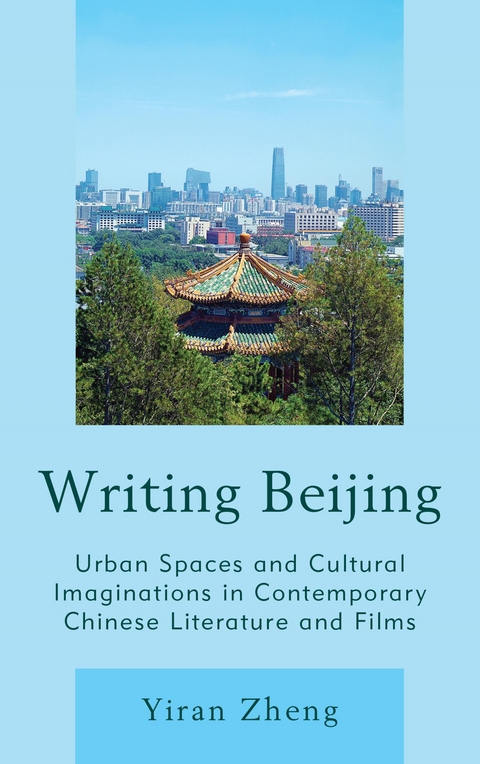
One of the oldest cities in the world, Beijing was an imperial capital for centuries. After the founding of the People's Republic of China in 1949, Beijing became not only the political center of the new communist country, but also the signifier of socialist ideol-ogy and revolutionary culture. Now, in the 21st century, Beijing embodies global conflicts and global connections. Over the course of the last century, then, Beijing moved from the quintessential "e;traditional"e; capital to the symbol of communist urban form and finally to a cosmopolitan metropolis. These three stages in the history of Beijing and its shifting representations are the topic of this study. Like other capitals, Beijing is much more than its physical entity. It also functions as a concept, a representation. As city planners have (and continue to) present Beijing to the world as a model, the fluctuating images of Beijing have become solidified in urban space. Today, the urban form of Beijing juxtaposes diverse spaces that span centuries, embodying the various representations of the city by its planners in different eras. These representations of space also provide possibilities for writers to rethink and rebuild the city in their literary works. Chinese writers and filmmakers often essentialize those urban spaces by making them symbols of different urban cultures, the old houses representing "e;traditional,"e; "e;patriarchal"e; Chinese culture while soviet-style buildings reflect revolu-tionary culture. Finally, the more recent sprouting of apartments, condos, and townhouses stands for the invasion of western modernity and provides evidence of global capitalism in contemporary China. Inspired by Henri Lefebvre, this study establishes a framework that connects urban spaces (representations of space) to writers and literary productions (representational space). I analyze the three major urban spatial forms of traditional, communist, and glob-alized Beijing and examine what these urban spaces mean to Chinese writers and filmmakers as well as how they use them to configure particular images of Beijing. I argue that these different configurations are actually the projections of those writers and filmmakers' own cultural imaginations; they provoke a form of emotional catharsis and also produce alternative visions of the cityscape.
Yiran Zheng is assistant professor at the Institute for Cultural Studies at Capital Normal University (CNU), Beijing.
Table of ContentsList of FiguresIntroductionPart IChapter 1 Work Unit Compound: An Emergence of a New Urban SpaceChapter 2 “Gongheguo xingui (New Aristocrats of the PRC)”Chapter 3 Red Nostalgia in the Literature of Military CompoundPart IIChapter 4 Siheyuan: Signifier of Traditional and Masculine CityChapter 5 Second-generation Beijing Flavor WritersChapter 6 Traditional Beijing and Masculine Beijing in Second-generation Beijing Flavor LiteraturePart IIIChapter 7 Modern and Postmodern Architectures: Presentations of the Global Context Chapter 8 Beijing FloatersChapter 9 Cosmopolitan Metropolis as An Urban Dream in Six-generation FilmsConclusion ReferencesAbout the Author
| Erscheint lt. Verlag | 29.4.2016 |
|---|---|
| Zusatzinfo | 14 Illustrations including: - 1 Black & White Illustrations; - 13 Halftones, Black & White including Black & White Photographs. |
| Sprache | englisch |
| Themenwelt | Kunst / Musik / Theater ► Film / TV |
| Sachbuch/Ratgeber ► Beruf / Finanzen / Recht / Wirtschaft ► Wirtschaft | |
| Geisteswissenschaften ► Sprach- / Literaturwissenschaft ► Anglistik / Amerikanistik | |
| Geisteswissenschaften ► Sprach- / Literaturwissenschaft ► Literaturwissenschaft | |
| Naturwissenschaften ► Geowissenschaften ► Geografie / Kartografie | |
| Sozialwissenschaften ► Kommunikation / Medien ► Medienwissenschaft | |
| Schlagworte | Beijing • Chinese City • Chinese film • Chinese literature • Cultural Studies • Urban space • urban studies |
| ISBN-10 | 1-4985-3102-4 / 1498531024 |
| ISBN-13 | 978-1-4985-3102-3 / 9781498531023 |
| Informationen gemäß Produktsicherheitsverordnung (GPSR) | |
| Haben Sie eine Frage zum Produkt? |
 EPUB (Adobe DRM)
Kopierschutz: Adobe-DRM
Adobe-DRM ist ein Kopierschutz, der das eBook vor Mißbrauch schützen soll. Dabei wird das eBook bereits beim Download auf Ihre persönliche Adobe-ID autorisiert. Lesen können Sie das eBook dann nur auf den Geräten, welche ebenfalls auf Ihre Adobe-ID registriert sind.
Details zum Adobe-DRM
Dateiformat: EPUB (Electronic Publication)
EPUB ist ein offener Standard für eBooks und eignet sich besonders zur Darstellung von Belletristik und Sachbüchern. Der Fließtext wird dynamisch an die Display- und Schriftgröße angepasst. Auch für mobile Lesegeräte ist EPUB daher gut geeignet.
Systemvoraussetzungen:
PC/Mac: Mit einem PC oder Mac können Sie dieses eBook lesen. Sie benötigen eine
eReader: Dieses eBook kann mit (fast) allen eBook-Readern gelesen werden. Mit dem amazon-Kindle ist es aber nicht kompatibel.
Smartphone/Tablet: Egal ob Apple oder Android, dieses eBook können Sie lesen. Sie benötigen eine
Geräteliste und zusätzliche Hinweise
Buying eBooks from abroad
For tax law reasons we can sell eBooks just within Germany and Switzerland. Regrettably we cannot fulfill eBook-orders from other countries.
aus dem Bereich