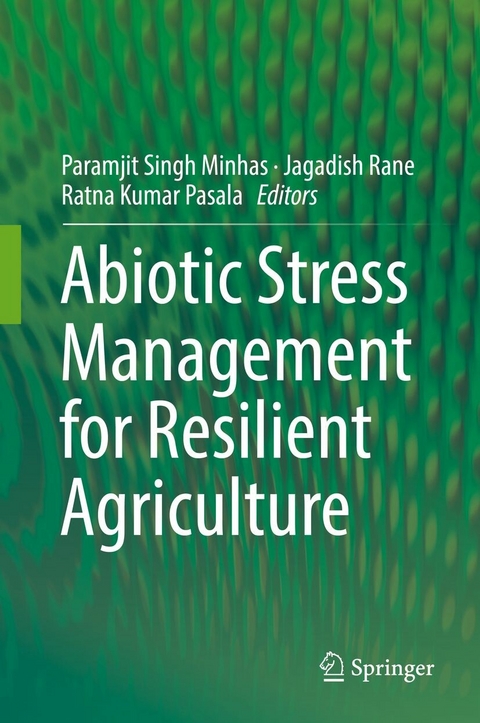
Abiotic Stress Management for Resilient Agriculture (eBook)
XVIII, 517 Seiten
Springer-Verlag
978-981-10-5744-1 (ISBN)
This book offers a state-of-the-art overview of on abiotic stresses in terms of the challenges; scope and opportunities; copping strategies for adaptation and mitigation using novel tools for building resilience in agricultural crops and livestock; as well as for policy implementation. Divided into four major parts: advances and prospects for understanding stress environments; adaptation and mitigation options; crop-based mitigation strategies; and mitigation options in animal husbandry, the book focuses on problem-solving approaches and techniques that are essential for the medium to long-term sustainability of agricultural production systems The synthesis and integration of knowledge and experiences of specialists from different disciplines offers new perspectives in the versatile field of abiotic stress management, and as such is useful for various stakeholders, including agricultural students, scientists, environmentalists, policymakers, and social scientists.
Dr. Paramjit Singh Minhas has about 4-decades of diversified research experience on Management of Natural Resources. His main contributions include soil-water-plant interactions in saline and other edaphically harsh environments and development of management strategies for deficit irrigation, use of low quality waters, salinity afflicted and shallow basaltic soils for raising the production potential of crops, orchard/forestry plantations. By holding key research management positions in Indian Council of Agricultural Research viz. Project Coordinator, All India Coordinated Project on Management of Salt-affected Soils & Use of Saline Water in Agriculture; Assistant Director General (Integrated Water Management); Director of Research, Punjab Agricultural University; Assistant Director General (Soil and Water Management) and Director, ICAR-National Institute on Abiotic Stress Management, he has demonstrated leadership skills in formulating and implementing research programs and providing vision and direction. His research endeavours have been recognised with several awards like Rafi Ahmed Kidwai Award, Swami Pranavananda Sarswati Award in Environmental Science and Ecology, Jain-INCID Krishi Sinchai Vikas Puraskar-2005; Hari Om Ashram Trust Award; The CSSRI Excellence Award on ‘Soil Salinity and Water Management; Su Kumar Basu Award; 12th International Congress Commemoration Medal. He is Fellow of National Academy of Agricultural Sciences; Indian Society of Soil Science, Punjab Academy of Sciences; and Associate Editor of Agricultural Water Management (Journal by Elsevier, Netherlands) and Member of Editorial Board of Indian Journal of Agricultural Sciences.Dr. Jagadish Rane , Principal Scientist and Head of School of Drought Stress Management at ICAR-National Institute of Abiotic Stress Management (NIASM), started his research carrier at ICAR-Indian Institute on Wheat and Barley Research in 1993. During 2007 to 2011, he led a Plant Phenotyping Team for evaluation of gene technology to improve drought tolerance in upland rice at International Centre for Tropical Agriculture (CIAT). He has organized multi-location experiments across India to understand the plant traits and genes for resilience to abiotic stresses. He has established a Plant Phenomics Platform and developed prototypes of low cost phenotyping tools for field evaluation of germplam. He has standardized protocols for various screening procedures viz., transgenic events in bio-safety, identification of water efficient genotypes etc. Dr. Ratna Kumar Pasala, Senior Scientist dealing PlantAbiotic Stress Physiology at ICAR-Indian Institute of Oilseeds Research, Hyderabad and Member Editorial Board of Plant Science Journals and Reviewer of many international and national journals. He has research experience in Plant Stress Functional Biology at ICAR- Institute of Abiotic Stress Management (NIASM) and International Crop Research Institute for Semi-Arid Tropics (ICRISAT). His major research expertise is in Plant Stress Physiology and Plant Bio-regulators for mitigation of abiotic stresses through redox mediated mechanism. He is recipient of R.D. Asana Gold Medal Award; Young Scientist Fellowship Award by FAO.
Part 1: Advances and Prospects for Understanding Stress Environments.- Chapter 1. Abiotic Stresses in Agriculture: An Overview.- Chapter 2. Atmospheric Stressors: Challenges and Coping Strategies.- Chapter 3. Agriculture Drought Management Options: Scope and Opportunities.- Chapter 4. Edaphic Stresses: Concerns and Opportunities for Their Management.- Part 2: Adaptation and Mitigation Options.- Chapter 5. Managing Soil Related Abiotic Constraints for Sustainable Agriculture.- Chapter 6. Developments in Management of Abiotic Stresses in Dryland Agriculture.- Chapter 7. Heavy Metal Toxicities in Soils and Their Management.- Chapter 8. Current Trends in Salinity and Water logging Tolerance.- Chapter 9. Impacts and Management of Temperature and Water Stress in Crop Plants.- Chapter 10. Plant Bio-regulators: A Mitigation Strategy for Resilient Agriculture.- Chapter 11. Thiourea: A Potential Bioregulator for Alleviating Abiotic Stresses.- Part 3: Crop Based Mitigation Strategies.- Chapter 12. Improving Crop Adaptations to Climate Change: Contextualizing the Strategy.- Chapter 13. Biotechnological Applications for Improvement of Drought Tolerance.- Chapter 14. Managing Abiotic Stresses in Wheat.- Chapter 15. Breeding Rice Varieties for Abiotic Stress Tolerance: Challenges and Opportunities.- Chapter 16. Abiotic Stress Tolerance in Barley.- Chapter 17. Sugarcane crop: Its Tolerance towards Abiotic Stresses.- Chapter 18.Abiotic Stress Management in Horticulture Crops.- Chapter 19. Impact of Climate Change on Vegetable Production and Adaptation Measures.- Part 4: Mitigation Options in Animal Husbandry.- Chapter 20. Nutritional Management for Sustaining Livestock during Drought.- Chapter 21. Mitigation Options for GHG Emissions from Ruminants.- Chapter 22. Mitigation of Climatic Change Effects for Sheep Farming in Arid Environment.- Chapter 23. Policy Support for Abiotically Stressed Agro-ecosystems: Challenges and Opportunities.- Chapter 24. Inculcating Resilience to Agriculture under Abiotically Stressed Environments: Synthesis and Way Forward.
| Erscheint lt. Verlag | 6.10.2017 |
|---|---|
| Zusatzinfo | XVIII, 517 p. 41 illus., 33 illus. in color. |
| Verlagsort | Singapore |
| Sprache | englisch |
| Themenwelt | Naturwissenschaften ► Biologie ► Ökologie / Naturschutz |
| Naturwissenschaften ► Geowissenschaften | |
| Technik | |
| Weitere Fachgebiete ► Land- / Forstwirtschaft / Fischerei | |
| Schlagworte | Abiotic stress tolerance • climate change • Climate Change Management • Drought • natural resource management • Options for mitigations |
| ISBN-10 | 981-10-5744-3 / 9811057443 |
| ISBN-13 | 978-981-10-5744-1 / 9789811057441 |
| Informationen gemäß Produktsicherheitsverordnung (GPSR) | |
| Haben Sie eine Frage zum Produkt? |
 PDF (Wasserzeichen)
DRM: Digitales Wasserzeichen
Dieses eBook enthält ein digitales Wasserzeichen und ist damit für Sie personalisiert. Bei einer missbräuchlichen Weitergabe des eBooks an Dritte ist eine Rückverfolgung an die Quelle möglich.
Dateiformat: PDF (Portable Document Format)
Mit einem festen Seitenlayout eignet sich die PDF besonders für Fachbücher mit Spalten, Tabellen und Abbildungen. Eine PDF kann auf fast allen Geräten angezeigt werden, ist aber für kleine Displays (Smartphone, eReader) nur eingeschränkt geeignet.
Systemvoraussetzungen:
PC/Mac: Mit einem PC oder Mac können Sie dieses eBook lesen. Sie benötigen dafür einen PDF-Viewer - z.B. den Adobe Reader oder Adobe Digital Editions.
eReader: Dieses eBook kann mit (fast) allen eBook-Readern gelesen werden. Mit dem amazon-Kindle ist es aber nicht kompatibel.
Smartphone/Tablet: Egal ob Apple oder Android, dieses eBook können Sie lesen. Sie benötigen dafür einen PDF-Viewer - z.B. die kostenlose Adobe Digital Editions-App.
Buying eBooks from abroad
For tax law reasons we can sell eBooks just within Germany and Switzerland. Regrettably we cannot fulfill eBook-orders from other countries.
aus dem Bereich