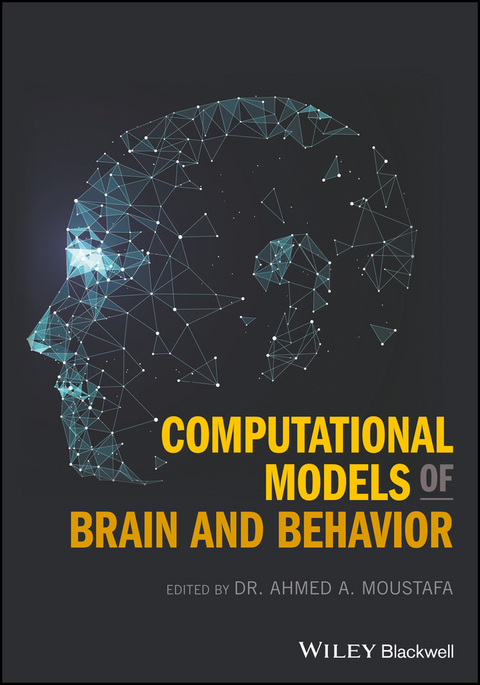
Computational Models of Brain and Behavior (eBook)
John Wiley & Sons (Verlag)
978-1-119-15918-6 (ISBN)
A comprehensive Introduction to the world of brain and behavior computational models
This book provides a broad collection of articles covering different aspects of computational modeling efforts in psychology and neuroscience. Specifically, it discusses models that span different brain regions (hippocampus, amygdala, basal ganglia, visual cortex), different species (humans, rats, fruit flies), and different modeling methods (neural network, Bayesian, reinforcement learning, data fitting, and Hodgkin-Huxley models, among others).
Computational Models of Brain and Behavior is divided into four sections: (a) Models of brain disorders; (b) Neural models of behavioral processes; (c) Models of neural processes, brain regions and neurotransmitters, and (d) Neural modeling approaches. It provides in-depth coverage of models of psychiatric disorders, including depression, posttraumatic stress disorder (PTSD), schizophrenia, and dyslexia; models of neurological disorders, including Alzheimer's disease, Parkinson's disease, and epilepsy; early sensory and perceptual processes; models of olfaction; higher/systems level models and low-level models; Pavlovian and instrumental conditioning; linking information theory to neurobiology; and more.
- Covers computational approximations to intellectual disability in down syndrome
- Discusses computational models of pharmacological and immunological treatment in Alzheimer's disease
- Examines neural circuit models of serotonergic system (from microcircuits to cognition)
- Educates on information theory, memory, prediction, and timing in associative learning
Computational Models of Brain and Behavior is written for advanced undergraduate, Master's and PhD-level students-as well as researchers involved in computational neuroscience modeling research.
DR. AHMED A. MOUSTAFA, PhD is a Senior Lecturer in Cognitive and Behavioral Neuroscience at the MARCS Institute for Brain, Behavior, and Development, School of Social Sciences and Psychology, Western Sydney University. He has published more than 100 papers in high-ranking journals including Science, Proceedings of the National Academy of Science, Journal of Neuroscience, and Brain, Neuroscience and Biobehavioral Reviews.
A comprehensive Introduction to the world of brain and behavior computational models This book provides a broad collection of articles covering different aspects of computational modeling efforts in psychology and neuroscience. Specifically, it discusses models that span different brain regions (hippocampus, amygdala, basal ganglia, visual cortex), different species (humans, rats, fruit flies), and different modeling methods (neural network, Bayesian, reinforcement learning, data fitting, and Hodgkin-Huxley models, among others). Computational Models of Brain and Behavior is divided into four sections: (a) Models of brain disorders; (b) Neural models of behavioral processes; (c) Models of neural processes, brain regions and neurotransmitters, and (d) Neural modeling approaches. It provides in-depth coverage of models of psychiatric disorders, including depression, posttraumatic stress disorder (PTSD), schizophrenia, and dyslexia; models of neurological disorders, including Alzheimer s disease, Parkinson s disease, and epilepsy; early sensory and perceptual processes; models of olfaction; higher/systems level models and low-level models; Pavlovian and instrumental conditioning; linking information theory to neurobiology; and more. Covers computational approximations to intellectual disability in down syndrome Discusses computational models of pharmacological and immunological treatment in Alzheimer's disease Examines neural circuit models of serotonergic system (from microcircuits to cognition) Educates on information theory, memory, prediction, and timing in associative learning Computational Models of Brain and Behavior is written for advanced undergraduate, Master's and PhD-level students as well as researchers involved in computational neuroscience modeling research.
DR. AHMED A. MOUSTAFA, PhD is a Senior Lecturer in Cognitive and Behavioral Neuroscience at the MARCS Institute for Brain, Behavior, and Development, School of Social Sciences and Psychology, Western Sydney University. He has published more than 100 papers in high-ranking journals including Science, Proceedings of the National Academy of Science, Journal of Neuroscience, and Brain, Neuroscience and Biobehavioral Reviews.
Notes on Contributors
Rick A. Adams is an academic clinical lecturer in psychiatry at University College London (UCL). He studied medicine at Cambridge University and did his clinical training and PhD at University College London, the latter under Professor Karl Friston. His research focuses on using techniques from computational psychiatry to understand schizophrenia and psychosis, and he co-organizes a computational psychiatry course at UCL.
Mohit H. Adhikari is a postdoctoral researcher at the Center for Brain and Cognition at the University of Pompeu Fabra. His current research focus is computational modeling of resting state functional data, particularly from human stroke patients.
Merav Ahissar is a professor of psychology, she holds the Joseph H. and Belle R. Braun Chair in Psychology, and is a member of the Edmond and Lily Safra Center for Brain Sciences at the Hebrew University. She studies theories of perceptual learning, and developed in collaboration with Professor Shaul Hochstein, the Reverse Hierarchy Theory of perception and perceptual learning, initially for vision and later for audition. She also studies abnormal learning processes among populations with learning disabilities, with an emphasis on reading disability. She developed the Anchoring Hypothesis Theory, which proposes that dyslexics use sound statistics inefficiently in forming auditory simple and linguistic precepts. She uses behavioral, computational, event-related potential (ERP), and imaging tools.
F. Frédéric Alexandre is a director of research at Inria, the French Institute for Research in Computer Science and Automation . He is the head of the Mnemosyne group, working in computational neuroscience in the Bordeaux Neurocampus, at the Institute of Neurodegenerative Diseases. His research interests are concerned with the emergence of intelligent behavior, by means of computational neuroscience, machine learning, artificial intelligence, and cognitive modeling, in tight loop with neuroscience and the medical domain.
Adel Alturki is a PhD student in electrical engineering at the University of Missouri-Columbia. He obtained dual Master's degrees in electrical engineering and applied mathematics from Western Michigan University in 2011. He is presently on leave from his position as instructor at Yanbu Industrial College, Saudi Arabia. His research interests include computational neuroscience, artificial intelligence, and control systems.
Natalia Arias-Trejo is a professor in the Faculty of Psychology, National Autonomous University of Mexico (UNAM). Her fields of research include psycholinguistics, early lexical networks, and intellectual disability. Key publications are Abreu-Mendoza, R. A. & Arias-Trejo, N. (2015). Numerical and Area Comparison Abilities in Down Syndrome. Research in Developmental Disabilities; Arias-Trejo, N., Cantrell, L. M., Smith, L., & Alva-Canto, E. A. (2014). Early Comprehension of the Spanish Plural. Journal of Child Language; Arias-Trejo, N. & Plunkett, K. (2013). What's in a Link: Associative and Semantic Priming Effects in the Infant Lexicon. Cognition.
Michael C. Avery received a BSc in mathematics and biochemistry in 2007 from Virginia Tech, a PhD in cognitive neuroscience from the University of California, Irvine in 2013, and is currently a postdoctoral researcher in the Systems Neurobiology Laboratories at the Salk Institute. He is interested in understanding the circuit-level computations that give rise to cognitive functions and how their failures may lead to mental disorders.
Fariba Bahrami received her PhD in biomedical engineering from the University of Tehran. She was awarded a scholarship for her PhD at the Technical University of Munich, Germany. Since 2013 she has been an associate professor at the University of Tehran. Her main fields of interest are biological system modeling, computational neuroscience, human motor control, and rehabilitation. In 2012, she was awarded the Institute of Electrical and Electronics Engineers (IEEE) Women-In-Engineering Award for her tremendous contribution to biomedical engineering in Iran.
Jyotika Bahuguna is a researcher at Forschungszentrum Jülich, Germany. She received her doctoral degree in computational neuroscience from Bernstein Center Freiburg and KTH Royal Institute of Technology, Stockholm, Sweden, in 2016. She in interested in the structure–function relationship in neuronal networks, the role of spike-time dependent plasticity on network function, and neural coding. She is currently developing large-scale mathematical models to investigate basal ganglia activity dynamics in healthy and pathological states, especially Parkinson's disease.
Jeffrey M. Beck received a BSc in mathematics from Harvey Mudd College and a PhD in applied mathematics from Northwestern University. He was a postdoctoral fellow in the Department of Brain and Cognitive Sciences at the University of Rochester and also at the Gatsby Computational Neuroscience Unit at UCL. He is now an assistant professor of neurobiology and bio-medical engineering at Duke University.
Udo Boehm is a PhD candidate in mathematical psychology. He received his bachelor's degree in psychology in 2009 and his Master's degree in behavioral and cognitive neurosciences (cognitive modeling) in 2012. His main research interests are mathematical models of decision making and Bayesian statistics.
Luke J. Chang is currently an assistant professor in psychological and brain sciences at Dartmouth College. He completed a BA at Reed College, an MA at the New School for Social Research, a PhD in clinical psychology at the University of Arizona, a predoctoral clinical internship in behavioral medicine at the University of California—Los Angeles (UCLA), and a postdoc at the University of Colorado Boulder. His research program is focused on understanding the neurobiological and computational mechanisms underlying emotion and social interactions.
Chong Chen, MD, PhD (medicine, Hokkaido University), was formerly at the Department of Psychiatry, Hokkaido University Graduate School of Medicine, and is now a research scientist at Riken Brain Science Institute. He studies the neurobiological basis of stress and depression and is particularly interested in computational psychiatry.
Jin Hyun Cheong graduated from Princeton University with a BA in psychology and certificates in neuroscience and finance. Postgraduation, he worked as a research assistant at the Princeton Neuroscience Institute and investigated the computational and neural foundations of optimal human decision making. Currently, he is a graduate student at Dartmouth College and is interested in applying computational, behavioral, psychophysiological, and neuroimaging methods to investigate how emotions and social cognition impact economic choices and behavior.
Jeremiah Y. Cohen is an assistant professor in the Solomon H. Snyder Department of Neuroscience and the Brain Science Institute at the Johns Hopkins University School of Medicine. His laboratory studies neurophysiology underlying reward and decision making. He was trained as a postdoctoral fellow at Harvard University and received his PhD in neuroscience at Vanderbilt University.
Vassilis Cutsuridis is an accomplished computational neuroscientist and cognitive systems researcher at the Foundation for Research and Technology Hellas (FORTH). His research aims to decipher how brain circuits and patterns of neural activity give rise to mental experience and how such an understanding can help design brain-mimetic algorithms for complex data analysis and systems with autonomous behavior. He has published over 70 peer reviewed papers and four edited books.
Gustavo Deco is Institució Catalana de Recerca i Estudis Avançats (ICREA) research professor and full professor at the Universitat Pompeu Fabra, where he heads the Computational Neuroscience Group and directs the Center for Brain and Cognition. Recognized as a world leader in computational neuroscience, he has pioneered work in dynamical modeling of human brain activity. He is a European Reaerch Council Advanced Grantee and core member of the Human Brain Project. He has published four books, over 210 international journal papers, and 30 book chapters.
Shyam Diwakar is an assistant professor and lab director of the Computational Neuroscience Laboratory, School of Biotechnology and a faculty fellow at the Center for International Programs at Amrita University, India. He is a co-investigator of a National virtual labs initiative and other projects funded by the Department of Science and Technology (DST) and the Department of Biotechnology (DBT), Government of India. He was awarded the Sir Visvesvaraya Young Faculty Research Fellowship in April 2016 by DeitY, Government of India, and the Nvidia Innovation award in 2015.
Seif Eldawlatly is an assistant professor at the Computer and Systems Engineering Department, Faculty of Engineering, Ain Shams University, Cairo, Egypt. He received his PhD in electrical and computer engineering from Michigan State University in 2011 and his MSc and BSc degrees in computer and systems engineering from Ain Shams University in 2006 and 2003, respectively. His research focuses on developing machine learning and signal processing algorithms for brain–machine interfaces and visual prostheses.
G. Bard Ermentrout received a BA and MA in mathematics from the Johns Hopkins University, and a PhD in biophysics and theoretical biology from the University of Chicago in...
| Erscheint lt. Verlag | 18.9.2017 |
|---|---|
| Sprache | englisch |
| Themenwelt | Geisteswissenschaften ► Psychologie ► Allgemeine Psychologie |
| Geisteswissenschaften ► Psychologie ► Biopsychologie / Neurowissenschaften | |
| Geisteswissenschaften ► Psychologie ► Verhaltenstherapie | |
| Medizin / Pharmazie ► Medizinische Fachgebiete ► Neurologie | |
| Naturwissenschaften ► Biologie ► Humanbiologie | |
| Naturwissenschaften ► Biologie ► Zoologie | |
| Schlagworte | Artificial Neural Networks • basal ganglia • Bayesian inference • brain disorders • brain simulation • Brain studies • cognitive neuropsychology • Cognitive Neuropsychology & Cognitive Neuroscience • Cognitive Neuroscience • Computational Cognitive Neuroscience • Computational Models of Brain and Behavior</p> • Computational Neuroscience • Computational Psychiatry • Computational psychology • deep brain simulation • dopamine • dyslexia • experimental neuroscience • hippocampus simulation • human brain function • Kognitive Neuropsychologie u. Neurowissenschaft • <p>computational modeling • molecular neuroscience • Neural Activity • neural models of behavioral processes • Neural Networking • Neural networks • Neurology • Neuromodulation • Neuropsychologie • Neuroscience • neurotransmitters • prefrontal cortex • psychological studies of the brain • Psychologie • Psychology • sensory information processing • Serotonin • simulating single brain areas and neurotransmitters • the Brain • working memory |
| ISBN-10 | 1-119-15918-0 / 1119159180 |
| ISBN-13 | 978-1-119-15918-6 / 9781119159186 |
| Informationen gemäß Produktsicherheitsverordnung (GPSR) | |
| Haben Sie eine Frage zum Produkt? |
 EPUB (Adobe DRM)
Kopierschutz: Adobe-DRM
Adobe-DRM ist ein Kopierschutz, der das eBook vor Mißbrauch schützen soll. Dabei wird das eBook bereits beim Download auf Ihre persönliche Adobe-ID autorisiert. Lesen können Sie das eBook dann nur auf den Geräten, welche ebenfalls auf Ihre Adobe-ID registriert sind.
Details zum Adobe-DRM
Dateiformat: EPUB (Electronic Publication)
EPUB ist ein offener Standard für eBooks und eignet sich besonders zur Darstellung von Belletristik und Sachbüchern. Der Fließtext wird dynamisch an die Display- und Schriftgröße angepasst. Auch für mobile Lesegeräte ist EPUB daher gut geeignet.
Systemvoraussetzungen:
PC/Mac: Mit einem PC oder Mac können Sie dieses eBook lesen. Sie benötigen eine
eReader: Dieses eBook kann mit (fast) allen eBook-Readern gelesen werden. Mit dem amazon-Kindle ist es aber nicht kompatibel.
Smartphone/Tablet: Egal ob Apple oder Android, dieses eBook können Sie lesen. Sie benötigen eine
Geräteliste und zusätzliche Hinweise
Buying eBooks from abroad
For tax law reasons we can sell eBooks just within Germany and Switzerland. Regrettably we cannot fulfill eBook-orders from other countries.
aus dem Bereich