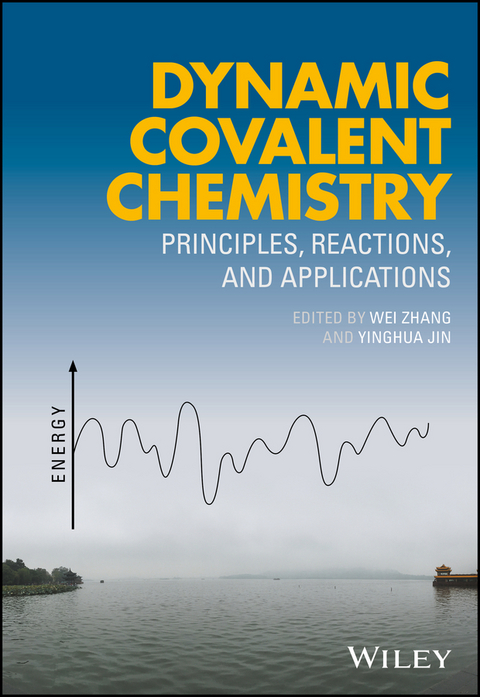
Dynamic Covalent Chemistry (eBook)
John Wiley & Sons (Verlag)
978-1-119-07571-4 (ISBN)
The first and only exhaustive review of the theory, thermodynamic fundamentals, mechanisms, and design principles of dynamic covalent systems
Dynamic Covalent Chemistry: Principles, Reactions, and Applications presents a comprehensive review of the theory, thermodynamic fundamentals, mechanisms, and design principles of dynamic covalent systems. It features contributions from a team of international scientists, grouped into three main sections covering the principles of dynamic covalent chemistry, types of dynamic covalent chemical reactions, and the latest applications of dynamic covalent chemistry (DCvC) across an array of fields.
The past decade has seen tremendous progress in (DCvC) research and industrial applications. The great synthetic power and reversible nature of this chemistry has enabled the development of a variety of functional molecular systems and materials for a broad range of applications in organic synthesis, materials development, nanotechnology, drug discovery, and biotechnology. Yet, until now, there have been no authoritative references devoted exclusively to this powerful synthetic tool, its current applications, and the most promising directions for future development. Dynamic Covalent Chemistry: Principles, Reactions, and Applications fills the yawning gap in the world literature with comprehensive coverage of:
- The energy landscape, the importance of reversibility, enthalpy vs. entropy, and reaction kinetics
- Single-type, multi-type, and non-covalent reactions, with a focus on the advantages and disadvantages of each reaction type
- Dynamic covalent assembly of discrete molecular architectures, responsive polymer synthesis, and drug discovery
- Important emerging applications of dynamic covalent chemistry in nanotechnology, including both material- and bio-oriented directions
- Real-world examples describing a wide range of industrial applications for organic synthesis, functional materials development, nanotechnology, drug delivery and more
Dynamic Covalent Chemistry: Principles, Reactions, and Applications is must-reading for researchers and chemists working in dynamic covalent chemistry and supramolecular chemistry. It will also be of value to academic researchers and advanced students interested in applying the principles of (DCvC) in organic synthesis, functional materials development, nanotechnology, drug discovery, and chemical biology.
Edited by
WEI ZHANG, PhD, is a professor in the Department of Chemistry and Biochemistry at the University of Colorado, Boulder, USA. He has been an active researcher of dynamic covalent chemistry for over 15 years.
YINGHUA JIN, PhD, is a Senior Research Associate, affiliated with both the Department of Chemical and Biological Engineering and the Department of Chemistry and Biochemistry at the University of Colorado, Boulder, USA.
The first and only exhaustive review of the theory, thermodynamic fundamentals, mechanisms, and design principles of dynamic covalent systems Dynamic Covalent Chemistry: Principles, Reactions, and Applications presents a comprehensive review of the theory, thermodynamic fundamentals, mechanisms, and design principles of dynamic covalent systems. It features contributions from a team of international scientists, grouped into three main sections covering the principles of dynamic covalent chemistry, types of dynamic covalent chemical reactions, and the latest applications of dynamic covalent chemistry (DCvC) across an array of fields. The past decade has seen tremendous progress in (DCvC) research and industrial applications. The great synthetic power and reversible nature of this chemistry has enabled the development of a variety of functional molecular systems and materials for a broad range of applications in organic synthesis, materials development, nanotechnology, drug discovery, and biotechnology. Yet, until now, there have been no authoritative references devoted exclusively to this powerful synthetic tool, its current applications, and the most promising directions for future development. Dynamic Covalent Chemistry: Principles, Reactions, and Applications fills the yawning gap in the world literature with comprehensive coverage of: The energy landscape, the importance of reversibility, enthalpy vs. entropy, and reaction kinetics Single-type, multi-type, and non-covalent reactions, with a focus on the advantages and disadvantages of each reaction type Dynamic covalent assembly of discrete molecular architectures, responsive polymer synthesis, and drug discovery Important emerging applications of dynamic covalent chemistry in nanotechnology, including both material- and bio-oriented directions Real-world examples describing a wide range of industrial applications for organic synthesis, functional materials development, nanotechnology, drug delivery and more Dynamic Covalent Chemistry: Principles, Reactions, and Applications is must-reading for researchers and chemists working in dynamic covalent chemistry and supramolecular chemistry. It will also be of value to academic researchers and advanced students interested in applying the principles of (DCvC) in organic synthesis, functional materials development, nanotechnology, drug discovery, and chemical biology.
Edited by WEI ZHANG, PhD, is a professor in the Department of Chemistry and Biochemistry at the University of Colorado, Boulder, USA. He has been an active researcher of dynamic covalent chemistry for over 15 years. YINGHUA JIN, PhD, is a Senior Research Associate, affiliated with both the Department of Chemical and Biological Engineering and the Department of Chemistry and Biochemistry at the University of Colorado, Boulder, USA.
Title Page 5
Copyright Page 6
Contents 7
Preface 13
List of Contributors 17
Chapter 1 Principles of Dynamic Covalent Chemistry 19
1.1 Introduction 19
1.1.1 What is Dynamic Covalent Chemistry? 19
1.1.2 Importance of Dynamic Covalent Chemistry 21
1.1.3 Basic Concepts 21
1.2 The Dynamic Covalent Bond 23
1.2.1 Requirements for Dynamic Covalent Bonds 23
1.2.2 Catalysis of Exchange 24
1.2.3 Halting Equilibration 24
1.2.4 Exchange Symmetry 25
1.2.5 Methods to Confirm Reversibility 26
1.3 Dynamic Covalent Reactions 27
1.3.1 Dynamic Polar Reactions 27
1.3.1.1 C–N Bonds 27
1.3.1.2 C–C Bonds 30
1.3.1.3 C–O Bonds 35
1.3.1.4 C–S Bonds 36
1.3.1.5 S–S Bonds and Se–Se Bonds 38
1.3.1.6 B–O Bonds 39
1.3.1.7 N–X Bonds 40
1.3.2 Other Dynamic Reaction Types 40
1.3.2.1 Dynamic Covalent Pericyclic Reactions 40
1.3.2.2 Dynamic Covalent Radical Reactions 43
1.4 Conclusions 44
References 44
Chapter 2 Dynamic Combinatorial Libraries 49
2.1 Introduction 49
2.1.1 A Short History of DCLs 49
2.1.2 Terminology 51
2.1.3 Theoretical Considerations 52
2.2 Template-controlled DCLs 58
2.2.1 Receptors for Small Molecules and Ions 58
2.2.1.1 Inorganic Cations 58
2.2.1.2 Inorganic Anions 62
2.2.1.3 Biologically Relevant Small Molecules 63
2.2.1.4 Miscellaneous Organic Molecules 65
2.2.2 Ligands for Biomolecules 69
2.2.2.1 Protein Inhibitors 69
2.2.2.2 Nucleic Acids 73
2.2.3 Catalysis 75
2.2.4 Self/Cross-templating and Replicators 76
2.2.5 Interlocked Structures from DCLs 79
2.2.6 Folding 82
2.3 Controlling DCLs by Physical Means 86
2.3.1 Solvent Environment 88
2.3.2 Light 88
2.3.3 Temperature 90
2.3.4 Mechanical Force 90
2.4 Multiphase DCLs 91
2.4.1 Multiple Liquid Phases 91
2.4.2 Transport 93
2.4.3 Amphiphiles 96
2.4.4 Surface-liquid Interfaces 97
2.4.4.1 Resins 97
2.4.4.2 Nanoparticles 97
2.4.4.3 Flat Surfaces 98
2.4.5 Kinetically Controlled Phase Transfer 100
2.5 Other Applications of DCLs 104
2.5.1 Information Acquisition and Processing 104
2.5.2 Self-synthesizing Materials 108
2.6 Non-equilibrium DCLs 109
2.7 Analysis of DCLs 113
2.7.1 Liquid and Gas Chromatography 114
2.7.2 Mass Spectrometry 115
2.7.3 NMR Spectroscopy 117
2.7.4 Optical Spectroscopy 118
2.7.5 Microscopy Techniques 119
2.7.6 Diffraction and Scattering Techniques 120
2.7.7 Calculations 121
2.8 Conclusions and Outlook 121
References 123
Chapter 3 Shape-persistent Macrocycles through Dynamic Covalent Reactions 139
3.1 Introduction and Importance of Shape-persistent Macrocycles 139
3.2 Thermodynamic Approach vs. Kinetic Approach 140
3.3 Macrocycles through Alkyne Metathesis 141
3.3.1 Monomer-to-Macrocycle Strategy 141
3.3.1.1 Homo-sequenced Symmetrical Macrocycles 141
3.3.1.2 Hetero-sequenced Macrocycles 148
3.3.2 Mechanism Study of the Cyclooligomerization Process 152
3.3.3 Polymer-to-Macrocycle Strategy 153
3.4 Macrocycles through Imine Metathesis 156
3.4.1 Salphen-containing Macrocycles 156
3.4.1.1 Synthesis 156
3.4.1.2 Coordination with Metal Ions 158
3.4.2 Other Imine-linked Macrocycles 164
3.5 Macrocycles through Olefin Metathesis 168
3.6 Macrocycles through Boronate Ester Formation 169
3.7 Macrocycles through Orthogonal Dynamic Covalent Reactions 169
3.8 Conclusions and Outlook 173
References 174
Chapter 4 Organic Cages through Dynamic Covalent Reactions 183
4.1 Introduction 183
4.2 Synthesis of Organic Molecular Cages 184
4.2.1 OMCs Synthesized through Imine Reaction 185
4.2.2 OMCs Synthesized through Boronic Acid Condensation 194
4.2.3 OMCs Synthesized through Alkene/Alkyne Metathesis 198
4.2.4 OMCs Synthesized through Other Reactions 203
4.3 Functionalization of Organic Molecular Cages 206
4.4 Applications of Organic Molecular Cages 212
4.4.1 Molecular Recognition 212
4.4.2 Molecular Flask 214
4.4.3 Porous Solid 215
4.4.4 Porous Liquid 218
4.5 Conclusion and Perspective 220
References 220
Chapter 5 Orthogonal Dynamic Covalent and Non-covalent Reactions 225
5.1 Introduction 225
5.2 Orthogonal Dynamic Covalent Chemical Reactions 226
5.2.1 Imine and Disulfide Bonds 226
5.2.2 Imine and Boronate Ester Bonds 227
5.2.3 Hydrazone and Disulfide Bonds 228
5.2.4 Disulfide and Thioester Bonds 230
5.2.5 Imine and Alkene Bonds 230
5.2.6 Disulfide and Alkene Bonds 235
5.2.7 Disulfide, Thioester, and Hydrazone Bonds 235
5.3 Dynamic Covalent Reactions and Hydrogen Bonding 238
5.3.1 Imine, Hydrazone, and Hydrogen Bonding 238
5.3.2 Disulfide and Hydrogen Bonding 246
5.3.3 Alkene Metathesis and Hydrogen Bonding 251
5.4 Imine and Hydrazone, ?-Stacking, and Donor–Acceptor Interaction 251
5.5 Disulfide, ?-Stacking, and/or Donor–Acceptor Interaction 255
5.6 Disulfide, Hydrazone, and ?-Stacking Interaction 264
5.7 Hydrazone, Boronate, and ?-Stacking Interaction 265
5.8 Concluding Remarks 265
References 267
Chapter 6 Self-sorting through Dynamic Covalent Chemistry 271
6.1 Definition of Self-sorting 271
6.2 Thermodynamically Controlled Self-sorting 273
6.2.1 Purely Organic Systems 273
6.2.2 Metal–Organic Systems 277
6.3 Kinetically Controlled Self-sorting 288
6.3.1 Self-sorting of Dynamic Libraries during Irreversible Chemical Reactions 293
6.3.2 Self-sorting of Dynamic Libraries under Physical Stimuli 295
6.4 Conclusions and Outlook 301
References 302
Chapter 7 Dynamic Covalent Chemistry for Synthetic Molecular Machines 305
7.1 Introduction 305
7.2 Molecular Machines Assembled by Dynamic Covalent Chemistry 306
7.2.1 Mechanically Interlocked Molecular Machines 307
7.2.1.1 By Imine Chemistry 307
7.2.1.2 By Disulfide Bond Formation 313
7.2.1.3 By Olefin Metathesis 316
7.2.1.4 By Iodide-catalyzed DCvC 318
7.2.2 Non-interlocked Molecular Machines 320
7.2.2.1 Imine-based Motors 320
7.2.2.2 Imine-based Switches 321
7.2.2.3 Hydrazone-based Switches 322
7.3 Molecular Machines Operated by DCvC 324
7.3.1 Molecular Shuttles 325
7.3.2 Molecular Walkers 327
7.4 Concluding Remarks and Outlook 334
References 335
Chapter 8 Responsive Dynamic Covalent Polymers 339
8.1 Introduction 339
8.2 Thermoresponsive Polymers 341
8.2.1 Polymers Possessing Critical Solution Temperatures 341
8.2.2 Polymers Possessing Thermo-labile Chemical Linkages 344
8.2.2.1 Polymers Containing Alkoxyamine Linkages 344
8.2.2.2 Polymers Containing Diels–Alder Linkages 345
8.3 Photo-responsive Polymers 350
8.4 Mechano-responsive Polymers 351
8.5 pH- and Chemo-responsive Polymers 354
8.5.1 Polymers Containing Acyl Hydrazone Links 354
8.5.2 Polymers Containing Imine Linkages 356
8.5.3 Polymers Containing Oxime Links 358
8.5.4 Polymers Containing Disulfide Links 360
8.5.5 Glucose-responsive Polymers 361
8.6 Conclusion 367
References 367
Chapter 9 Self-healing Polymers through Dynamic Covalent Chemistry 377
9.1 Introduction 377
9.2 Reversible Condensation Reactions 382
9.2.1 Acylhydrazone Bonds 382
9.2.2 Imine Bonds 384
9.2.3 Boronate Ester Linkages 384
9.2.4 Hemiaminal Linkages 385
9.3 Reversible Addition Reactions 385
9.3.1 Diels–Alder Reaction 385
9.3.2 Urea Bonds 389
9.4 Catalyzed Exchange Reactions 389
9.4.1 Transesterification 390
9.4.2 Olefin Metathesis 391
9.4.3 Siloxane Chemistry 392
9.5 Radical Transfer and Crossover Reactions 392
9.5.1 Disulfide and Diselenide Bonds 394
9.5.2 Thiuram Disulfide Bonds 395
9.5.3 Trithiocarbonate Linkages 395
9.6 Homolytic Bond Cleavage and Re-formation 395
9.6.1 Alkoxyamine Linkages 397
9.6.2 Diarylbibenzofuranone Linkages 397
9.7 Conclusions 399
References 401
Chapter 10 Emerging Applications of Dynamic Covalent Chemistry from Macro- to Nanoscopic Length Scales 407
10.1 Introduction 407
10.2 Rearrangeable Polymer Networks 407
10.2.1 Stress Relaxation and Shape Modification 408
10.2.2 Reversible Self-healing 408
10.2.3 Overcoming the Limitations of Dynamic Covalent Healable Materials 415
10.3 Biotechnological Applications 418
10.3.1 Kinase Inhibitors 418
10.3.2 Micelles 419
10.3.3 Targeting and Transport 423
10.3.4 Dynamic Covalent Gels: Self-healing and Drug Delivery/Transport 424
10.3.5 Nucleic Acid Probes 429
10.4 Other Applications 429
10.4.1 Organic Electronics 429
10.4.2 Gas Storage/Capture 437
10.4.3 Catalysis 439
10.4.4 Molecular Separations 440
10.4.5 Surface Science 441
10.4.6 Color-changing Materials 443
10.4.7 Food Chemistry 445
10.4.8 Fluoride-catalyzed Silsesquioxane Bond Rearrangement 446
10.5 Conclusion 447
References 447
Index 453
EULA 472
| Erscheint lt. Verlag | 6.9.2017 |
|---|---|
| Sprache | englisch |
| Themenwelt | Naturwissenschaften ► Chemie ► Organische Chemie |
| Naturwissenschaften ► Chemie ► Physikalische Chemie | |
| Schlagworte | Chemie • Chemistry • Drug Discovery & Development • dynamic combinatorial chemistry • dynamic combinatorial libraries • dynamic covalent chemistry design principles • dynamic covalent chemistry for biotechnology • dynamic covalent chemistry for materials development • dynamic covalent chemistry in drug discovery • dynamic covalent chemistry in nanotechnology • dynamic covalent chemistry in organic synthesis • dynamic covalent chemistry mechanisms • dynamic covalent chemistry non-covalent reactions • dynamic covalent chemistry reaction kinetics • dynamic covalent chemistry state-of-the-art applications • dynamic covalent chemistry theory • dynamic covalent chemistry thermodynamic fundamentals • multi-type dynamic covalent chemical reactions • Polymer Science & Technology • Polymersynthese • polymer synthesis • Polymerwissenschaft u. -technologie • responsive dynamic-covalent polymers • reversibility of dynamic covalent chemical reactions • self-healing materials • single-type dynamic covalent chemical reactions • supramolecular chemistry • supramolecular chemistry dynamic covalent chemical reactions • Supramolekulare Chemie • Wei Zhang • Wirkstoffforschung • Wirkstoffforschung u. -entwicklung • Yinghua Jin |
| ISBN-10 | 1-119-07571-8 / 1119075718 |
| ISBN-13 | 978-1-119-07571-4 / 9781119075714 |
| Informationen gemäß Produktsicherheitsverordnung (GPSR) | |
| Haben Sie eine Frage zum Produkt? |
 PDF (Adobe DRM)
Kopierschutz: Adobe-DRM
Adobe-DRM ist ein Kopierschutz, der das eBook vor Mißbrauch schützen soll. Dabei wird das eBook bereits beim Download auf Ihre persönliche Adobe-ID autorisiert. Lesen können Sie das eBook dann nur auf den Geräten, welche ebenfalls auf Ihre Adobe-ID registriert sind.
Details zum Adobe-DRM
Dateiformat: PDF (Portable Document Format)
Mit einem festen Seitenlayout eignet sich die PDF besonders für Fachbücher mit Spalten, Tabellen und Abbildungen. Eine PDF kann auf fast allen Geräten angezeigt werden, ist aber für kleine Displays (Smartphone, eReader) nur eingeschränkt geeignet.
Systemvoraussetzungen:
PC/Mac: Mit einem PC oder Mac können Sie dieses eBook lesen. Sie benötigen eine
eReader: Dieses eBook kann mit (fast) allen eBook-Readern gelesen werden. Mit dem amazon-Kindle ist es aber nicht kompatibel.
Smartphone/Tablet: Egal ob Apple oder Android, dieses eBook können Sie lesen. Sie benötigen eine
Geräteliste und zusätzliche Hinweise
Buying eBooks from abroad
For tax law reasons we can sell eBooks just within Germany and Switzerland. Regrettably we cannot fulfill eBook-orders from other countries.
aus dem Bereich