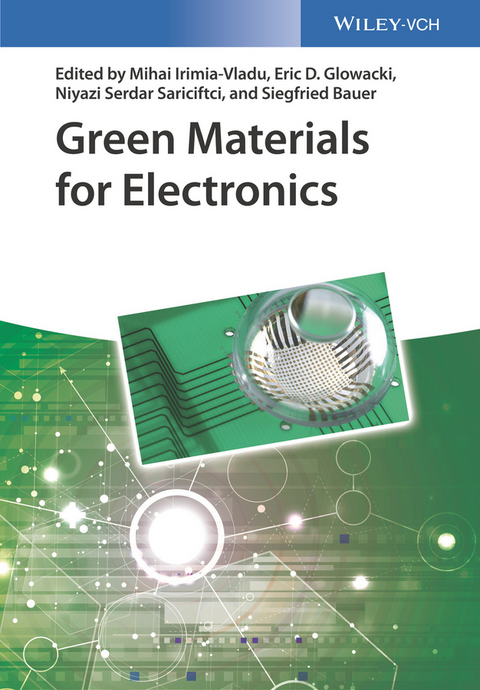
Green Materials for Electronics (eBook)
352 Seiten
Wiley-VCH (Verlag)
978-3-527-69296-5 (ISBN)
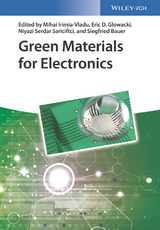
With contributions from top-notch editors and authors, in one focus, the book covers a collection of natural materials suited for electronics applications such as paper, silk, melanin, DNA and nucleobases, resins, gums, saccharides, cellulose, gelatine and peptides. In another thrust, the book focuses on device fabrication based on these materials, including processing aspects, and applications such as sensors, signal transducers, transient, implantable and digestible electronics.
With its interdisciplinary approach this text will appeal to the chemistry, physics, materials science, and engineering communities.
Mihai Irimia-Vladu is a Senior Scientist at Joanneum Research Forschungsgesellschaft GmbH in Weiz, Austria. Having obtained his PhD at Auburn University, Alabama, USA in the field of Materials Engineering, he spent his post-doctoral tenure at Johannes Kepler University in Linz, Austria. Dr. Mihai Irimia-Vladu is one of the pioneers of the field of biodegradable and biocompatible electronics and has contributed to defining the emerging research field by co-organizing three MRS symposiums on this topic.
Eric Daniel Glowacki studied dual degrees in chemistry and history at the University of Rochester, USA, graduating with a BSc and MSc in 2009 and 2010, respectively. He completed his PhD in 2013 at the Johannes Kepler University in Linz, Austria working in the field of nature-inspired semiconducting materials, followed by a postdoctoral stay continuing these topics. In 2015 he was appointed assistant professor in Linz, with research focused on nanoscale organic crystalline materials for bioelectronics. Since 2016 he has been a Senior Lecturer at the Linkoping University in Sweden as a Wallenberg Centre for Molecular Medicine fellow.
Siegfried Bauer is full professor and head of the Soft Matter Physics department at the Johannes Kepler University Linz, Austria. He obtained his Diploma and PhD degrees from the Technical University of Karlsruhe and subsequently was research scientist and project manager at the Heinrich Hertz Institute for Communications Technology in Berlin. He was assistant professor at the University of Potsdam before moving to the University of Linz. His group's main research areas are soft dielectric materials and organic semiconductors and applications of these materials to flexible and stretchable electronics, sensors and actuators as well as energy harvesting systems.
Niyazi Serdar Sariciftci is Ordinarius Professor for Physical Chemistry and the Founding Director of the Linz Institute for Organic Solar Cells (LIOS) at the Johannes Kepler University of Linz, Austria. After his PhD in physics, obtained from the University of Vienna, and a two-year post-doctoral stay at the University of Stuttgart he joined the group of Alan Heeger at the Institute for Polymers and Organic Solids at the University of California, Santa Barbara, USA. Serdar Sariciftci's major contributions are in the fields of photoinduced optical, magnetic resonance and transport phenomena in semiconducting and metallic polymers, being the inventor of conjugated polymer and fullerene-based bulk heterojunction solar cells.
Mihai Irimia-Vladu is a Senior Scientist at Joanneum Research Forschungsgesellschaft GmbH in Weiz, Austria. Having obtained his PhD at Auburn University, Alabama, USA in the field of Materials Engineering, he spent his post-doctoral tenure at Johannes Kepler University in Linz, Austria. Dr. Mihai Irimia-Vladu is one of the pioneers of the field of biodegradable and biocompatible electronics and has contributed to defining the emerging research field by co-organizing three MRS symposiums on this topic. Eric Daniel Glowacki studied dual degrees in chemistry and history at the University of Rochester, USA, graduating with a BSc and MSc in 2009 and 2010, respectively. He completed his PhD in 2013 at the Johannes Kepler University in Linz, Austria working in the field of nature-inspired semiconducting materials, followed by a postdoctoral stay continuing these topics. In 2015 he was appointed assistant professor in Linz, with research focused on nanoscale organic crystalline materials for bioelectronics. Since 2016 he has been a Senior Lecturer at the Linköping University in Sweden as a Wallenberg Centre for Molecular Medicine fellow. Siegfried Bauer is full professor and head of the Soft Matter Physics department at the Johannes Kepler University Linz, Austria. He obtained his Diploma and PhD degrees from the Technical University of Karlsruhe and subsequently was research scientist and project manager at the Heinrich Hertz Institute for Communications Technology in Berlin. He was assistant professor at the University of Potsdam before moving to the University of Linz. His group's main research areas are soft dielectric materials and organic semiconductors and applications of these materials to flexible and stretchable electronics, sensors and actuators as well as energy harvesting systems. Niyazi Serdar Sariciftci is Ordinarius Professor for Physical Chemistry and the Founding Director of the Linz Institute for Organic Solar Cells (LIOS) at the Johannes Kepler University of Linz, Austria. After his PhD in physics, obtained from the University of Vienna, and a two-year post-doctoral stay at the University of Stuttgart he joined the group of Alan Heeger at the Institute for Polymers and Organic Solids at the University of California, Santa Barbara, USA. Serdar Sariciftci's major contributions are in the fields of photoinduced optical, magnetic resonance and transport phenomena in semiconducting and metallic polymers, being the inventor of conjugated polymer and fullerene-based bulk heterojunction solar cells.
Foreword and Introduction
PART I. NATURAL MATERIALS FOR ELECTRONICS APPLICATIONS
Paper
Silk
Melanin
DNA and Nucleobases
Natural Dielectrics
H-bonded Semiconductors
Genetically Engineered Peptides for Electronics
PART II. BIOCOMPATIBLE MATERIALS AND SUSTAINABLE PROCESSES FOR GREEN ELECTRONICS
Bioelectronic Devices for Sensing and Actuation
Organic Materials as Transducers of Neural Signals
Low Impedance Biomimetic Conductive Polymer and Bioactive Hydrogel Coatings for Microelectrodes and Biomedical Biosensors
Materials for Neural Interfaces
Biocompatible Circuits for Human-Machine Interfacing
Protonic Devices
Biocompatible Materials for Transient Electronics
Materials and Devices for Electronic Skin
Materials and Devices for Imperceptible Electronics
Energy Requirement for High-performance Electronics Fabrication
Bioelectronics: Quo Vadis?
Foreword and Introduction
PART I. NATURAL MATERIALS FOR ELECTRONICS APPLICATIONS
Paper
Silk
Melanin
DNA and Nucleobases
Natural Dielectrics
H-bonded Semiconductors
Genetically Engineered Peptides for Electronics
PART II. BIOCOMPATIBLE MATERIALS AND SUSTAINABLE PROCESSES FOR GREEN ELECTRONICS
Bioelectronic Devices for Sensing and Actuation
Organic Materials as Transducers of Neural Signals
Low Impedance Biomimetic Conductive Polymer and Bioactive Hydrogel Coatings for Microelectrodes and Biomedical Biosensors
Materials for Neural Interfaces
Biocompatible Circuits for Human-Machine Interfacing
Protonic Devices
Biocompatible Materials for Transient Electronics
Materials and Devices for Electronic Skin
Materials and Devices for Imperceptible Electronics
Energy Requirement for High-performance Electronics Fabrication
Bioelectronics: Quo Vadis?
List of Contributors
- Maria R. Antognazza
- Center for Nano Science and Technology
- Istituto Italiano di Tecnologia
- 20133 Milano
- Italy
- Siegfried Bauer
- Johannes Kepler University Linz
- Department of Soft Matter Physics
- 4040 Linz
- Austria
- Melanie Baumgartner
- Johannes Kepler University Linz
- Department of Soft Matter Physics
- 4040 Linz
- Austria
- and
- Johannes Kepler University Linz
- Institute of Polymer Science
- 4040 Linz
- Austria
- Fabio Benfenati
- Center for Synaptic Neuroscience and Technology
- Istituto Italiano di Tecnologia
- 16132 Genoa
- Italy
- and
- University of Genova
- Department of Experimental Medicine
- 16132 Genova
- Italy
- Magnus Berggren
- Linköping University
- Department of Science and Technology
- Laboratory of Organic Electronics
- 60174 Norrköping
- Sweden
- Eloïse Bihar
- Ecole Nationale Supérieure des Mines
- CMP-EMSE, MOC
- Department of Bioelectronics
- Gardanne 13541
- France
- and
- MicroVitae Technologies
- Hôtel Technologique Europarc Sainte Victoire
- Europarc Sainte Victoire
- Meyreuil 13590
- France
- and
- Ecole Nationale Supérieure des Mines
- CMP-EMSE, MOC
- Department of Flexible Electronics
- Gardanne 13541
- France
- Stefania R. Cicco
- CNR-ICCOM Bari
- Dipartimento di Chimica
- 4-70126 BARI
- Italy
- Maria E. Coppola
- Joanneum Research Forschungsgesellschaft mbH
- Department of Materials
- Weiz 8160
- Austria
- and
- Politecnico di Milano
- Department of Chemistry, Materials and Chemical Engineering “Giulio Natta”
- Piazza Leonardo da Vinci 32 Milano 20133
- Italy
- Andrea Desii
- Center for Nano Science and Technology
- Istituto Italiano di Tecnologia
- 20133 Milano
- Italy
- Jessamyn A. Fairfield
- National University of Ireland Galway
- School of Physics
- University Road
- Galway
- H91 CF50
- Ireland
- Gianluca M. Farinola
- Università degli Studi di Bari “Aldo Moro”
- Dipartimento di Chimica
- 70126 Bari
- Italy
- Erik O. Gabrielsson
- Linköping University
- Department of Science and Technology
- Laboratory of Organic Electronics
- 60174 Norrköping
- Sweden
- Eric D. Glowacki
- Linköping University
- Norrköping campus
- Department of Science and Technology
- Laboratory of Organic Electronics
- 60174 Norrköping
- Sweden
- Eliot F. Gomez
- University of Cincinnati
- Department of Electrical Engineering and Computer Science
- Nanoelectronics Laboratory
- Cincinnati OH 45221-0030
- USA
- Suk-Won Hwang
- Korea University
- KU-KIST Graduate School of Converging Science and Technology
- Seoul 02841
- Republic of Korea
- Mihai Irimia-Vladu
- Joanneum Research Forschungsgesellschaft mbH
- Department of Materials
- Weiz 8160
- Austria
- Dimitrios A. Koutsouras
- Ecole Nationale Supérieure des Mines
- CMP-EMSE, MOC
- Department of Bioelectronics
- Gardanne 13541
- France
- Guglielmo Lanzani
- Center for Nano Science and Technology
- Istituto Italiano di Tecnologia
- 20133 Milano
- Italy
- and
- Politecnico di Milano
- Dip.to di Fisica
- Piazza Leonardo Da Vinci 32
- 20133 Milano
- Italy
- Maria Magliulo
- Università degli Studi di Bari “Aldo Moro”
- Dipartimento di Chimica
- 70126 Bari
- Italy
- George G. Malliaras
- Ecole Nationale Supérieure des Mines
- CMP-EMSE, MOC
- Department of Bioelectronics
- Gardanne 13541
- France
- Kyriaki Manoli
- Università degli Studi di Bari “Aldo Moro”
- Dipartimento di Chimica
- 70126 Bari
- Italy
- Takeo Miyake
- Waseda University
- Graduate School of Information
- Production and System
- Kitakyushu
- Fukuoka, 808-0135
- Japan
- Mohammad Yusuf Mulla
- Università degli Studi di Bari “Aldo Moro”
- Dipartimento di Chimica
- 70126 Bari
- Italy
- Ronald Österbacka
- Åbo Akademi University
- Center for Functional Materials and Faculty of Science and Engineering
- Laboratory of Physics
- Turku
- Finland
- Gerardo Palazzo
- Università degli Studi di Bari “Aldo Moro”
- Dipartimento di Chimica
- 70126 Bari
- Italy
- Jouko Peltonen
- Åbo Akademi University
- Center for Functional Materials and Faculty of Science and Engineering
- Laboratory of Physical Chemistry
- Turku
- Finland
- Roberta Ragni
- Università degli Studi di Bari “Aldo Moro”
- Dipartimento di Chimica
- 70126 Bari
- Italy
- John A. Rogers
- University of Illinois at Urbana-Champaign
- Department of Materials Science and Engineering
- Frederick Seitz Materials Research Laboratory
- Urbana, IL 61801
- USA
- Marco Rolandi
- University of California
- Santa Cruz Department of Electrical Engineering
- Santa Cruz
- CA 95064
- USA
- Mohamed Saadaoui
- Ecole Nationale Supérieure des Mines
- CMP-EMSE, MOC
- Department of Flexible Electronics
- Gardanne 13541
- France
- Niyazi S. Sariciftci
- Johannes Kepler University Linz
- Department of Physical Chemistry
- Linz Institute for Organic Solar Cells
- 4040 Linz
- Austria
- Preethi Seshadri
- Università degli Studi di Bari “Aldo Moro”
- Dipartimento di Chimica
- 70126 Bari
- Italy
- Daniel T. Simon
- Linköping University
- Department of Science and Technology
- Laboratory of Organic Electronics
- 60174 Norrköping
- Sweden
- Mandeep Singh
- Università degli Studi di Bari “Aldo Moro”
- Dipartimento di Chimica
- 70126 Bari
- Italy
- Eva-Kathrin Sinner
- University of Natural Resources and Life Sciences, BOKU
- Department of Nanobiotechnology
- Institute of Synthetic Bioarchitectures
- 1190 Vienna
- Austria
- Andrew J. Steckl
- University of Cincinnati
- Department of Electrical Engineering and Computer Science
- Nanoelectronics Laboratory
- Cincinnati, OH 45221-0030
- USA
- Cherng-Wen Darren Tan
- University of Natural Resources and Life Sciences, BOKU
- Department of Nanobiotechnology
- Institute of Synthetic Bioarchitectures
- 1190 Vienna
- Austria
- Amber Tiwari
- Università degli Studi di Bari “Aldo Moro”
- Dipartimento di Chimica
- 70126 Bari
- Italy
- Martti Toivakka
- Åbo Akademi University
- Center for Functional Materials and Faculty of Science and Engineering
- Laboratory of Paper Coating and Converting
- Turku
- Finland
- Luisa Torsi
- Università degli Studi di Bari “Aldo Moro”
- Dipartimento di Chimica
- 70126 Bari
- Italy
- Danilo Vona
- Università degli Studi di Bari “Aldo...
| Erscheint lt. Verlag | 4.9.2017 |
|---|---|
| Sprache | englisch |
| Themenwelt | Naturwissenschaften ► Chemie |
| Schlagworte | actuation • applications paper • Biocompatible • bioelectronic • Chemie • Chemistry • dielectrics • Electronic materials • Electronics • Elektronische Materialien • Energie • Energieeffizienz • Energy • energy efficiency • engineered • genetically • Green • Materials • Materials Science • Materialwissenschaften • Melanin • Nachhaltige u. Grüne Chemie • Nachhaltige u. Grüne Chemie • Nachhaltigkeit • NATURAL • Neural • organic • Peptides • semiconductors • sensing • SiLK • Sustainable • Sustainable Chemistry & Green Chemistry • transducers |
| ISBN-10 | 3-527-69296-7 / 3527692967 |
| ISBN-13 | 978-3-527-69296-5 / 9783527692965 |
| Informationen gemäß Produktsicherheitsverordnung (GPSR) | |
| Haben Sie eine Frage zum Produkt? |
 EPUB (Adobe DRM)
Kopierschutz: Adobe-DRM
Adobe-DRM ist ein Kopierschutz, der das eBook vor Mißbrauch schützen soll. Dabei wird das eBook bereits beim Download auf Ihre persönliche Adobe-ID autorisiert. Lesen können Sie das eBook dann nur auf den Geräten, welche ebenfalls auf Ihre Adobe-ID registriert sind.
Details zum Adobe-DRM
Dateiformat: EPUB (Electronic Publication)
EPUB ist ein offener Standard für eBooks und eignet sich besonders zur Darstellung von Belletristik und Sachbüchern. Der Fließtext wird dynamisch an die Display- und Schriftgröße angepasst. Auch für mobile Lesegeräte ist EPUB daher gut geeignet.
Systemvoraussetzungen:
PC/Mac: Mit einem PC oder Mac können Sie dieses eBook lesen. Sie benötigen eine
eReader: Dieses eBook kann mit (fast) allen eBook-Readern gelesen werden. Mit dem amazon-Kindle ist es aber nicht kompatibel.
Smartphone/Tablet: Egal ob Apple oder Android, dieses eBook können Sie lesen. Sie benötigen eine
Geräteliste und zusätzliche Hinweise
Buying eBooks from abroad
For tax law reasons we can sell eBooks just within Germany and Switzerland. Regrettably we cannot fulfill eBook-orders from other countries.
aus dem Bereich