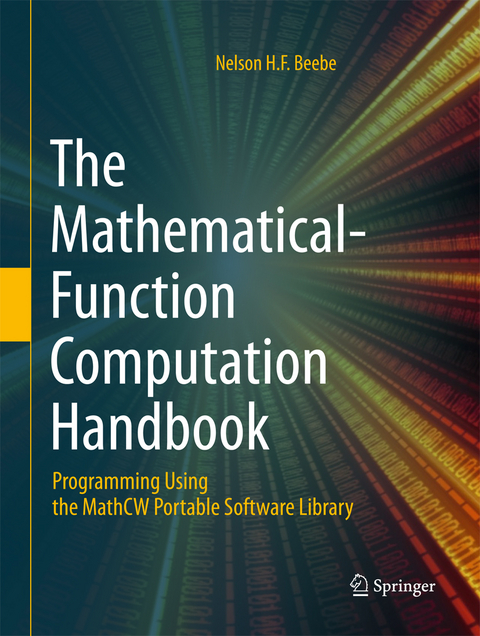
The Mathematical-Function Computation Handbook (eBook)
XXXVI, 1115 Seiten
Springer International Publishing (Verlag)
978-3-319-64110-2 (ISBN)
This highly comprehensive handbook provides a substantial advance in the computation of elementary and special functions of mathematics, extending the function coverage of major programming languages well beyond their international standards, including full support for decimal floating-point arithmetic. Written with clarity and focusing on the C language, the work pays extensive attention to little-understood aspects of floating-point and integer arithmetic, and to software portability, as well as to important historical architectures. It extends support to a future 256-bit, floating-point format offering 70 decimal digits of precision.
Select Topics and Features: references an exceptionally useful, author-maintained MathCW website, containing source code for the book's software, compiled libraries for numerous systems, pre-built
C compilers, and other related materials; offers a unique approach to covering mathematical-function computation using decimal arithmetic; provides extremely versatile appendices for interfaces to numerous other languages: Ada, C#, C++, Fortran, Java, and Pascal; presupposes only basic familiarity with computer programming in a common language, as well as early level algebra; supplies a library that readily adapts for existing scripting languages, with minimal effort; supports both binary and decimal arithmetic, in up to 10 different floating-point formats; covers a significant portion (with highly accurate implementations) of the U.S National Institute of Standards and Technology's 10-year project to codify mathematical functions.This highly practical text/reference is an invaluable tool for advanced undergraduates, recording many lessons of the intermingled history of computer hardw
are and software, numerical algorithms, and mathematics. In addition, professional numerical analysts and others will find the handbook of real interest and utility because it builds on research by the mathematical software community over the last four decades.Dr. Nelson H.F. Beebe is a Research Professor and Software Specialist in the Department of Mathematics at the University of Utah, USA. He has a diverse background in chemistry, physics, mathematics, computer science, systems management, and typography, having studied, worked, and taught in three countries. He has written extensive software projects in numerous programming-language, operating-system, and hardware environments. His bibliographic database work has exposed him to a wide range of journals on current research.
Dr. Nelson H.F. Beebe is a Research Professor and Software Specialist in the Department of Mathematics at the University of Utah, USA. He has a diverse background in chemistry, physics, mathematics, computer science, systems management, and typography, having studied, worked, and taught in three countries. He has written extensive software projects in numerous programming-language, operating-system, and hardware environments. His bibliographic database work has exposed him to a wide range of journals on current research.
Introduction Iterative Solutions and Other Tools Polynomial Approximations Implementation Issues The Floating-Point Environment Converting Floating-Point Values to Integers Random Numbers Roots Argument Reduction Exponential and Logarithm Trigonometric Functions Hyperbolic Functions Pair-Precision Arithmetic Power Function Complex Arithmetic Primitives Quadratic Equations Elementary Functions in Complex Arithmetic The Greek Functions: Gamma, Psi, and Zeta Error and Probability Functions Elliptic Integral Functions Bessel Functions Testing the Library Pair-Precision Elementary Functions Accuracy of the Cody/Waite Algorithms Improving Upon the Cody/Waite Algorithms Floating-Point Output Floating-Point Input Appendix A: Ada Interface Appendix B: C# Interface Appendix C: C++ Interface Appendix D: Decimal Arithmetic Appendix E: Errata in the Cody/Waite Book Appendix F: Fortran Interface Appendix H: Historical Floating-Point Architectures Appendix I: Integer Arithmetic Appendix J: Java Interface Appendix L: Letter Notation Appendix P: Pascal Interface
| Erscheint lt. Verlag | 20.8.2017 |
|---|---|
| Zusatzinfo | XXXVI, 1115 p. |
| Verlagsort | Cham |
| Sprache | englisch |
| Themenwelt | Mathematik / Informatik ► Informatik |
| Mathematik / Informatik ► Mathematik | |
| Naturwissenschaften ► Chemie | |
| Naturwissenschaften ► Physik / Astronomie | |
| Schlagworte | Decimal and binary • elementary functions • Floating-point arithmetic • Random Numbers • software portability |
| ISBN-10 | 3-319-64110-7 / 3319641107 |
| ISBN-13 | 978-3-319-64110-2 / 9783319641102 |
| Informationen gemäß Produktsicherheitsverordnung (GPSR) | |
| Haben Sie eine Frage zum Produkt? |
 PDF (Wasserzeichen)
DRM: Digitales Wasserzeichen
Dieses eBook enthält ein digitales Wasserzeichen und ist damit für Sie personalisiert. Bei einer missbräuchlichen Weitergabe des eBooks an Dritte ist eine Rückverfolgung an die Quelle möglich.
Dateiformat: PDF (Portable Document Format)
Mit einem festen Seitenlayout eignet sich die PDF besonders für Fachbücher mit Spalten, Tabellen und Abbildungen. Eine PDF kann auf fast allen Geräten angezeigt werden, ist aber für kleine Displays (Smartphone, eReader) nur eingeschränkt geeignet.
Systemvoraussetzungen:
PC/Mac: Mit einem PC oder Mac können Sie dieses eBook lesen. Sie benötigen dafür einen PDF-Viewer - z.B. den Adobe Reader oder Adobe Digital Editions.
eReader: Dieses eBook kann mit (fast) allen eBook-Readern gelesen werden. Mit dem amazon-Kindle ist es aber nicht kompatibel.
Smartphone/Tablet: Egal ob Apple oder Android, dieses eBook können Sie lesen. Sie benötigen dafür einen PDF-Viewer - z.B. die kostenlose Adobe Digital Editions-App.
Buying eBooks from abroad
For tax law reasons we can sell eBooks just within Germany and Switzerland. Regrettably we cannot fulfill eBook-orders from other countries.
aus dem Bereich