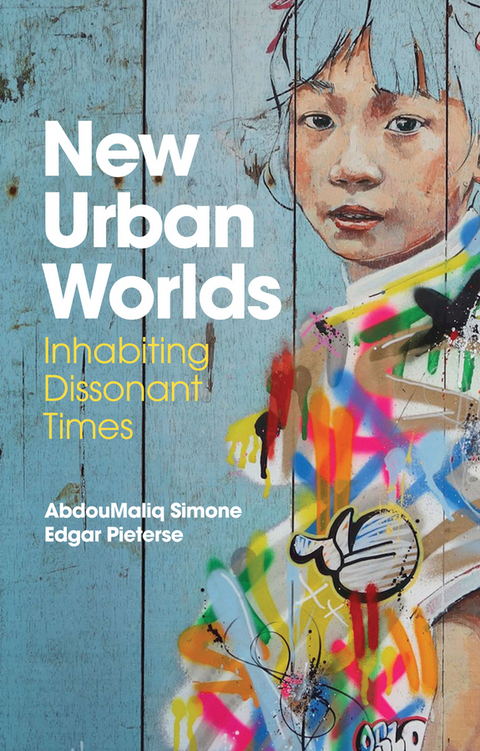
New Urban Worlds (eBook)
John Wiley & Sons (Verlag)
978-0-7456-9159-6 (ISBN)
It is well known that the world is transitioning to an irrevocable urban future whose epicentre has moved into the cities of Asia and Africa. What is less clear is how this will be managed and deployed as a multi-polar world system is being born. The full implications of this challenge cry out to be understood because city building (and retrofitting) cannot but be an undertaking entangled in profound societal and cultural shifts.
In this highly original account, renowned urban sociologists AbdouMaliq Simone and Edgar Pieterse offer a call for action based fundamentally on the detail of people's lives. Urban regions are replete with residents who are compelled to come up with innovative ways to maintain or extend livelihoods, whose makeshift character is rarely institutionalized into a fixed set of practices, locales or organizational forms. This novel analytical approach reveals a more complex relationship between people, the state and other agents than has previously been understood. As the authors argue, we need adequate concepts and practices to grasp the composition and intricacy of these shifting efforts to make visible new political possibilities for action and social justice in cities across Asia and Africa.
AbdouMaliq Simone is Professor of Sociology and Urbanism at Goldsmiths, University of London.
Edgar Pieterse is South African Research Chair in Urban Policy at the University of Cape Town.
It is well known that the world is transitioning to an irrevocable urban future whose epicentre has moved into the cities of Asia and Africa. What is less clear is how this will be managed and deployed as a multi-polar world system is being born. The full implications of this challenge cry out to be understood because city building (and retrofitting) cannot but be an undertaking entangled in profound societal and cultural shifts. In this highly original account, renowned urban sociologists AbdouMaliq Simone and Edgar Pieterse offer a call for action based fundamentally on the detail of people's lives. Urban regions are replete with residents who are compelled to come up with innovative ways to maintain or extend livelihoods, whose makeshift character is rarely institutionalized into a fixed set of practices, locales or organizational forms. This novel analytical approach reveals a more complex relationship between people, the state and other agents than has previously been understood. As the authors argue, we need adequate concepts and practices to grasp the composition and intricacy of these shifting efforts to make visible new political possibilities for action and social justice in cities across Asia and Africa.
AbdouMaliq Simone is Professor of Sociology and Urbanism at Goldsmiths, University of London. Edgar Pieterse is South African Research Chair in Urban Policy at the University of Cape Town.
Detailed Table of Contents
Acknowledgements
Preface
Chapter 1: Paradoxes of the Urban
Chapter 2: Precarious Now
Chapter 3: Re-Description
Chapter 4: Secretions
Chapter 5: Horizons From Within the Break
Chapter 6: Experimentations
Chapter 7: Epilogue: A Story About Stories
Endnotes
References
"Ceaselessly inventive and frequently provocative, New Urban Worlds anticipates new models, methods and modes of urbanism. Paying attention to the details, AbdouMaliq Simone and Edgar Pieterse recount a multiplicity of urban stories from Asia and Africa - stories of political possibility and experimental potential - with a keen-eyed and always creative purpose."
--Jamie Peck, University of British Columbia
"Deeply conceptual and creatively pragmatic, this is a core text from two of the most significant voices in urban studies today. They offer a highly original retheorization of the urban and open up distinctive new horizons for scholars everywhere seeking to catch the dynamic, varied meanings and effects of the urban."
--Jennifer Robinson, University College London
"The vision of urban life that emerges here is messy, pluralistic, paradoxical and - perhaps above all - serendipitous. Simone and Pieterse call on researchers to be as experimental and eclectic in our scholarship as urban inhabitants are in their everyday lives; borrowing ideas and resources from different domains, and re-assembling them in ways that shed new light on pressing issues."
--Urban Studies
Preface
New Urban Worlds is primarily a polemic, an impassioned argument that stretches across diverse experiences, literatures and professional domains. It is a polemic because it tries to “call for things” even if all of the evidence is not yet in and often hard to come by. We call for the intersection of long-honed everyday practices of African and Asian urban residents with new forms of governing and with a strategic deployment of technological innovations of varying kinds. We desire to restore experimentation as a normative aspect of living in and running cities and want to think about how concretely to create space for such experimentation to be possible.
We are aware that, when you call for things, the immediate question is “How do you know enough about what is going on in order to call for something specific?” And, even then, should you reveal everything you know is going on, especially at a time when we are all being “read” in ways that we cannot control and often do not even know are taking place? But let us consider briefly what we think is going on – something about the fundamental conditions that drive the “calling” of this book.
If you are one of the scores of millions of residents across much of the urban “South” who cannot depend upon one specific job to earn your keep, who lacks sufficient documentation to secure a place to live over the long term, or who can't afford to get sick or into any kind of trouble, what is it that you pay attention to in order to know something about what to do? What happens if the people you rely upon for support or information are no longer available or suddenly turn against you? What happens when the skills you have to apply are also those of an increasing number of residents, and competition becomes increasingly fierce for opportunities? The question here is how can you best know what is going on and try to situate yourself in a position where opportunities might “come your way”? In other words, how can you be at the right place at the right time when there is no clear map available? We are convinced that these kinds of considerations dominate the minds and spiritual practices of most urban dwellers, yet much of what appears in both urban scholarship and policy prescripts seems oblivious.
In a not dissimilar way, researchers of urban life face difficulties when it comes to engaging with the largely makeshift complexion of many cities in Africa and Asia. The enormous transformations of the built environment and the enhanced possibilities of consumption that have marked even some of the most marginal of the world's cities should not detract from acknowledging just how dependent the majority of the urban residents of these regions are upon constantly putting together some workable form of income and inhabitation. The makeshift character of much of what this majority does is quite literally “make+shift,” as pointed out by Vasudevan (2015).
Whatever they come up with is rarely institutionalized into a fixed set of practices, locales or organizational forms. This doesn't mean that relationships and economic activities do not endure, that people do not find themselves rooted in the same place and set of affiliations over a long period of time. Rather, these stabilities come from constant efforts on the part of inhabitants to redefine the boundaries and interfaces between work, leisure, home, neighborhood and elsewhere. It entails constantly addressing the questions “What spaces are relevant to me?,” “What do I pay attention to and where?,” “Who do I talk to and do things with?,” “Who can I depend on and show things to?” In neighborhoods across the urban South, whatever is made, in terms of economic activities, buildings and social solidarities, then shifts in terms of its availability to specific uses and users, as well as its exposure to new potentials and vulnerability.
Drawing upon decades of work in poor, working- and lower-middle-class districts in urban regions across Africa and South-East Asia, this book attempts to weave interconnections among different ways of engaging and thinking about the complexity of how different urban actors decide and act within highly circumscribed and often uncertain contexts.
In methodological terms, it means that we locate our research and propositions within a relational epistemological force field that is anchored by two axes. The first axis stretches from surface knowledge to in-depth understandings of highly localized phenomena, including psychological interiors of actors. Surface knowledge references the insights that one can assemble from quantitative data sets that allow the analyst to consider scale, frequency, relationalities and patterns over time. Quantitative trends are crucial to appreciate the specificities of urbanization dynamics in diverse geographical scales in the early twenty-first century, when the very foundations of the economy, political systems and cultural reference points are undergoing profound change. At the same time, due to the “make+shift” character of these cities, it is equally important to expand dramatically in-depth accounts of the social drawing on relational ontologies (Pieterse 2015a). It is only by triangulating both depth and surface dimensions of contemporary urbanism that can we hope to get a purchase on what is actually going on.
The second axis of our epistemological force field stretches between applied theoretical concerns that we define, in contradistinction to philosophy, aesthetics and the poetic, as “grounded pragmatism.” These denote theoretical rest-stops that store conceptual resources to support sense-making of different kinds of data, but also to instigate propositional concepts and experiments. This book draws on an eclectic mix of theoretical resources to anchor our sense-making of highly fluid contexts, but we have deliberately resisted getting into the nitty-gritty of competing theoretical frames or performing a review of the literature. The references offer the reader a comprehensive insight into materials we find most compelling. Moreover, we are not particularly interested in the academic game of theoretical one-upmanship that seems to dominate so much of urban scholarship these days.
In a nutshell, this epistemological force field allows us to adopt a research approach that seeks to articulate the generous engagement with the details of urban life with the power of re-description in order to understand what might be going on while keeping an eye on clarifying resonant propositions. Thus, the work we have done includes ethnographic and applied research, forging research, advocacy and policy-making networks, advising municipal governments and development agencies, and starting and running urban institutions dedicated to enhancing broad-based participation in making rules and plans. The language of the book then reflects these different viewpoints and engagements with different actors, sectors and cities. It is a language that covers different “musical scales” – i.e., styles and rhythms. It looks for different ways into cityscapes that always seem to be switching, pulsating and reshaping. Thus the analysis applied and the proposals suggested are experimental and provisional and invariably ask for patience to see the conceptual journey to the end. Our account reflects a need to be able to do things differently now. While massive and long-term transformations are of course necessary, this book attempts to make use of what exists now but is sometimes not seen, not read, and thus does not become a resource for deciding and acting. While we offer strategic visions for how to face the enormous challenges of impoverishment, urban growth during climate change, and the exigency of justice, we concentrate on mapping out the potentials of the immediate – the lived realms of the “make+shift” city.
Just like the processes through which urban actors decide and act, this task of reworking the immediate is full of twists and turns. This is in part because the urban is full of paradoxes. Clear differentiations between urban and rural, local and global, self and other, time and space, human and non-human, North and South, public and private – long critical vehicles of orientation – are simultaneously intensifying and waning, becoming more sharply drawn as they are also being folded into each other. In a world where there is so much to pay attention to, where each decision seems more urgent, imbued with greater significance, it is harder to make distinctions between what is and what is not important to pay attention to, what is salient or irrelevant. This means that decision-making gets simultaneously more complicated and frustrating. The constitutive nature and generative potential of paradox is foregrounded throughout the book.
The capacities of the poor to get by with little, and thus to be rendered either targets of development or manipulated pawns in a game of continuous displacement, may ironically suggest a conceivable future for everyone in light of carbonated dystopias that become more apparent every year that CO2 emission reduction targets are spectacularly missed. How is it possible to live through these seeming paradoxes? How is it possible to maintain the productive boundaries among places, between spatial exteriors and interiors, and among distinctive ways of life without being disabled by their paradoxical encounters? How to think the doubleness of things, of ways in which differences can move toward and draw from each other as a movement of justice...
| Erscheint lt. Verlag | 7.8.2017 |
|---|---|
| Sprache | englisch |
| Themenwelt | Naturwissenschaften ► Geowissenschaften ► Geografie / Kartografie |
| Sozialwissenschaften ► Soziologie ► Spezielle Soziologien | |
| Schlagworte | acupunctural action • adaptive cities • Autoconstruction • Cities • City • Collective Action • comparative urbanism • decentralisation • destiuent power • Disruptive technology • Everyday Urbanism • experimentation • financialization • food security • Geographie • Geography • Globalization • global South • Governance • Green economy • Indifference • Inequality • informality • Inhabitation • interconnectiveness • invisibility • land politics • Lifeworlds • middle-classes • molecular urban development • parametric space • Political Science • Politikwissenschaft • post-capitalism • precarious employment • Precarity • Public Space • relational urban politics • resistance • secretion • Social Justice • Social Movements • Sociology • southern urbanism • Soziologie • Speculative Design • splintered instructure • Stadtgeographie • Stadtpolitik • Stadtsoziologie • strategic urban planning • Transitions • Uncertainty • Urban Cultures • Urban Geography • urban geography development studies • Urbanism • urbanization • urbanization. • urban planning • Urban Policy • urban politics • Urban renewal • Urban sociology • urban studies • Urban sustainability • Urban theory • World Cities |
| ISBN-10 | 0-7456-9159-5 / 0745691595 |
| ISBN-13 | 978-0-7456-9159-6 / 9780745691596 |
| Informationen gemäß Produktsicherheitsverordnung (GPSR) | |
| Haben Sie eine Frage zum Produkt? |
 EPUB (Adobe DRM)
Kopierschutz: Adobe-DRM
Adobe-DRM ist ein Kopierschutz, der das eBook vor Mißbrauch schützen soll. Dabei wird das eBook bereits beim Download auf Ihre persönliche Adobe-ID autorisiert. Lesen können Sie das eBook dann nur auf den Geräten, welche ebenfalls auf Ihre Adobe-ID registriert sind.
Details zum Adobe-DRM
Dateiformat: EPUB (Electronic Publication)
EPUB ist ein offener Standard für eBooks und eignet sich besonders zur Darstellung von Belletristik und Sachbüchern. Der Fließtext wird dynamisch an die Display- und Schriftgröße angepasst. Auch für mobile Lesegeräte ist EPUB daher gut geeignet.
Systemvoraussetzungen:
PC/Mac: Mit einem PC oder Mac können Sie dieses eBook lesen. Sie benötigen eine
eReader: Dieses eBook kann mit (fast) allen eBook-Readern gelesen werden. Mit dem amazon-Kindle ist es aber nicht kompatibel.
Smartphone/Tablet: Egal ob Apple oder Android, dieses eBook können Sie lesen. Sie benötigen eine
Geräteliste und zusätzliche Hinweise
Buying eBooks from abroad
For tax law reasons we can sell eBooks just within Germany and Switzerland. Regrettably we cannot fulfill eBook-orders from other countries.
aus dem Bereich