


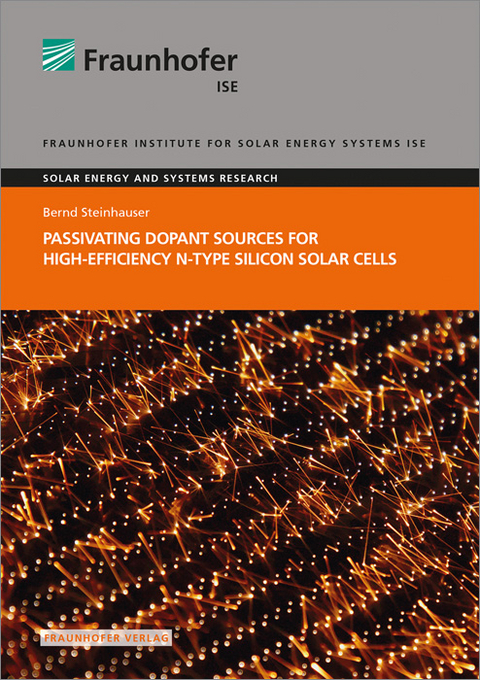
Passivating Dopant Sources for High-Efficiency n-type Silicon Solar Cells.
Seiten
- Titel ist leider vergriffen;
keine Neuauflage - Artikel merken
The focus in this work was on the development and characterization of multifunctional passivation layers for n-type PERL silicon solar cells. These doped layers act as a dopant source during a laser process creating the local contacts. The properties of the layers as well as the locally laser processed spots were analyzed. With these layers n-type silicon solar cells were fabricated to demonstrate the potential achieving efficiencies up to 23.5 percent.
Passivated emitter and rear locally diffused silicon solar cells have proven to offer a high efficiency potential, but there were doubts about the industrial feasibility due to the complex structuring being required for device fabrication. The PassDop concept introduced an approach that allowed reducing the number of process steps significantly by using doped passivation layers in combination with a laser process.
The first topic of this work is focused on the development and characterization of the multifunctional layers that form a central part of this concept. Here new layers based on a-SiNx:P are introduced. It is shown that layers for both low temperature device fabrication as well as firing stable layers (for screen printed contacts) are viable.
The next part aims for an improved understanding of the properties and implications of the local laser processing. The laser spots are analyzed with focus on doping profiles, impurities as well as minority carrier recombination.
Finally the transfer of the concept to the device level is described demonstrating that with this industrially feasible approach high efficiency solar cells can be fabricated achieving efficiencies up to 23.5 percent.
Passivated emitter and rear locally diffused silicon solar cells have proven to offer a high efficiency potential, but there were doubts about the industrial feasibility due to the complex structuring being required for device fabrication. The PassDop concept introduced an approach that allowed reducing the number of process steps significantly by using doped passivation layers in combination with a laser process.
The first topic of this work is focused on the development and characterization of the multifunctional layers that form a central part of this concept. Here new layers based on a-SiNx:P are introduced. It is shown that layers for both low temperature device fabrication as well as firing stable layers (for screen printed contacts) are viable.
The next part aims for an improved understanding of the properties and implications of the local laser processing. The laser spots are analyzed with focus on doping profiles, impurities as well as minority carrier recombination.
Finally the transfer of the concept to the device level is described demonstrating that with this industrially feasible approach high efficiency solar cells can be fabricated achieving efficiencies up to 23.5 percent.
| Erscheinungsdatum | 17.08.2017 |
|---|---|
| Reihe/Serie | Solare Energie- und Systemforschung |
| Zusatzinfo | num., mostly col. illus. and tab. |
| Verlagsort | Stuttgart |
| Sprache | englisch |
| Maße | 148 x 210 mm |
| Themenwelt | Naturwissenschaften ► Physik / Astronomie ► Angewandte Physik |
| Technik ► Elektrotechnik / Energietechnik | |
| Schlagworte | Alternative & renewable energy sources & technolog • Alternative Energiequelle • alternative energy source • Alternative Technologie • Angewandte Physik • applied physics • B • Erneuerbare Energiequelle • Erneuerbare Technologie • Forscher im Bereich Silicium Photovoltaik, Siliciu • Forscher im Bereich Silicium Photovoltaik, Silicium Oberflächenpassivierung oder Laserdotieren • Forschung • Fraunhofer ISE • Laserdotieren • Oberflächenpassivierung • Photovoltaik • renewable energy source • Silicium • Technology |
| ISBN-13 | 9783839612071 / 9783839612071 |
| Zustand | Neuware |
| Informationen gemäß Produktsicherheitsverordnung (GPSR) | |
| Haben Sie eine Frage zum Produkt? |
Mehr entdecken
aus dem Bereich



aus dem Bereich


