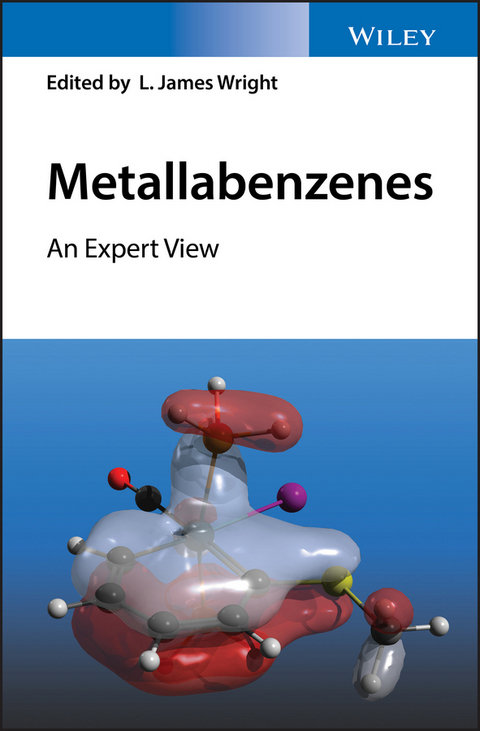
Metallabenzenes (eBook)
John Wiley & Sons (Verlag)
978-1-119-06808-2 (ISBN)
The only comprehensive book covering of advances in metallabenzene chemistry-written by the leading experts in the field
Metallabenzenes: An Expert View provides comprehensive coverage of all aspects of metallabenzene chemistry, including syntheses, reactions, physical properties, and theoretical treatments of metallabenzenes. Fused ring metallabenzenes, heterometallabenzenes, and metallabenzenes that are p-bound to other metal fragments are also discussed in depth.
Although benzene itself was discovered in 1825, it wasn't until 1982 that the first metallabenzene was isolated. Since then, interest in these compounds has built steadily, and metallabenzene chemistry is now a flourishing sub discipline in its own right. A diverse range of synthetic approaches to these compounds have been devised, and new developments and discoveries have appeared regularly over the past several decades. Yet, until now, no books devoted to this fascinating and important class of chemical compounds have been available to researchers and students. This bookfills that gap in the literature with a comprehensive review of recent advances in metallabenzene chemistry theory and applications. Featuring contributions by an international group of experts in the field, each chapter summarizes important recent research in and significant contributions to various aspects of metallabenzene chemistry.
- Provides academics, researchers and graduate students with a comprehensive review of advances in metallabenzene research
- Covers fused-ring metallabenzenes-including metallanaphthalenes, metallabenzofurans, and metallabenzothiophenes-as well as p-bound heterometallabenzenes and metallabenzenes
- Reviews the latest computational studies that have led to the theoretical understanding of metallabenzenes
- Includes critical discussions of metallabenzene aromaticity, an area rarely covered by computational experts
Metallabenzenes: An Expert View is an important working resource for those working in organometallic chemistry, aromaticity, coordination chemistry, theoretical chemistry, catalysis and materials science. It is also an excellent text for graduate-level courses in those areas.
L. James Wright is a Professor in the School of Chemical Sciences, University of Auckland, New Zealand. Professor Wright has been an active researcher in the area of metallabenzenes for over 15 years and has published reviews and articles on various aspects of metallabenzene chemistry. His current research focuses on organometallic chemistry, including metallabenzenes and new carbon donor ligands, carbon donor ligands, development of new nitrogen donor ligands, macrocyclic complexes, CORMs, catalysis, oxidation chemistry and green chemistry.
The only comprehensive book covering of advances in metallabenzene chemistry written by the leading experts in the field Metallabenzenes: An Expert View provides comprehensive coverage of all aspects of metallabenzene chemistry, including syntheses, reactions, physical properties, and theoretical treatments of metallabenzenes. Fused ring metallabenzenes, heterometallabenzenes, and metallabenzenes that are p-bound to other metal fragments are also discussed in depth. Although benzene itself was discovered in 1825, it wasn t until 1982 that the first metallabenzene was isolated. Since then, interest in these compounds has built steadily, and metallabenzene chemistry is now a flourishing sub discipline in its own right. A diverse range of synthetic approaches to these compounds have been devised, and new developments and discoveries have appeared regularly over the past several decades. Yet, until now, no books devoted to this fascinating and important class of chemical compounds have been available to researchers and students. This bookfills that gap in the literature with a comprehensive review of recent advances in metallabenzene chemistry theory and applications. Featuring contributions by an international group of experts in the field, each chapter summarizes important recent research in and significant contributions to various aspects of metallabenzene chemistry. Provides academics, researchers and graduate students with a comprehensive review of advances in metallabenzene research Covers fused-ring metallabenzenes including metallanaphthalenes, metallabenzofurans, and metallabenzothiophenes as well as p-bound heterometallabenzenes and metallabenzenes Reviews the latest computational studies that have led to the theoretical understanding of metallabenzenes Includes critical discussions of metallabenzene aromaticity, an area rarely covered by computational experts Metallabenzenes: An Expert View is an important working resource for those working in organometallic chemistry, aromaticity, coordination chemistry, theoretical chemistry, catalysis and materials science. It is also an excellent text for graduate-level courses in those areas.
L. James Wright is a Professor in the School of Chemical Sciences, University of Auckland, New Zealand. Professor Wright has been an active researcher in the area of metallabenzenes for over 15 years and has published reviews and articles on various aspects of metallabenzene chemistry. His current research focuses on organometallic chemistry, including metallabenzenes and new carbon donor ligands, carbon donor ligands, development of new nitrogen donor ligands, macrocyclic complexes, CORMs, catalysis, oxidation chemistry and green chemistry.
Chapter 1
Metallabenzenes and Fused-Ring Metallabenzenes of Osmium, Ruthenium and Iridium: Syntheses, Properties and Reactions
Benjamin J. Frogley, Warren R. Roper and L. James Wright*
School of Chemical Sciences, University of Auckland, Auckland, New Zealand
*Corresponding author: lj.wright@auckland.ac.nz
1.1 Introduction
The origin of metallabenzenes can be traced back almost two centuries to the discovery of benzene by Michael Faraday in 1825 [1]. He managed to separate benzene from the oily liquid obtained as a by-product during the manufacture of an “illuminating gas” by the destructive distillation of fish or whale oil. He correctly described a wide range of its properties and identified the formula as two proportions of carbon to one proportion of dihydrogen gas – thus describing it by the name “bicarburet of hydrogen”. A few years later, in 1833, it was also isolated by the German chemist Eilhard Mitscherlich by the distillation of benzoic acid from gum benzoin. Mitscherlich correctly noted that it was identical to Faraday's bicarburet of hydrogen and gave it the name “benzin”, from which the common name benzene is derived [2].
The molecular structure eluded chemists for many years. It was not until 1865 that German scientist Friedrich August Kekulé proposed the six-membered cyclohexatriene ring structure with alternating single and double bonds which subsequently led to the development of the concept of aromaticity [3, 4]. These advances revolutionised organic chemistry and began a flood of research into this exciting new area of so-called aromatic chemistry. Benzene is now considered the archetypical aromatic compound, and it is often used as the yardstick against which other species are compared with regard to aromatic character. While a precise definition of “aromaticity” remains somewhat nebulous, properties associated with benzene that have been classically used to characterise aromaticity include planarity, bond length equalisation, π-electron delocalisation, aromatic stabilisation energy, diamagnetic ring currents and electrophilic substitution, rather than addition, reactions. In more recent times, determinations of aromatic stabilisation energies by computational methods have been used to obtain more tangible measures of aromaticity.
Heteroaromatic species could be considered the next generation of aromatic compounds to be discovered. Amongst this large class of compounds, there are many six-membered heterocycles that can be thought of as benzene analogues in which one CH unit of benzene has been formally replaced by an appropriate heteroatom. Pyridine, with the heteroatom nitrogen, was one of the earliest examples, and Scottish scientist Thomas Anderson is credited with the first report of this compound in 1849 [5]. Since then, related benzene analogues incorporating a wide array of main group heteroatoms have been isolated and these include, but are not limited to, phosphorus [6, 7], arsenic [7, 8], silicon [9], antimony [10], bismuth [10], germanium [11] and tin [12].
Metallabenzenes, which are perhaps the third generation of related aromatic compounds, have arrived comparatively recently in this timeline. The notion of formally replacing one CH unit of benzene with an appropriate transition metal (and its ancillary ligands) was proposed theoretically in 1979 by Thorn and Hoffmann [13] and it was only a short three years later before the first metallabenzene, an osmabenzene, was synthesised and characterised by Warren Roper and co-workers in New Zealand [14]. The aromatic character of this and other metallabenzenes (Chart 1.1) has now been thoroughly established through a range of different computational methods, and these are discussed in detail in Chapter 7 of this book. From these beginnings a new class of aromatic compounds, the metallabenzenes, was born.
Chart 1.1 Metallabenzene delocalised representation and contributing resonance forms.
In this chapter we provide a personal perspective on the contributions our group has made to this field, including studies of the syntheses, properties and reaction chemistry of osma-, ruthena- and iridabenzenes as well as related fused-ring derivatives.
1.2 Syntheses and Properties of Metallabenzenes with Methylthiolate Substituents
1.2.1 Osmabenzenes
In the 1970s and early 1980s, there was an acceleration of research efforts focused on the organometallic chemistry of transition metals, particularly on species where a transition metal is multiply bonded to a carbon donor ligand. We had been working in this area for some time and had developed a number of new carbene [15, 16], carbyne [17, 18] and thiocarbonyl [19–21] complexes of second- and third-row transition metals. We were aware of the 1979 theoretical paper by Thorn and Hoffmann that briefly describes the possibility of metallabenzenes as stable species [13]. Therefore, a few years later, when we were exploring the coordination of ethyne at the osmium centre of the zero-valent complex Os(CS)(CO)(PPh3)3, it did not take long for us to realise the CS ligand and two ethyne molecules had cyclised at the metal centre to produce the first metallabenzene, the osmabenzene, Os(C5H4{S-1})(CO)(PPh3)2 (1) (Scheme 1.1). In this compound the six-membered metallacyclic ring comprises the thiocarbonyl carbon atom, the four carbons of the two ethyne molecules and the osmium atom. The sulfur atom is also coordinated to the osmium metal centre, generating a secondary three-membered Os–C–S osmathiirene ring [14]. Therefore, the osmabenzene 1 could also formally be considered an osmabenzothiirene [22].
Scheme 1.1 Preparation of osmium complexes 1–5.
To synthesise the osmabenzene 1, a solution of Os(CS)(CO)(PPh3) in benzene or toluene was treated with a slow stream of ethyne at 70°C for 20 min. Dark-brown crystals of pure 1 were formed in around 30% yield following purification by recrystallisation from n-hexane and column chromatography of the solid obtained [23].
This reaction can be considered a formal [1+2+2] cyclisation at the osmium centre of two molecules of ethyne and the carbon of the CS ligand. The most likely mechanism has been determined computationally using the model complex Os(CS)(CO)(PH3)3 [24]. The adduct 1A (Scheme 1.2) is formed by coordination of the first molecule of ethyne after phosphine dissociation. The thiocarbonyl and ethyne ligands then combine to give the osmacyclobutenethione 1B. The propensity of ligands such as CS to engage in cyclisation and migratory insertion reactions has proven to be invaluable in the synthesis of a number of metallaaromatic compounds. Coordination of the second molecule of ethyne, to give 1C, and subsequent insertion of both carbon atoms into the four-membered ring gives the osmacyclohexadienethione 1D. Finally, coordination of the sulfur atom to osmium results in aromatisation of the six-membered ring and formation of the osmabenzene 1.
Scheme 1.2 Proposed mechanism for the synthesis of the osmabenzene 1 based on computational studies using PH3 model compounds.
This cyclisation reaction is not limited to ethyne, and later we found the related dimethyl-substituted osmabenzene Os(C5H2{S-1}{Me-2}{Me-4})(CO)(PPh3)2 (2) (Scheme 1.1) is formed as dark-brown crystals when Os(CS)(CO)(PPh3)3 is treated with propyne, albeit in the low yield of 8%. The major product from this reaction is the complex OsH(C≡CMe)(CS)(CO)(PPh3)2 which arises from the simple C–H oxidative addition of propyne. Fortunately, this can be easily separated from the metallabenzene 2 by column chromatography and isolated in 23% yield [25].
Our original report of the first metallabenzenes also included several derivatives of 1 which could be prepared through reactions in which the osmium–sulfur bond was cleaved. The sulfur atom in 1 is nucleophilic and readily undergoes protonation with hydrochloric acid or alkylation with methyl iodide to give the neutral osmabenzenethiol 3a or the methylthiolate-substituted osmabenzene 3b, respectively (Scheme 1.1). The sulfur atom in 1 is also displaced from osmium on treatment with carbon monoxide. The resulting osmacyclohexadienethione, 4, does not have the same π-bond delocalisation about the six-membered ring that is present in 1, but this can be returned by protonation or alkylation of the thione sulfur. Thus, treatment of 4 with perchloric acid or methyl iodide followed by crystallisation in the presence of sodium perchlorate gives the corresponding osmabenzenes 5a or 5b, respectively, which are the cationic analogues of 3a and 3b (Scheme 1.1) [14]. 5a or 5b can be prepared by an alternative route starting from 3a or 3b, respectively, as indicated in Scheme 1.1.
A key question that had to be addressed in the original paper describing the osmabenzene 1 was whether it was best described as a metallabenzene with delocalised π-bonding or, alternatively, as an osmacyclohexatriene with localised double bonds. Key information that strongly supported a delocalised π-system was provided by the single crystal X-ray structure determination (see Figure 1.1). The structure of 1, and later 2 (Figure 1.2), showed a planar six-membered metallacyclic ring with similar...
| Erscheint lt. Verlag | 1.8.2017 |
|---|---|
| Sprache | englisch |
| Themenwelt | Naturwissenschaften ► Chemie ► Organische Chemie |
| Schlagworte | advances in metallabenzene chemistry • applied organometallic chemistry • aromatic metallacycles • catalysis • Chemie • Chemistry • Coordination Chemistry • fused ring metallabenzenes • heterometallabenzenes • iridabenzenes • iridanaphthalenes • Katalyse • Koordinationschemie • L. James Wright • meallabenzene characterization • metallabenzene catalysis • metallabenzene chemistry • metallabenzene computational studies • metallabenzene conjugation effects • metallabenzene reaction mechanisms • metallabenzene reactions • metallabenzene reactivity • metallabenzene research findings • metallabenzenes • metallabenzenes and carbon donor ligands • metallabenzenes physical properties • metallabenzenes pi-bound to other metal fragments • metallabenzenes synthesis • metallabenzene structures • metallabenzene theoretical studies • metallabenzene valence isomers • metallabenzenoid compounds bearing phosphonium substituents • metallabenzenoid reactions • metallacycles • metallacyclic chemistry • Metallorganische Verbindungen • Organometallchemie • Organometallic Chemistry • osmabenzene • Transition metal chemistry |
| ISBN-10 | 1-119-06808-8 / 1119068088 |
| ISBN-13 | 978-1-119-06808-2 / 9781119068082 |
| Informationen gemäß Produktsicherheitsverordnung (GPSR) | |
| Haben Sie eine Frage zum Produkt? |
 EPUB (Adobe DRM)
Kopierschutz: Adobe-DRM
Adobe-DRM ist ein Kopierschutz, der das eBook vor Mißbrauch schützen soll. Dabei wird das eBook bereits beim Download auf Ihre persönliche Adobe-ID autorisiert. Lesen können Sie das eBook dann nur auf den Geräten, welche ebenfalls auf Ihre Adobe-ID registriert sind.
Details zum Adobe-DRM
Dateiformat: EPUB (Electronic Publication)
EPUB ist ein offener Standard für eBooks und eignet sich besonders zur Darstellung von Belletristik und Sachbüchern. Der Fließtext wird dynamisch an die Display- und Schriftgröße angepasst. Auch für mobile Lesegeräte ist EPUB daher gut geeignet.
Systemvoraussetzungen:
PC/Mac: Mit einem PC oder Mac können Sie dieses eBook lesen. Sie benötigen eine
eReader: Dieses eBook kann mit (fast) allen eBook-Readern gelesen werden. Mit dem amazon-Kindle ist es aber nicht kompatibel.
Smartphone/Tablet: Egal ob Apple oder Android, dieses eBook können Sie lesen. Sie benötigen eine
Geräteliste und zusätzliche Hinweise
Buying eBooks from abroad
For tax law reasons we can sell eBooks just within Germany and Switzerland. Regrettably we cannot fulfill eBook-orders from other countries.
aus dem Bereich