


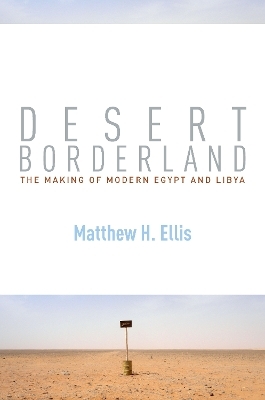
Desert Borderland
The Making of Modern Egypt and Libya
Seiten
2018
|
New edition
Stanford University Press (Verlag)
978-1-5036-0500-8 (ISBN)
Stanford University Press (Verlag)
978-1-5036-0500-8 (ISBN)
Desert Borderland investigates the historical processes that transformed political identity in the easternmost reaches of the Sahara Desert in the half century before World War I. Adopting a view from the margins—illuminating the little-known history of the Egyptian–Libyan borderland—the book challenges prevailing notions of how Egypt and Libya were constituted as modern territorial nation-states.
Matthew H. Ellis draws on a wide array of archival sources to reconstruct the multiple layers and meanings of territoriality in this desert borderland. Throughout the decades, a heightened awareness of the existence of distinctive Egyptian and Ottoman Libyan territorial spheres began to develop despite any clear-cut boundary markers or cartographic evidence. National territoriality was not simply imposed on Egypt's western—or Ottoman Libya's eastern—domains by centralizing state power. Rather, it developed only through a complex and multilayered process of negotiation with local groups motivated by their own local conceptions of space, sovereignty, and political belonging. By the early twentieth century, distinctive "Egyptian" and "Libyan" territorial domains emerged—what would ultimately become the modern nation-states of Egypt and Libya.
Matthew H. Ellis draws on a wide array of archival sources to reconstruct the multiple layers and meanings of territoriality in this desert borderland. Throughout the decades, a heightened awareness of the existence of distinctive Egyptian and Ottoman Libyan territorial spheres began to develop despite any clear-cut boundary markers or cartographic evidence. National territoriality was not simply imposed on Egypt's western—or Ottoman Libya's eastern—domains by centralizing state power. Rather, it developed only through a complex and multilayered process of negotiation with local groups motivated by their own local conceptions of space, sovereignty, and political belonging. By the early twentieth century, distinctive "Egyptian" and "Libyan" territorial domains emerged—what would ultimately become the modern nation-states of Egypt and Libya.
Matthew H. Ellis is the Christian A. Johnson Endeavor Foundation Chair in Middle Eastern Studies and International Affairs at Sarah Lawrence College.
Introduction: Rethinking Territorial Egypt
1. Legal Exceptionalism in Egypt's Borderlands
2. Accommodating Egyptian Sovereignty in Siwa
3. 'Abbas Hilmi II and the Anatomy of a Siwan Murder
4. Cultivating Territorial Sovereignty in the Western Desert
5. The Limits of Ottoman Sovereignty in the Eastern Sahara
6. The Emergence of Egypt's Western Border Conflict
Conclusion: Unsettling the Egyptian-Libyan Border
| Erscheinungsdatum | 26.04.2018 |
|---|---|
| Zusatzinfo | 8 halftones, 4 maps |
| Verlagsort | Palo Alto |
| Sprache | englisch |
| Maße | 152 x 229 mm |
| Themenwelt | Sachbuch/Ratgeber ► Geschichte / Politik ► Allgemeines / Lexika |
| Geisteswissenschaften ► Geschichte ► Regional- / Ländergeschichte | |
| Naturwissenschaften ► Geowissenschaften ► Geografie / Kartografie | |
| Sozialwissenschaften ► Politik / Verwaltung ► Europäische / Internationale Politik | |
| ISBN-10 | 1-5036-0500-0 / 1503605000 |
| ISBN-13 | 978-1-5036-0500-8 / 9781503605008 |
| Zustand | Neuware |
| Informationen gemäß Produktsicherheitsverordnung (GPSR) | |
| Haben Sie eine Frage zum Produkt? |
Mehr entdecken
aus dem Bereich

aus dem Bereich
Handbuch zum Lesen des Himmels
Buch | Hardcover (2025)
Harpercollins (Verlag)
CHF 30,80
historische Porträts von George Washington bis Donald Trump
Buch | Softcover (2025)
C.H.Beck (Verlag)
CHF 33,55
eine Erfindung der globalen Welt : 4000 Jahre Geschichte
Buch | Hardcover (2025)
Klett-Cotta (Verlag)
CHF 53,20


