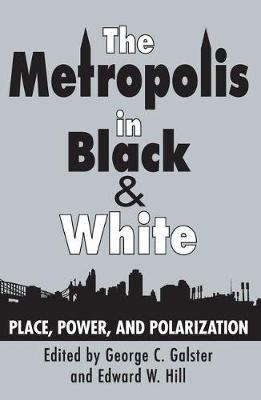
The Metropolis in Black and White highlights a stark fact: America's metropolitan areas are more polarized along racial lines than at any time since the mid-1960s. Though urban areas have become multicultural, the editors argue that black-white racial differences will outlast ethnic differences in metropolitan America and that the race issue in most urban areas is perceived as a black-white one. Galster and Hill perceive that the theme of place, power, and polarization is most powerful when blacks and whites are contrasted. African Americans, on average, are the poorest, most segregated, most disadvantaged urban racial (or ethnic) group, because they are deeply entangled in the web of interrelationships connecting place, power, and polarization. Since these interrelationships form a comprehensive set of social structures that oppress African Americans, they can be judged to be racist at their core. Race, not merely class, continues to play a pivotal role in shaping urban African Americans. In clear analyses, the contributors examine employment, income, the underclass, education, housing, health and mortality, political participation, and racial politics. Intertwined themes of spatial isolation, political empowerment, and racial disparities-place, power, and polarization-guide the analyses. Thisis a vital text for courses in urban affairs, American studies, economics, geography, sociology, political science, urban planning, and racial and ethnic studies. In clear analyses, the contributors examine employment, income, the underclass, education, housing, health and mortality, political participation, and racial politics. Intertwined themes of spatial isolation, political empowerment, and racial disparities-place, power, and polarization-guide the analyses. This is a vital text for courses in urban affairs, American studies, economics, geography, sociology, political science, urban planning, and racial and ethnic studies.
 PDF (Adobe DRM)
Kopierschutz: Adobe-DRM
Adobe-DRM ist ein Kopierschutz, der das eBook vor Mißbrauch schützen soll. Dabei wird das eBook bereits beim Download auf Ihre persönliche Adobe-ID autorisiert. Lesen können Sie das eBook dann nur auf den Geräten, welche ebenfalls auf Ihre Adobe-ID registriert sind.
Details zum Adobe-DRM
Dateiformat: PDF (Portable Document Format)
Mit einem festen Seitenlayout eignet sich die PDF besonders für Fachbücher mit Spalten, Tabellen und Abbildungen. Eine PDF kann auf fast allen Geräten angezeigt werden, ist aber für kleine Displays (Smartphone, eReader) nur eingeschränkt geeignet.
Systemvoraussetzungen:
PC/Mac: Mit einem PC oder Mac können Sie dieses eBook lesen. Sie benötigen eine Adobe-ID und die Software Adobe Digital Editions (kostenlos). Von der Benutzung der OverDrive Media Console raten wir Ihnen ab. Erfahrungsgemäß treten hier gehäuft Probleme mit dem Adobe DRM auf.
eReader: Dieses eBook kann mit (fast) allen eBook-Readern gelesen werden. Mit dem amazon-Kindle ist es aber nicht kompatibel.
Smartphone/Tablet: Egal ob Apple oder Android, dieses eBook können Sie lesen. Sie benötigen eine Adobe-ID sowie eine kostenlose App.
Geräteliste und zusätzliche Hinweise
Buying eBooks from abroad
For tax law reasons we can sell eBooks just within Germany and Switzerland. Regrettably we cannot fulfill eBook-orders from other countries.