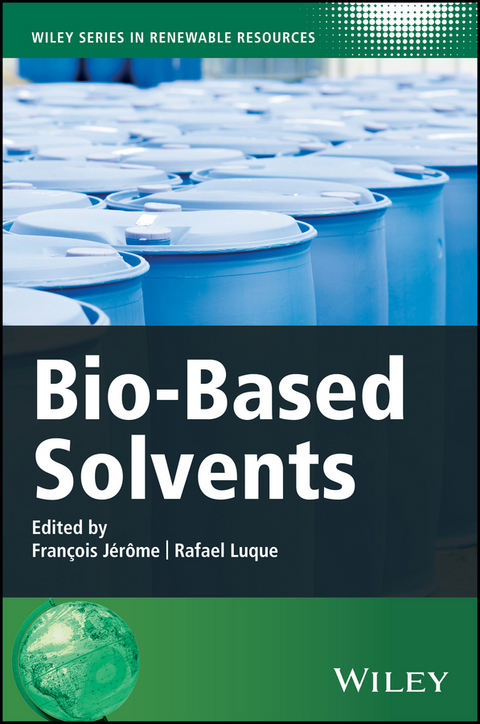
Bio-Based Solvents (eBook)
John Wiley & Sons (Verlag)
978-1-119-06543-2 (ISBN)
A multidisciplinary overview of bio-derived solvent applications, life cycle analysis, and strategies required for industrial commercialization
This book provides the first and only comprehensive review of the state-of-the-science in bio-derived solvents. Drawing on their own pioneering work in the field, as well as an exhaustive survey of the world literature on the subject, the authors cover all the bases-from bio-derived solvent applications to life cycle analysis to strategies for industrial commercialization-for researchers and professional chemists working across a range of industries.
In the increasingly critical area of sustainable chemistry, the search for new and better green solvents has become a top priority. Thanks to their renewability, biodegradability and low toxicity, as well as their potential to promote advantageous organic reactions, green solvents offer the promise of significantly reducing the pernicious effects of chemical processes on human health and the environment.
Following an overview of the current solvents markets and the challenges and opportunities presented by bio-derived solvents, a series of dedicated chapters cover all significant classes of solvent arranged by origin and/or chemical structure. Throughout, real-world examples are used to help demonstrate the various advantages, drawbacks, and limitations of each class of solvent.
Topics covered include:
- The commercial potential of various renewably sourced solvents, such as glycerol
- The various advantages and disadvantages of bio-derived versus petroleum-based solvents
- Renewably-sourced and waste-derived solvents in the design of eco-efficient processes
- Life cycle assessment and predictive methods for bio-based solvents
- Industrial and commercial viability of bio-based solvents now and in the years ahead
- Potential and limitations of methodologies involving bio-derived solvents
- New developments and emerging trends in the field and the shape of things to come
Considering the vast potential for new and better products suggested by recent developments in this exciting field, Bio-Based Solvents will be a welcome resource among students and researchers in catalysis, organic synthesis, electrochemistry, and pharmaceuticals, as well as industrial chemists involved in manufacturing processes and formulation, and policy makers.
Editors
François Jérôme, Institut de Chimie des Milieux et Matériaux de Poitiers, Université de Poitiers, ENSIP, France
Rafael Luque, Departamento de Química Orgánica, Universidad de Córdoba, Spain
Series Editor
Christian Stevens, Faculty of Bioscience Engineering, Ghent University, Belgium
A multidisciplinary overview of bio-derived solvent applications, life cycle analysis, and strategies required for industrial commercialization This book provides the first and only comprehensive review of the state-of-the-science in bio-derived solvents. Drawing on their own pioneering work in the field, as well as an exhaustive survey of the world literature on the subject, the authors cover all the bases from bio-derived solvent applications to life cycle analysis to strategies for industrial commercialization for researchers and professional chemists working across a range of industries. In the increasingly critical area of sustainable chemistry, the search for new and better green solvents has become a top priority. Thanks to their renewability, biodegradability and low toxicity, as well as their potential to promote advantageous organic reactions, green solvents offer the promise of significantly reducing the pernicious effects of chemical processes on human health and the environment. Following an overview of the current solvents markets and the challenges and opportunities presented by bio-derived solvents, a series of dedicated chapters cover all significant classes of solvent arranged by origin and/or chemical structure. Throughout, real-world examples are used to help demonstrate the various advantages, drawbacks, and limitations of each class of solvent. Topics covered include: The commercial potential of various renewably sourced solvents, such as glycerol The various advantages and disadvantages of bio-derived versus petroleum-based solvents Renewably-sourced and waste-derived solvents in the design of eco-efficient processes Life cycle assessment and predictive methods for bio-based solvents Industrial and commercial viability of bio-based solvents now and in the years ahead Potential and limitations of methodologies involving bio-derived solvents New developments and emerging trends in the field and the shape of things to come Considering the vast potential for new and better products suggested by recent developments in this exciting field, Bio-Based Solvents will be a welcome resource among students and researchers in catalysis, organic synthesis, electrochemistry, and pharmaceuticals, as well as industrial chemists involved in manufacturing processes and formulation, and policy makers.
Editors François Jérôme, Institut de Chimie des Milieux et Matériaux de Poitiers, Université de Poitiers, ENSIP, France Rafael Luque, Departamento de Química Orgánica, Universidad de Córdoba, Spain Series Editor Christian Stevens, Faculty of Bioscience Engineering, Ghent University, Belgium
Cover 1
Title Page 5
Copyright 6
Contents 7
List of Contributors 11
Series Preface 13
Foreword 15
Chapter 1 Glycerol as Eco-Efficient Solvent for Organic Transformations 19
1.1 Introduction 19
1.2 Metal-Free Organic Transformations in Glycerol 21
1.3 Metal-Promoted Organic Transformations in Glycerol 33
1.4 Conclusions and Perspectives 41
Acknowledgements 41
References 41
Chapter 2 Aromatic Bio-Based Solvents 47
2.1 Introduction 47
2.2 Resorcinolic Lipids 48
2.2.1 General Description 48
2.2.2 Occurrence of Alkylresorcinols 48
2.2.3 Extraction of Alkylresorcinols 49
2.2.4 Scientific Interest in Alkylresorcinols 53
2.3 Cashew Nut Shell Liquid 56
2.3.1 Description and Occurrence 56
2.3.2 Extraction of Cashew Nut Shell Liquid 56
2.3.3 Scientific Interest in Cashew Nut Shell Liquid 57
2.4 Conclusion 61
References 61
Chapter 3 Solvents from Waste 67
3.1 Introduction 67
3.2 Lignocellulosic Waste as a Feedstock for the Production of Solvents 70
3.2.1 Chemical Transformations of Sugars 71
3.2.2 Fermentation of Lignocellulosic Waste 78
3.3 Solvents from Used Cooking Oil 83
3.4 Terpenes and Derivatives 85
3.5 Conclusion 89
3.5 References 91
Chapter 4 Deep Eutectic and Low-Melting Mixtures 101
4.1 Introduction 101
4.2 Deep Eutectic and Low-Melting Mixtures: Definition and Composition 103
4.3 Deep Eutectic and Low-Melting Mixtures in Metal-Catalysed Organic Reactions 105
4.3.1 Metal-Catalysed Organic Reactions in ChCl-Based Deep Eutectic Solvents 105
4.3.2 Metal-Catalysed Organic Reactions in Low-Melting Mixtures 108
4.4 Conversion of Carbohydrates 110
4.4.1 Synthesis of 5-Hydroxymethylfurfural from Carbohydrates in Low-Melting Mixture 113
4.4.2 Synthesis of Furanic Compounds (Furfural and 5-Hydroxymethylfurfural) in ChCl-Based Deep Eutectic Solvents 119
4.5 Extraction with or from Deep Eutectic Solvents 122
4.6 Conclusion 125
References 126
Chapter 5 Organic Carbonates: Promising Reactive Solvents for Biorefineries and Biotechnology 133
5.1 The Quest for Sustainable Solvents and the Emerging Role of Organic Carbonates 133
5.2 Carbonate Solvents in Biorefineries 135
5.3 Biotechnology: from Enzymatic Synthesis of Organic Carbonates to Enzyme Catalysis in these Non-Conventional Media 142
5.4 Concluding Remarks 145
References 145
Chapter 6 Life Cycle Assessment for Green Solvents 149
6.1 Introduction 149
6.2 Life Cycle Assessment: An Overview 151
6.3 Application of Life Cycle Assessment for Conventional Solvents 154
6.4 Critical Review of Life Cycle Assessment Applied to Green Solvents 155
6.4.1 Criteria of the Review 155
6.4.2 Results of the Review 155
6.5 Discussion: Methodological Challenges 161
6.5.1 Life Cycle Inventory Analysis: from Lab, to Pilot, to Industrial Scale 161
6.5.2 Life Cycle Inventory Analysis: Use of Up-to-Date Methods 161
6.5.3 Coupling Life Cycle Analysis with Other Environmental Assessment Methods 162
6.5.4 Using Multi-Criteria Decision Approaches for Life Cycle Analysis 163
6.5.5 Broadening the Scope of the Application of Life Cycle Analysis for Solvents 163
6.6 Conclusion 164
6.6 References 164
Chapter 7 Alkylphenols as Bio-Based Solvents: Properties, Manufacture and Applications 167
7.1 Introduction 167
7.2 Properties of Alkylphenols 169
7.3 Manufacture of Alkylphenols 170
7.3.1 Oil-Derived Synthesis 171
7.3.2 Separation from Coal Tar 172
7.3.3 (Methoxylated) Alkylphenols from Lignin 173
7.4 Alkylphenols as Solvent 176
7.5 Other Applications of Alkylphenols 180
7.6 Stability and Toxicity of Alkylphenols 181
7.7 Conclusions and Perspectives 182
Acknowledgements 182
References 183
Index 193
Supplemental Images 197
EULA 207
| Erscheint lt. Verlag | 29.6.2017 |
|---|---|
| Reihe/Serie | Wiley Series in Renewable Resource | Wiley Series in Renewable Resources |
| Sprache | englisch |
| Themenwelt | Naturwissenschaften ► Chemie ► Technische Chemie |
| Technik | |
| Schlagworte | alkylphenols as bio-based solvents • aromatic bio-based solvents • bio-derived industrial solvents • bio-derived solvent applications • bio-derived solvent chemical structures • Bio-derived solvents • bio-derived solvents chemistry • bio-derived solvents life cycle analysis • bio-derived solvents manufacturing • bio-derived solvent technology • bio-derived versus petroleum-based solvents • biosolvents • carbonate solvents in biorefineries • Chemie • Chemistry • Glycerol as eco-efficient solvent for organic transformations • Green chemistry • green solvent life cycles • green solvents • Industrial Chemistry • industrial solvents • lignocellulosic waste solvents • Lösungsmittel • Nachhaltige u. Grüne Chemie • Organic carbonate solvents • Organic Chemistry • Organische Chemie • renewably sourced solvents • solvents • solvents from used cooking oils • solvents made from cashew nut shells • Sustainable Chemistry & Green Chemistry • sustainable solvents • sustainable solvent synthesis • Technische u. Industrielle Chemie • waste-derived solvent chemistry • waste-derived solvents • waste-derived solvents manufacturing |
| ISBN-10 | 1-119-06543-7 / 1119065437 |
| ISBN-13 | 978-1-119-06543-2 / 9781119065432 |
| Informationen gemäß Produktsicherheitsverordnung (GPSR) | |
| Haben Sie eine Frage zum Produkt? |
 PDF (Adobe DRM)
Kopierschutz: Adobe-DRM
Adobe-DRM ist ein Kopierschutz, der das eBook vor Mißbrauch schützen soll. Dabei wird das eBook bereits beim Download auf Ihre persönliche Adobe-ID autorisiert. Lesen können Sie das eBook dann nur auf den Geräten, welche ebenfalls auf Ihre Adobe-ID registriert sind.
Details zum Adobe-DRM
Dateiformat: PDF (Portable Document Format)
Mit einem festen Seitenlayout eignet sich die PDF besonders für Fachbücher mit Spalten, Tabellen und Abbildungen. Eine PDF kann auf fast allen Geräten angezeigt werden, ist aber für kleine Displays (Smartphone, eReader) nur eingeschränkt geeignet.
Systemvoraussetzungen:
PC/Mac: Mit einem PC oder Mac können Sie dieses eBook lesen. Sie benötigen eine
eReader: Dieses eBook kann mit (fast) allen eBook-Readern gelesen werden. Mit dem amazon-Kindle ist es aber nicht kompatibel.
Smartphone/Tablet: Egal ob Apple oder Android, dieses eBook können Sie lesen. Sie benötigen eine
Geräteliste und zusätzliche Hinweise
Buying eBooks from abroad
For tax law reasons we can sell eBooks just within Germany and Switzerland. Regrettably we cannot fulfill eBook-orders from other countries.
aus dem Bereich