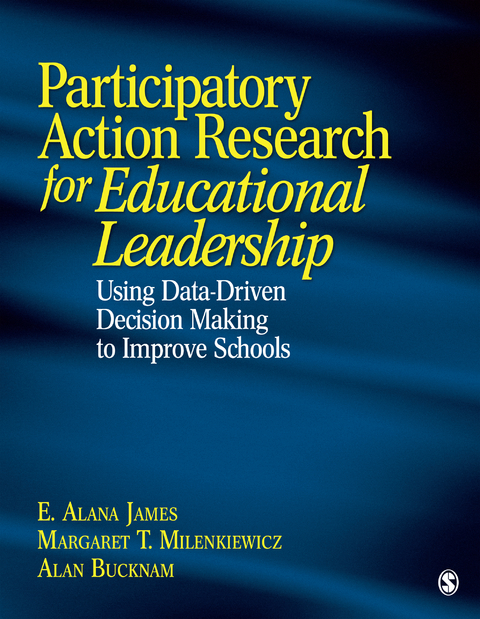
Participatory Action Research for Educational Leadership (eBook)
248 Seiten
Sage Publications, Inc (Verlag)
978-1-5063-1987-2 (ISBN)

Acknowledgments
Introduction
Welcome to PAR for Educational Leaders
Our Approach to PAR
Our Readers
Features
How to Use This Book
Final Notes
1. The Participatory Action Research Model
Reflective Questions
Section 1: PAR---A Tool for Change
PAR as a Tool for Educational Leadership
Reflective Questions
Section 2: Research and Action in the PAR Process
Reflective Questions
Section 3: Participatory Research as a Tool to Address Adaptive Change
An Example of PAR Use in the Classroom
Task 1.1: Beginning a Reflective Journal
Conclusion
2. The Tenets of PAR: Ethics, Purpose, and Logic
Reflective Questions
Section 1: Ethics
Ethical Elements
Task 2.1: The Formation of an Ethical Plan for PAR Projects
Reflective Questions
Section 2: The Power of Purpose
Format for Purpose Statements
Task 2.2: Multiple Journal Entries Define Purpose
Reflective Questions
Section 3: Logic Models
Task 2.3: Planning Your First Draft of Your Logic Model
Conclusion
3. Starting to Research
Reflective Questions
Section 1: Asking Good Research Questions
Task 3.1: PAR Practitioners Reflect On and Share Their Initials Ideas for Research Questions
Surfacing Assumptions
Task 3.2: Surfacing Assumptions
Reflective Questions
Section 2: Informal and Formal Reviews of Literature
Task 3.3: The Mini "Lit Review"
Reflective Questions
Section 3: A Brief Overview of the Basic Research Methods
Qualitative Methods
Quantitative Methods
Reflective Practice
Task 3.4: Reflective Journal Practice
Conclusion
4. Qualitative Data Collection
How Is Qualitative Evidence Useful?
What Makes Qualitative Evidence Difficult?
Reflective Questions
Section 1: Qualitative Data Collection Methods
Data Collected Directly in Words From People: Interviews and Focus Groups
Data Collected Through a Process of Change: Reflective Data/Field Notes/Anecdotal Accounts
Data Collected During the Event(s) Being Studied: Observations/Student Work/Logs
Task 4.1: Collecting a Variety of Qualitative Data
Reflective Questions
Section 2: Maximum Success and Rigor
Managing Time and Resources
How to Make It More Rigorous
Introduction to Mixed Methodology
Task 4.2: Data-Planning Matrix
Conclusion
5. Qualitative Analysis
Reflective Questions
Section 1: Stages in Analyzing Qualitative Evidence
Graphic Organizers
Codes
Memos
Families
Triangulation
Rubrics and Multiple Observers
Similarities and Differences
Reflective Questions
Section 2: Validity, Credibility, and Reliability in the Analysis of Qualitative Data
Task 5.1: Practice Analysis of Data
Conclusion
6. Quantitative Evidence
Data Found in Schools
Standardized Tests
Reflective Questions
Section 1: Questions Answered by Quantitative and Mixed Methods Evidence
Observations and Time Studies
Surveys or Questionnaires
Descriptive Statistics
Variance and Correlation
Complex Questions
Reflective Questions
Section 2: Quantitative Data Collection
Observations
Questionnaires or Surveys
Samples
Time Series
Reflective Questions
Section 3: Analysis and Statistical Information
Descriptive Analysis
Frequencies
Survey Analysis
Percentages and Mean
Standard Deviation
The t-Test
Correlation
Reporting Results
Task 6.1: Preliminary Quantitative Analysis
Conclusion
7. Taking and Measuring Action
Reflective Questions
Section 1: How to Know What Actions to Take
Three Continuums of Action
The Continuum of Actions From Emancipatory to Professional Development
The Continuum From the Individual to the Organizational
Examples of PAR to Foster School Improvement
Teachers or Support Staff in a Classroom or Whole-School Setting
Principals
Whole Schools or School Districts
Reflective Question
Section 2: Efforts at Change
The Challenge of Inertia
Defensive Behaviors
Task 7.1: Analyzing Force Fields and Defensive Behaviors
Reflective Questions
Section 3: Measurement
Formative Evaluation
Focus and Responsiveness
Determining Variables With Which to Measure Short-Term Outcomes
Measuring Outcome Steps
Conclusion
8. Cycles of PAR: The Power of the Iterative Process
Reflective Questions
Section 1: Messy Cycles
Reflective Questions
Section 2: Iterative Growth
Diagnosis
Action
Measurement
Reflection
Time Line and Group Process for Significant Success
Task 8.1: Using the Forward Planner
Reflective Questions
Section 3: Theoretical Understanding Bolsters Action and Visa Versa
Conclusion
9. Final Analysis and Results
Alchemy
Reasoning and Writing
Standards for the Final Analysis
Reflective Questions
Section 1: Validity
My "Real" World--or Yours?
Theory Building and Testing
Reporting the Analysis Process to Others
Task 9.1: Building a Preliminary Report on the Analysis Process for Others
Reflective Questions
Section 2: Credible Interpretation
Graphic Organizers
Compelling Arguments
Disclaimers
Reflective Questions
Section 3: Reliability
Fallacy
Reflective Questions
Section 4: Passionate Conclusions
Task 9.2: One Sentence and Three Words
Conclusion
10. The Final Report
Reflective Questions
Section 1: The Formal Report
The Formal Academic Report
Reflective Questions
Section 2: The Formal Presentation
Prior to Beginning
Constraints
Openings and Closings
Content and How to Present It
Reflective Questions
Section 3: The Informal Individual Report
Reflective Questions
Section 4: The Community Report
Conclusion
11. PAR for Educational Leadership
Reflective Questions
Section 1: A Creative Tool in Environments of Chaos and Complexity
Counteracting Educator Mobility
Inclusion: Both/And Rather Than Either/Or
The Need for Flexibility
Prediction: The Study of Outliers
Feedback Loops
Reflective Questions
Section 2: A Tool for Adaptive Leadership
Creating a Holding Environment
Avoiding Implementation Failure
Reflective Questions
Section 3: PAR and Educational Reform Efforts
Professional Learning Communities and Communities of Practice
What Is Required?
The Development of an Inclusive Leadership Structure
Conclusion
Glossary
References
Index
About the Authors
| Erscheint lt. Verlag | 17.7.2007 |
|---|---|
| Verlagsort | Thousand Oaks |
| Sprache | englisch |
| Themenwelt | Schulbuch / Wörterbuch ► Lektüren / Interpretationen |
| Naturwissenschaften | |
| Sozialwissenschaften ► Pädagogik | |
| Sozialwissenschaften ► Soziologie ► Empirische Sozialforschung | |
| ISBN-10 | 1-5063-1987-4 / 1506319874 |
| ISBN-13 | 978-1-5063-1987-2 / 9781506319872 |
| Informationen gemäß Produktsicherheitsverordnung (GPSR) | |
| Haben Sie eine Frage zum Produkt? |
 EPUB (Adobe DRM)
Kopierschutz: Adobe-DRM
Adobe-DRM ist ein Kopierschutz, der das eBook vor Mißbrauch schützen soll. Dabei wird das eBook bereits beim Download auf Ihre persönliche Adobe-ID autorisiert. Lesen können Sie das eBook dann nur auf den Geräten, welche ebenfalls auf Ihre Adobe-ID registriert sind.
Details zum Adobe-DRM
Dateiformat: EPUB (Electronic Publication)
EPUB ist ein offener Standard für eBooks und eignet sich besonders zur Darstellung von Belletristik und Sachbüchern. Der Fließtext wird dynamisch an die Display- und Schriftgröße angepasst. Auch für mobile Lesegeräte ist EPUB daher gut geeignet.
Systemvoraussetzungen:
PC/Mac: Mit einem PC oder Mac können Sie dieses eBook lesen. Sie benötigen eine
eReader: Dieses eBook kann mit (fast) allen eBook-Readern gelesen werden. Mit dem amazon-Kindle ist es aber nicht kompatibel.
Smartphone/Tablet: Egal ob Apple oder Android, dieses eBook können Sie lesen. Sie benötigen eine
Geräteliste und zusätzliche Hinweise
Buying eBooks from abroad
For tax law reasons we can sell eBooks just within Germany and Switzerland. Regrettably we cannot fulfill eBook-orders from other countries.
aus dem Bereich