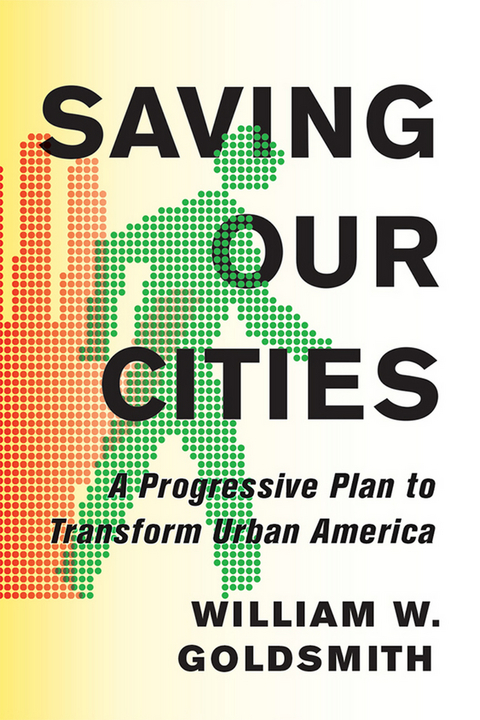
Saving Our Cities (eBook)
304 Seiten
Cornell University Press (Verlag)
978-1-5017-0658-5 (ISBN)
In Saving Our Cities, William W. Goldsmith shows how cities can be places of opportunity rather than places with problems. With strongly revived cities and suburbs, working as places that serve all their residents, metropolitan areas will thrive.
In Saving Our Cities, William W. Goldsmith shows how cities can be places of opportunity rather than places with problems. With strongly revived cities and suburbs, working as places that serve all their residents, metropolitan areas will thrive, thus making the national economy more productive, the environment better protected, the citizenry better educated, and the society more reflective, sensitive, and humane.
Goldsmith argues that America has been in the habit of abusing its cities and their poorest suburbs, which are always the first to be blamed for society's ills and the last to be helped. As federal and state budgets, regulations, and programs line up with the interests of giant corporations and privileged citizens, they impose austerity on cities, shortchange public schools, make it hard to get nutritious food, and inflict the drug war on unlucky neighborhoods.
Frustration with inequality is spreading. Parents and teachers call persistently for improvements in public schooling, and education experiments abound. Nutrition indicators have begun to improve, as rising health costs and epidemic obesity have led to widespread attention to food. The futility of the drug war and the high costs of unwarranted, unprecedented prison growth have become clear. Goldsmith documents a positive development: progressive politicians in many cities and some states are proposing far-reaching improvements, supported by advocacy groups that form powerful voting blocs, ensuring that Congress takes notice. When more cities forcefully demand enlightened federal and state action on these four interrelated problems—inequality, schools, food, and the drug war—positive movement will occur in traditional urban planning as well, so as to meet the needs of most residents for improved housing, better transportation, and enhanced public spaces.
In Saving Our Cities, William W. Goldsmith shows how cities can be places of opportunity rather than places with problems. With strongly revived cities and suburbs, working as places that serve all their residents, metropolitan areas will thrive, thus making the national economy more productive, the environment better protected, the citizenry better educated, and the society more reflective, sensitive, and humane.
Goldsmith argues that America has been in the habit of abusing its cities and their poorest suburbs, which are always the first to be blamed for society's ills and the last to be helped. As federal and state budgets, regulations, and programs line up with the interests of giant corporations and privileged citizens, they impose austerity on cities, shortchange public schools, make it hard to get nutritious food, and inflict the drug war on unlucky neighborhoods.Frustration with inequality is spreading. Parents and teachers call persistently for improvements in public schooling, and education experiments abound. Nutrition indicators have begun to improve, as rising health costs and epidemic obesity have led to widespread attention to food. The futility of the drug war and the high costs of unwarranted, unprecedented prison growth have become clear. Goldsmith documents a positive development: progressive politicians in many cities and some states are proposing far-reaching improvements, supported by advocacy groups that form powerful voting blocs, ensuring that Congress takes notice. When more cities forcefully demand enlightened federal and state action on these four interrelated problems—inequality, schools, food, and the drug war—positive movement will occur in traditional urban planning as well, so as to meet the needs of most residents for improved housing, better transportation, and enhanced public spaces.
William W. Goldsmith is Professor Emeritus of City and Regional Planning at Cornell University. He is coauthor of Separate Societies: Poverty and Inequality in U.S. Cities.
| Erscheint lt. Verlag | 23.8.2016 |
|---|---|
| Zusatzinfo | 11 charts, 1 table |
| Verlagsort | Ithaca |
| Sprache | englisch |
| Maße | 150 x 150 mm |
| Themenwelt | Naturwissenschaften ► Geowissenschaften ► Geografie / Kartografie |
| Sozialwissenschaften ► Pädagogik | |
| Sozialwissenschaften ► Soziologie | |
| Technik ► Architektur | |
| ISBN-10 | 1-5017-0658-6 / 1501706586 |
| ISBN-13 | 978-1-5017-0658-5 / 9781501706585 |
| Informationen gemäß Produktsicherheitsverordnung (GPSR) | |
| Haben Sie eine Frage zum Produkt? |
 EPUB (Adobe DRM)
Kopierschutz: Adobe-DRM
Adobe-DRM ist ein Kopierschutz, der das eBook vor Mißbrauch schützen soll. Dabei wird das eBook bereits beim Download auf Ihre persönliche Adobe-ID autorisiert. Lesen können Sie das eBook dann nur auf den Geräten, welche ebenfalls auf Ihre Adobe-ID registriert sind.
Details zum Adobe-DRM
Dateiformat: EPUB (Electronic Publication)
EPUB ist ein offener Standard für eBooks und eignet sich besonders zur Darstellung von Belletristik und Sachbüchern. Der Fließtext wird dynamisch an die Display- und Schriftgröße angepasst. Auch für mobile Lesegeräte ist EPUB daher gut geeignet.
Systemvoraussetzungen:
PC/Mac: Mit einem PC oder Mac können Sie dieses eBook lesen. Sie benötigen eine
eReader: Dieses eBook kann mit (fast) allen eBook-Readern gelesen werden. Mit dem amazon-Kindle ist es aber nicht kompatibel.
Smartphone/Tablet: Egal ob Apple oder Android, dieses eBook können Sie lesen. Sie benötigen eine
Geräteliste und zusätzliche Hinweise
Buying eBooks from abroad
For tax law reasons we can sell eBooks just within Germany and Switzerland. Regrettably we cannot fulfill eBook-orders from other countries.
aus dem Bereich