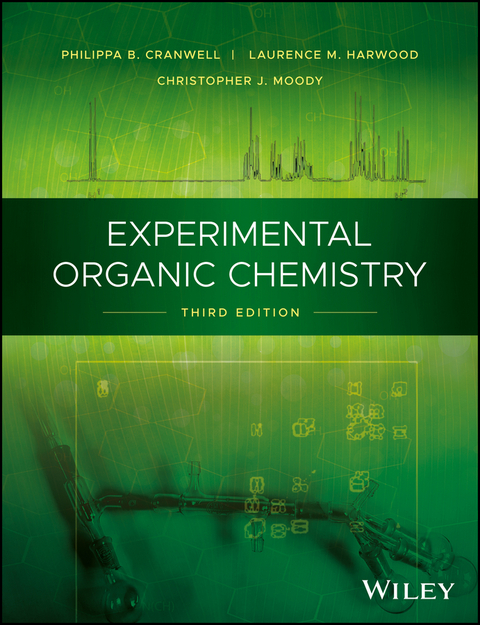
Experimental Organic Chemistry (eBook)
John Wiley & Sons (Verlag)
978-1-118-68341-5 (ISBN)
The definitive guide to the principles and practice of experimental organic chemistry - fully updated and now featuring more than 100 experiments
The latest edition of this popular guide to experimental organic chemistry takes students from their first day in the laboratory right through to complex research procedures. All sections have been updated to reflect new techniques, equipment and technologies, and the text has been revised with an even sharper focus on practical skills and procedures.
The first half of the book is devoted to safe laboratory practice as well as purification and analytical techniques; particularly spectroscopic analysis. The second half contains step-by-step experimental procedures, each one illustrating a basic principle, or important reaction type. Tried and tested over almost three decades, over 100 validated experiments are graded according to their complexity and all are chosen to highlight important chemical transformations and to teach key experimental skills.
New sections cover updated health and safety guidelines, additional spectroscopic techniques, electronic notebooks and record keeping, and techniques, such as semi-automated chromatography and enabling technologies such as the use of microwave and flow chemistry. New experiments include transition metal-catalysed cross-coupling, organocatalysis, asymmetric synthesis, flow chemistry, and microwave-assisted synthesis. Key aspects of this third edition include:
- Detailed descriptions of the correct use of common apparatus used in the organic laboratory
- Outlines of practical skills that all chemistry students must learn
- Highlights of aspects of health and safety in the laboratory, both in the first section and throughout the experimental procedures
- Four new sections reflecting advances in techniques and technologies, from electronic databases and information retrieval to semi-automated chromatography
- More than 100 validated experiments of graded complexity from introductory to research level
- A user-friendly experiment directory
- An instructor manual and PowerPoint slides of the figures in the book available on a companion website
A comprehensive guide to contemporary organic chemistry laboratory principles, procedures, protocols, tools and techniques, Experimental Organic Chemistry, Third Edition is both an essential laboratory textbook for students of chemistry at all levels, and a handy bench reference for experienced chemists.
Philippa B. Cranwell, PhD is a Lecturer in the Department of Chemistry, University of Reading, UK.
Laurence M. Harwood, PhD is Professor of Organic Chemistry in the Department of Chemistry and Director of the Chemical Analysis Facility, University of Reading, UK.
Christopher J. Moody, PhD is Sir Jesse Boot Professor in the School of Chemistry, University of Nottingham, UK.
The definitive guide to the principles and practice of experimental organic chemistry fully updated and now featuring more than 100 experiments The latest edition of this popular guide to experimental organic chemistry takes students from their first day in the laboratory right through to complex research procedures. All sections have been updated to reflect new techniques, equipment and technologies, and the text has been revised with an even sharper focus on practical skills and procedures. The first half of the book is devoted to safe laboratory practice as well as purification and analytical techniques; particularly spectroscopic analysis. The second half contains step-by-step experimental procedures, each one illustrating a basic principle, or important reaction type. Tried and tested over almost three decades, over 100 validated experiments are graded according to their complexity and all are chosen to highlight important chemical transformations and to teach key experimental skills. New sections cover updated health and safety guidelines, additional spectroscopic techniques, electronic notebooks and record keeping, and techniques, such as semi-automated chromatography and enabling technologies such as the use of microwave and flow chemistry. New experiments include transition metal-catalysed cross-coupling, organocatalysis, asymmetric synthesis, flow chemistry, and microwave-assisted synthesis. Key aspects of this third edition include: Detailed descriptions of the correct use of common apparatus used in the organic laboratory Outlines of practical skills that all chemistry students must learn Highlights of aspects of health and safety in the laboratory, both in the first section and throughout the experimental procedures Four new sections reflecting advances in techniques and technologies, from electronic databases and information retrieval to semi-automated chromatography More than 100 validated experiments of graded complexity from introductory to research level A user-friendly experiment directory An instructor manual and PowerPoint slides of the figures in the book available on a companion website A comprehensive guide to contemporary organic chemistry laboratory principles, procedures, protocols, tools and techniques, Experimental Organic Chemistry, Third Edition is both an essential laboratory textbook for students of chemistry at all levels, and a handy bench reference for experienced chemists.
Philippa B. Cranwell, PhD is a Lecturer in the Department of Chemistry, University of Reading, UK. Laurence M. Harwood, PhD is Professor of Organic Chemistry in the Department of Chemistry and Director of the Chemical Analysis Facility, University of Reading, UK. Christopher J. Moody, PhD is Sir Jesse Boot Professor in the School of Chemistry, University of Nottingham, UK.
Title Page 5
Copyright Page 6
Contents 7
About the authors 11
Preface to the third edition 13
About the companion website 17
Part 1 Laboratory practice 19
Chapter 1 Safety in the chemical laboratory 21
1.1 Essential rules for laboratory safety 22
1.2 Hazardous chemicals 25
1.3 Disposal of hazardous waste 29
1.4 Accident procedures 30
Chapter 2 Glassware and equipment in the laboratory 33
2.1 Glass equipment 34
2.2 Hardware 39
2.3 Heating 42
2.4 Stirring 48
2.5 Vacuum pumps 50
2.6 The rotary evaporator 60
2.7 Catalytic hydrogenation 64
2.8 Ozonolysis 66
2.9 Irradiation 68
2.10 Compressed gases 72
Chapter 3 Organic reactions: From starting materials to pure organic product 79
3.1 Handling chemicals 80
3.2 The reaction 99
3.3 Purification of organic compounds 123
Chapter 4 Qualitative analysis of organic compounds 203
4.1 Purity 203
4.2 Determination of structure using chemical methods 220
Chapter 5 Spectroscopic analysis of organic compounds 225
5.1 Absorption spectroscopy 225
5.2 Infrared spectroscopy 227
5.3 Nuclear magnetic resonance spectroscopy 245
5.4 Ultraviolet spectroscopy 297
5.5 Mass spectrometry 313
Chapter 6 Keeping records: The laboratory notebook and chemical literature 329
6.1 The laboratory notebook 330
6.2 The research report 340
6.3 The chemical literature 345
Part 2 Experimental procedures 347
Introduction 349
List of experiments 351
Experiments that can be taken in sequence 371
Experiments that can be used to compare directly different techniques for undertaking a reaction 372
Experiments that illustrate particular techniques 372
Chapter 7 Functional group interconversions 373
7.1 Simple transformations 373
7.2 Reactions of alkenes 384
7.3 Substitution 404
7.4 Reduction 408
7.5 Oxidation 442
7.6 Rearrangements 454
Chapter 8 Carbon–carbon bond-forming reactions 461
8.1 Grignard and organolithium reagents 462
8.2 Enolate anions 474
8.3 Heteroatom-stabilized carbanions 502
8.4 Aromatic electrophilic substitution 522
8.5 Pericyclic reactions 532
8.6 Metal-mediated coupling reactions 552
Chapter 9 Experiments using enabling technologies 563
9.1 Microwave chemistry 563
9.2 Flow chemistry 572
Chapter 10 Projects 587
10.1 Natural product isolation and identification 587
10.2 Project in organic synthesis 596
10.3 Aspects of physical organic chemistry 626
Appendices 645
Appendix 1 Organic solvents 647
Appendix 2 Spectroscopic correlation tables 653
Index of chemicals 667
General index 675
EULA 690
| Erscheint lt. Verlag | 9.6.2017 |
|---|---|
| Sprache | englisch |
| Themenwelt | Naturwissenschaften ► Chemie ► Organische Chemie |
| Naturwissenschaften ► Chemie ► Physikalische Chemie | |
| Schlagworte | carbon bond-forming reaction experiments • Chemie • Chemistry • chemistry laboratory safety protocols • Einführung in die Chemie • Einführung in die Chemie • experimental organic chemistry • experimental procedures in organic chemistry • experiments in organic chemistry • guide to working in an organic chemistry lab • <p>experimental organic chemistry • mass spectroscopy in organic chemistry • Methods - Synthesis & Techniques • microscale organic chemistry experiments • organic chemistry experiments • organic chemistry in the lab • organic chemistry lab equipment • organic chemistry lab equipment</p> • organic chemistry lab experiments illustrated • organic chemistry laboratory abcs • organic chemistry laboratory procedures • organic chemistry laboratory techniques • organic spectroscopy techniques • organic spectroscopy technologies • organic synthesis laboratory procedures • Organische Chemie • Organische Chemie / Methoden, Synthesen, Verfahren • Pharmaceutical & Medicinal Chemistry • Pharmazeutische u. Medizinische Chemie • Preparatory / Introductory Chemistry • qualitative analysis of organic compounds • safety in the chemistry laboratory • small scale organic chemistry experiments • spectroscopic analysis of organic compounds • the practice of experimental organic chemistry |
| ISBN-10 | 1-118-68341-2 / 1118683412 |
| ISBN-13 | 978-1-118-68341-5 / 9781118683415 |
| Informationen gemäß Produktsicherheitsverordnung (GPSR) | |
| Haben Sie eine Frage zum Produkt? |
 PDF (Adobe DRM)
Kopierschutz: Adobe-DRM
Adobe-DRM ist ein Kopierschutz, der das eBook vor Mißbrauch schützen soll. Dabei wird das eBook bereits beim Download auf Ihre persönliche Adobe-ID autorisiert. Lesen können Sie das eBook dann nur auf den Geräten, welche ebenfalls auf Ihre Adobe-ID registriert sind.
Details zum Adobe-DRM
Dateiformat: PDF (Portable Document Format)
Mit einem festen Seitenlayout eignet sich die PDF besonders für Fachbücher mit Spalten, Tabellen und Abbildungen. Eine PDF kann auf fast allen Geräten angezeigt werden, ist aber für kleine Displays (Smartphone, eReader) nur eingeschränkt geeignet.
Systemvoraussetzungen:
PC/Mac: Mit einem PC oder Mac können Sie dieses eBook lesen. Sie benötigen eine
eReader: Dieses eBook kann mit (fast) allen eBook-Readern gelesen werden. Mit dem amazon-Kindle ist es aber nicht kompatibel.
Smartphone/Tablet: Egal ob Apple oder Android, dieses eBook können Sie lesen. Sie benötigen eine
Geräteliste und zusätzliche Hinweise
Buying eBooks from abroad
For tax law reasons we can sell eBooks just within Germany and Switzerland. Regrettably we cannot fulfill eBook-orders from other countries.
aus dem Bereich