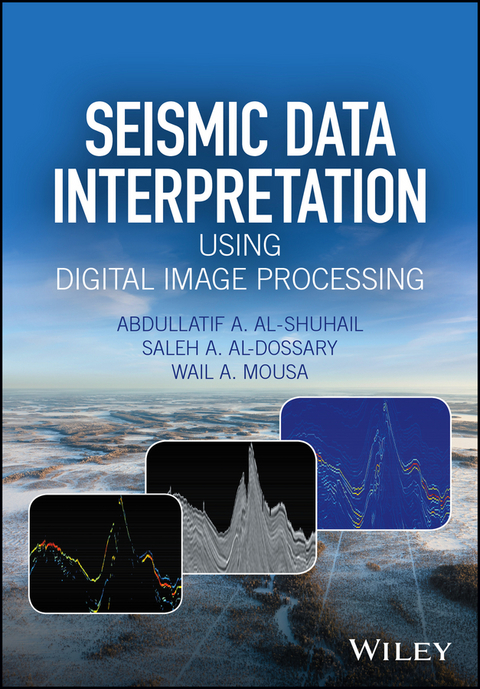
Seismic Data Interpretation using Digital Image Processing (eBook)
John Wiley & Sons (Verlag)
978-1-118-88180-4 (ISBN)
Bridging the gap between modern image processing practices by the scientific community at large and the world of geology and reflection seismology
This book covers the basics of seismic exploration, with a focus on image processing techniques as applied to seismic data. Discussions of theories, concepts, and algorithms are followed by synthetic and real data examples to provide the reader with a practical understanding of the image processing technique and to enable the reader to apply these techniques to seismic data. The book will also help readers interested in devising new algorithms, software and hardware for interpreting seismic data.
Key Features:
- Provides an easy to understand overview of popular seismic processing and interpretation techniques from the point of view of a digital signal processor.
- Presents image processing concepts that may be readily applied directly to seismic data.
- Includes ready-to-run MATLAB algorithms for most of the techniques presented.
The book includes essential research and teaching material for digital signal and image processing individuals interested in learning seismic data interpretation from the point of view of digital signal processing. It is an ideal resource for students, professors and working professionals who are interested in learning about the application of digital signal processing theory and algorithms to seismic data.
ABDULLATIF A. AL-SHUHAIL is an Associate Professor of Geophysics at King Fahd University of Petroleum & Minerals (KFUPM). He got his BS from KFUPM in Geophysics in 1988, his MS and PhD in Geophysics from Texas A&M University at College Station in 1993 and 1998, respectively. Since then he has been teaching and advising at KFUPM. He founded and directed the Near Surface Seismic Investigation Consortium at KFUPM in 2006-2008. He has authored and co-authored several papers in the field of petroleum seismic exploration. He is an active member of the Society of Exploration Geophysicists, the European Association of Geoscientists & Engineers, and the Dhahran Geoscience Society. His interests include near-surface effects on petroleum seismic data, seismic investigation of fractured reservoirs, and ground penetrating radar.
SALEH A. AL-DOSSARY works in the Exploration Application Services Department in Saudi Aramco Oil Company, developing new seismic processing, attributes and pre-stack depth-migration algorithms. In 1991, Saleh received his B.S. degree in Computer Science with a minor in Geophysics from the New Mexico Institute of Mining and Technology, Socorro, NM. He received his M.S. degree in 1997 from Stanford University, Palo Alto, CA, and in 2004 he received his Ph.D. from the University of Houston, TX, both in Geophysics. Saleh holds five patents, and is an applicant for five additional patents in seismic edge preserving and detection technology. He is the author and coauthor of several articles published by the Society of Exploration Geophysicists (SEG). Saleh received the Distinguished Employee Award in Saudi Aramco's Exploration Application Services Department in 1999, the Outstanding Student Award from the University of Houston in 2003 and the Saudi Aramco Excellence Award in 2015.
WAIL A. MOUSA is an Associate Professor with the Electrical Engineering Department, King Fahd University of Petroleum and Minerals (KFUPM). He received the B.Sc. degrees in electrical engineering and mathematical sciences and M.Sc. degree in electrical engineering from KFUPM, in 2000, 2001, and 2003, respectively, and the Ph.D. degree in electronics and electrical engineering from the University of Leeds in 2006. Between 2003 and 2009, he worked as a Research Scientist on applied signal processing for geology and geophysics at the Schlumberger. His research interests include digital signal processing and its application in geophysics, with particular emphasis on Seismic Data Processing. Additional interests include design and implementation of digital filters including wavefield extrapolation filters, image segmentation, pattern recognition, and classification and their applications related to geophysical and geological data.
Bridging the gap between modern image processing practices by the scientific community at large and the world of geology and reflection seismology This book covers the basics of seismic exploration, with a focus on image processing techniques as applied to seismic data. Discussions of theories, concepts, and algorithms are followed by synthetic and real data examples to provide the reader with a practical understanding of the image processing technique and to enable the reader to apply these techniques to seismic data. The book will also help readers interested in devising new algorithms, software and hardware for interpreting seismic data. Key Features: Provides an easy to understand overview of popular seismic processing and interpretation techniques from the point of view of a digital signal processor. Presents image processing concepts that may be readily applied directly to seismic data. Includes ready-to-run MATLAB algorithms for most of the techniques presented. The book includes essential research and teaching material for digital signal and image processing individuals interested in learning seismic data interpretation from the point of view of digital signal processing. It is an ideal resource for students, professors and working professionals who are interested in learning about the application of digital signal processing theory and algorithms to seismic data.
ABDULLATIF A. AL-SHUHAIL is an Associate Professor of Geophysics at King Fahd University of Petroleum & Minerals (KFUPM). He got his BS from KFUPM in Geophysics in 1988, his MS and PhD in Geophysics from Texas A&M University at College Station in 1993 and 1998, respectively. Since then he has been teaching and advising at KFUPM. He founded and directed the Near Surface Seismic Investigation Consortium at KFUPM in 2006-2008. He has authored and co-authored several papers in the field of petroleum seismic exploration. He is an active member of the Society of Exploration Geophysicists, the European Association of Geoscientists & Engineers, and the Dhahran Geoscience Society. His interests include near-surface effects on petroleum seismic data, seismic investigation of fractured reservoirs, and ground penetrating radar. SALEH A. AL-DOSSARY works in the Exploration Application Services Department in Saudi Aramco Oil Company, developing new seismic processing, attributes and pre-stack depth-migration algorithms. In 1991, Saleh received his B.S. degree in Computer Science with a minor in Geophysics from the New Mexico Institute of Mining and Technology, Socorro, NM. He received his M.S. degree in 1997 from Stanford University, Palo Alto, CA, and in 2004 he received his Ph.D. from the University of Houston, TX, both in Geophysics. Saleh holds five patents, and is an applicant for five additional patents in seismic edge preserving and detection technology. He is the author and coauthor of several articles published by the Society of Exploration Geophysicists (SEG). Saleh received the Distinguished Employee Award in Saudi Aramco's Exploration Application Services Department in 1999, the Outstanding Student Award from the University of Houston in 2003 and the Saudi Aramco Excellence Award in 2015. WAIL A. MOUSA is an Associate Professor with the Electrical Engineering Department, King Fahd University of Petroleum and Minerals (KFUPM). He received the B.Sc. degrees in electrical engineering and mathematical sciences and M.Sc. degree in electrical engineering from KFUPM, in 2000, 2001, and 2003, respectively, and the Ph.D. degree in electronics and electrical engineering from the University of Leeds in 2006. Between 2003 and 2009, he worked as a Research Scientist on applied signal processing for geology and geophysics at the Schlumberger. His research interests include digital signal processing and its application in geophysics, with particular emphasis on Seismic Data Processing. Additional interests include design and implementation of digital filters including wavefield extrapolation filters, image segmentation, pattern recognition, and classification and their applications related to geophysical and geological data.
Cover 1
Title Page 5
Copyright 6
Contents 9
Foreword 13
Preface 17
Chapter 1 Introduction 21
1.1 Image Processing of Exploration Seismic Data 21
1.2 Exploration Seismic Data: From Acquisition to Interpretation 21
1.2.1 Seismic Data Acquisition 22
1.2.2 Seismic Data Processing 22
1.2.3 Seismic Data Interpretation 22
1.3 The Seismic Convolution Model 23
1.4 Summary 26
Chapter 2 Seismic Data Interpretation 27
2.1 Introduction 27
2.2 Structural Features 31
2.2.1 Faults 31
2.2.2 Folds 38
2.2.3 Diapirs 41
2.3 Stratigraphic Features 42
2.3.1 Channels 44
2.3.2 Reefs 46
2.3.3 Truncation 47
2.4 Seismic Interpretation Tools 47
2.4.1 Seismic Sequence Stratigraphy 49
2.4.2 Seismic Facies Analysis 53
2.4.3 Direct Hydrocarbon Indicators 55
2.4.4 Tying Seismic and Well Data 55
2.4.5 Seismic Modeling 55
2.4.6 Time-to-Depth Conversion 61
2.4.7 Seismic Attributes 64
2.5 Pitfalls in Seismic Interpretation 64
2.6 Summary 68
2.7 Problems and Computer Assignments 69
Chapter 3 Seismic Image Enhancement in the Spatial Domain 79
3.1 Introduction 79
3.1.1 The Mean (Running-Average) Filter 80
3.2 The Median Filter 83
3.3 The Edge-Preserving Smoothing Algorithm 86
3.3.1 Two-Dimensional Structure-Preserving Smoothing 87
3.4 Wavelet-Based Smoothing 90
3.4.1 Method 90
3.4.2 Sharpening Filter 91
3.5 Summary 92
3.6 Problems and Computer Assignments 93
Chapter 4 Seismic Image Enhancement in the Spectral Domain 97
4.1 Introduction 97
4.2 The Fourier Transform 97
4.3 Filtering in the Spectral Domain 100
4.4 Spectral Attributes 103
4.5 Summary 105
4.6 Problems and Computer Assignments 105
Chapter 5 Seismic Attributes 107
5.1 Introduction 107
5.2 Detection of Interesting Regions from Time or Depth Three-Dimensional Slices using Seismic Attributes 107
5.3 Two-Dimensional Numerical Gradient Edge-Detector Operators 109
5.4 Application to Real Seismic Data 111
5.5 Two-Dimensional Second-Order Derivative Operator 116
5.5.1 The Coherence Attribute 116
5.5.2 The Dip Attribute 120
5.6 The Curvature Attribute 121
5.7 Curvature of the Surface 123
5.7.1 Curve, Velocity, and Curvature 123
5.7.2 Surface, Tangent Plane, and Norm 124
5.8 Shape Operator, Normal Curvature, and Principal Curvature 125
5.8.1 Normal Curvature 125
5.8.2 Shape Operator 125
5.8.3 The Principal Curvatures 126
5.8.4 Calculation of the Principal Curvatures 126
5.8.5 Summary of Calculation of Principal Curvature for a Surface 127
5.9 The Randomness Attribute 128
5.10 Technique for Two-Dimensional Images 129
5.10.1 Problem Statement and Preliminaries 129
5.10.2 Review of Fast Noise Variance Estimation Algorithm 130
5.10.3 Design Mask by Constrained Optimization 131
5.11 The Spectral Decomposition Attribute 133
5.12 Summary 135
5.13 Problems and Computer Assignments 136
Chapter 6 Color Display of Seismic Images 143
6.1 Introduction 143
6.2 Color Models and Useful Color Bars 144
6.2.1 The RGB Model 145
6.2.2 The CMY Model 145
6.2.3 The HSI Model 146
6.2.4 Useful Color Bars 147
6.3 Overlay and Mixed Displays of Seismic Attribute Images 147
6.4 Summary 150
6.5 Problems and Computer Assignments 150
Chapter 7 Seismic Image Segmentation 153
7.1 Introduction 153
7.2 Basic Seismic Image Segmentation 154
7.3 Advanced Seismic Image Segmentation 156
7.3.1 Color-Based Segmentation 156
7.3.1.1 The Imposed Constraints for the POCS Color Segmentation Method 157
7.3.2 Graph-Based Segmentation 159
7.4 Automatic Fault Extraction 160
7.5 Summary 163
Glossary 165
References 171
Index 177
Supplemental Images 181
EULA 233
| Erscheint lt. Verlag | 5.6.2017 |
|---|---|
| Sprache | englisch |
| Themenwelt | Naturwissenschaften ► Geowissenschaften ► Geologie |
| Technik ► Elektrotechnik / Energietechnik | |
| Schlagworte | 2-D Convolution • attributes • Bildgebende Systeme u. Verfahren • Colour display • Colour models • detection • Digitale Bildverarbeitung • Electrical & Electronics Engineering • Elektrotechnik u. Elektronik • Fernerkundung • filtering • Frequency domain enhancement • Imaging Systems & Technology • Remote Sensing • Segmentation • Seismic • Seismik • Signal Processing • Signalverarbeitung • Spatial domain enhancement |
| ISBN-10 | 1-118-88180-X / 111888180X |
| ISBN-13 | 978-1-118-88180-4 / 9781118881804 |
| Informationen gemäß Produktsicherheitsverordnung (GPSR) | |
| Haben Sie eine Frage zum Produkt? |
 PDF (Adobe DRM)
Kopierschutz: Adobe-DRM
Adobe-DRM ist ein Kopierschutz, der das eBook vor Mißbrauch schützen soll. Dabei wird das eBook bereits beim Download auf Ihre persönliche Adobe-ID autorisiert. Lesen können Sie das eBook dann nur auf den Geräten, welche ebenfalls auf Ihre Adobe-ID registriert sind.
Details zum Adobe-DRM
Dateiformat: PDF (Portable Document Format)
Mit einem festen Seitenlayout eignet sich die PDF besonders für Fachbücher mit Spalten, Tabellen und Abbildungen. Eine PDF kann auf fast allen Geräten angezeigt werden, ist aber für kleine Displays (Smartphone, eReader) nur eingeschränkt geeignet.
Systemvoraussetzungen:
PC/Mac: Mit einem PC oder Mac können Sie dieses eBook lesen. Sie benötigen eine
eReader: Dieses eBook kann mit (fast) allen eBook-Readern gelesen werden. Mit dem amazon-Kindle ist es aber nicht kompatibel.
Smartphone/Tablet: Egal ob Apple oder Android, dieses eBook können Sie lesen. Sie benötigen eine
Geräteliste und zusätzliche Hinweise
Buying eBooks from abroad
For tax law reasons we can sell eBooks just within Germany and Switzerland. Regrettably we cannot fulfill eBook-orders from other countries.
aus dem Bereich