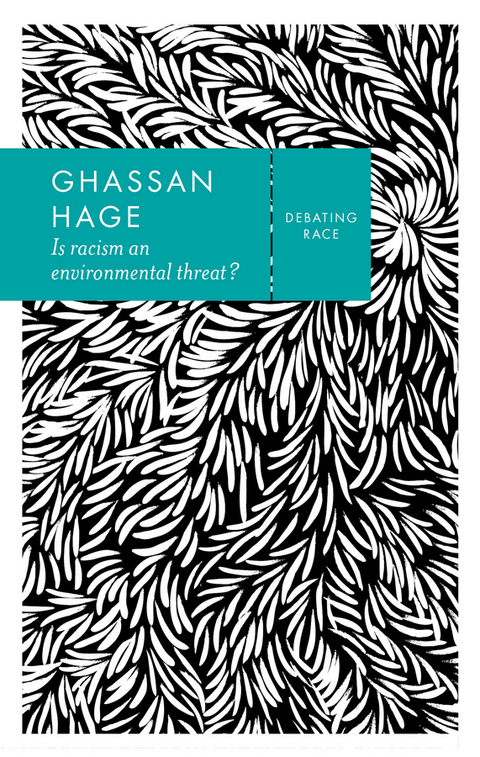
Is Racism an Environmental Threat? (eBook)
John Wiley & Sons (Verlag)
978-0-7456-9230-2 (ISBN)

The ecological crisis is the most overwhelming to have ever faced humanity and its consequences permeate every domain of life. This trenchant book examines its relation to Islamophobia as the dominant form of racism today, showing how both share roots in domination, colonialism, and the logics of capitalism.
Ghassan Hage proposes that both racism and humanity's destructive relationship with the environment emanate from the same mode of inhabiting the world: an occupying force imposes its own interest as law, subordinating others for the extraction of value, eradicating or exterminating what gets in the way.
In connecting these two issues, Hage gives voice to the claim taking shape in many activist spaces that anti-racist and ecological struggles are intrinsically related. In both, the aim is to move beyond what makes us see otherness, whether human or nonhuman, as something that exists solely to be managed.
Ghassan Hage is Future Generation Professor of Anthropology and Social Theory at the University of Melbourne
The ecological crisis is the most overwhelming to have ever faced humanity and its consequences permeate every domain of life. This trenchant book examines its relation to Islamophobia as the dominant form of racism today, showing how both share roots in domination, colonialism, and the logics of capitalism. Ghassan Hage proposes that both racism and humanity s destructive relationship with the environment emanate from the same mode of inhabiting the world: an occupying force imposes its own interest as law, subordinating others for the extraction of value, eradicating or exterminating what gets in the way. In connecting these two issues, Hage gives voice to the claim taking shape in many activist spaces that anti-racist and ecological struggles are intrinsically related. In both, the aim is to move beyond what makes us see otherness, whether human or nonhuman, as something that exists solely to be managed.
Ghassan Hage is Future Generation Professor of Anthropology and Social Theory at the University of Melbourne
Introduction
1 Islamophobia and the becoming-wolf of the Muslim other
2 Islamophobia and the dynamics of ecological and colonial over-exploitaion
3 The elementary structures of generalized domestication
Conclusion: Negotiating the wolf
"In his usual grippingly lucid prose, Ghassan Hage gives us here an insightful critique of the intrinsic connection between racism and speciesism in their most 'ungovernable' contemporary expressions, namely, Islamophobia and the planetary ecological catastrophe. He thereby exposes the politico-metaphysical foundations of Western colonialism alongside with the colonialist - in the broadest and deepest sense - foundations of Western metaphysics, particularly in its capitalist expression with its relentless need of so-called primitive accumulation. By showing, with the help of anthropological classics such as Mauss and Lévy-Bruhl, that our own anthropotechnics of 'generalized domestication' (one of the most innovative concepts of this book) is by no means the only human way of ecologizing - of making ourselves at home in the world - Hage offers us a nuanced, subtle analysis of the metonymic and metaphorical wolves that haunt the obsessive 'mono-realist' project of capitalism, whose glaring failure is now forcing us to pay increased attention to the counter-hegemonic modes of existence (re)emerging through the widening cracks in the ecocidal and racist-colonial nomos of Modernity."
--Eduardo Viveiros de Castro, The National Museum of Brazil
"[This fine book speaks] to the deep healing in people's relations with each other and with the earth that's needed if we are to meaningfully address the damage being done to both our social and natural environments. [Hage] sheds persuasive light on why action on climate change is stalled at the level of talk, by linking it to racism. To him this signals the (largely white male) elites projecting their fear of loss of power onto the racialized 'other' to avoid coming to terms with their need for power through domination, which underlies the environmental crisis in the first place. [...] Anyone interested in helping to break this impasse by better understanding it will find this book invaluable."
--Watershed Sentinel
"Hage has written a rich and profoundly thought-provoking and original monograph on the intertwining of anti-racism and environmentalism."
Politics, Religion & Ideology
Introduction
To argue that a social phenomenon is related to the ecological crisis is not difficult today. It is the single most important crisis that has ever faced humanity. When a crisis is deemed “ecological” or “environmental” it is no longer a crisis in a specific relationship to x or y. It becomes a crisis of the very milieu in which we can have relationships to x or y. This was dramatically illustrated by a garbage crisis in Lebanon in 2015. It began as a breakdown in the garbage disposal system due to its complex entanglement with the logic of economic and political sectarian competition in the country. As people began to dispose of their rubbish anywhere they could, the garbage started fouling the already polluted environment. Soon the street smells, the ugly appearance of sea and mountain vistas, the contaminated rivers, permeated everything, causing inconveniences, discomfort and disease. “Garbage disposal” was no longer an unmanageable relation to garbage; it became constitutive of the entire social atmosphere. It affected the way people worked, their mood, where children played, what could be eaten and where one could eat, how and where one could exercise, and more…It is this all-encompassing quality that defines the “environmental crisis” we are facing globally today.
Because of the all-encompassing nature of the crisis exemplified above, not only is it always possible to demonstrate that any social phenomenon is related to the environmental crisis, it is also analytically and even ethically imperative to do so. The crisis makes of the planet a sinking ship. It becomes futile and even obscurantist to study anything aboard the ship on its own, as if the ship is not sinking. Likewise, it becomes equally imperative to show in what way what one is studying can help stop the sinking process. This book is written with these analytical, political, and ethical imperatives in mind. In doing so, I strive to consolidate a political claim that is already taking shape in many activist spaces, and which animal liberationists and eco-feminists began making many years ago, concerning the relation between speciesism and racism: one cannot be anti-racist without being an ecologist today, and vice versa.
But important as it may be to highlight, as I did above, how the ecological crisis affects racism, the book's central argument moves in the opposite causal direction. It aims to explore the way racism itself exacerbates the ecological crisis. This argument takes up a specific form of racism that is quite prevalent today: the anti-Muslim racism generally referred to as Islamophobia. I choose to concentrate on Islamophobia because it is a variant of what remains the most important form of racism pervading the world: the Western/white racism rooted in slavery and colonialism. To be clear, I know that racism is not a disease that only white people can contract. I have witnessed and written about nonwhite racism in a number of places. Nonetheless, if I am to rank various racisms in terms of global impact I have no problem saying that nonwhite racism is far less important than the racism I am examining here. This is true in terms of its empirical frequency, its impact on people, and in terms of its structural effects on and degree of infiltration of existing national and international institutions.
At least since the turn of the century, anti-Muslim practices and beliefs have come to the fore as one of the dominant forms of racism marking our contemporary era. This period saw a globalization of the “Islamic other” around the world. And like all forms of cultural globalization, it involved contradictory processes of homogenization and differentiation (Hannerz 1996). Thus, while an abstract “Islam” and an undifferentiated plural “Muslims” were becoming homogenized as a global threatening form of otherness, the categories that concretely embodied the Islamic threat differed from one country to another. The Muslim other started out by being “Asian” in Britain (there meaning Indians and Pakistanis), “Turkish” in Germany, “North African” in France, “Lebanese” in Australia, and a more vague “Arab” in the United States. But even at these national levels, the picture was rapidly getting more and more complicated during the first decade of the twenty-first century, with more Palestinians and Afghanis, and African Muslims, Arab and non-Arab, joining in almost everywhere. Today, Syrian and Iraqi nationals have also been added to the “Muslim otherly mix” as a result of the flow of refugees escaping the Syrian and Iraqi wars. What's more, the rise of first Al-Qaedah and then ISIS accelerated a global diffusion of transnational Muslim radicalism among immigrant and Western-born subjects of varied ethnic and national backgrounds, adding an “icing of otherness” on the racialized Muslim cake.
The racist practices that accompanied this globalization have been many and are increasing. Statistical and anecdotal data are abundant and can be obtained from many international and national organizations around the world monitoring the incidence of attacks against Muslims or people thought to be Muslim. There are many cases of Muslim women being shouted at and abused, or having their hijabs ripped off, in the streets or on public transport. These practices, which were already prevalent in the late twentieth century, well before 9/11, have become far more numerous throughout the Western world today. There are also increased reports of Muslim job-seekers being denied jobs the moment their Muslim background is suspected. Likewise Muslim workers are joked about, humiliated, and discriminated against at their workplaces. More publicly, Muslims have to contend with the refusal to respect their taboos in cases well-known internationally, such as the Muhammad cartoons or the attacks on halal meat. They are faced with the continual belittling of the loss of lives among them, whether in war zones such as Syria, Iraq, or Afghanistan, or in Israel, or at sea among those seeking asylum. They are also faced with a Western electioneering culture where Muslim-bashing has become de rigueur and widely seen by politicians as a route to popular success. Every time Muslims turn on a television or read the newspaper they have to come to terms with the prejudice peddled by the media in all its diversity. At the same time, they have to live with a routinization of the spectacle of seeing themselves or their fellow Muslims behind barbed wire, either in jail or in refugee camps, waiting on one or another European border, or in detention centers such as those built by the Australian government in and outside of Australia. These scenes and practices come in addition to the more common and unspectacular everyday petty forms of racialization and marginalization that mark the phenomenon everywhere: interactions laced with avoidance, disapproval, aggression, or hatred. The totality of these images and practices creates an inescapable feeling among many that today “Muslim” is short for “the wretched of the earth.”
Despite all this, there are some analysts who want to differentiate Islamophobia from racism “proper.” They do so in the name of a tighter and more rigorous definition grounded in the history and logic of racism as it emerges in the early phases of modernity. According to such writers it is not useful to talk about race and racism unless we are dealing with a mode of thinking that espouses some form of biological conception of race. For the purposes of this work, such approaches have all the hallmarks of what Pierre Bourdieu critically identifies as a form of scholastic thought (Bourdieu 2000: 49). “Scholastic” here refers to a mode of thinking that detaches racism from its practical/usage context and conceives it as an academic exercise aimed at some kind of pure knowledge, a desire to classify for classification's sake.
This intellectualist tendency has had a limiting effect on both anti-racist analysis and anti-racist politics. Indeed, if we are to compare racism and anti-racism across history, we can say that racism has exhibited a far greater malleability than academic anti-racism. It has morphed, and shown a capacity to target a variety of people, sometimes many at the same time: blacks, Asians, Arabs, Jews, Roma, and Muslims. It has been deployed as part of a technology of segregation, of conditional integration, and, most dramatically, of extermination. It has efficiently constructed its object, successfully adapting to the dominant modes of classification of the time, be they phenotypical, biological, cultural, or a combination of these and more. Comparatively speaking, academic anti-racism has become conceptually somewhat ossified and is always trying to catch up with the racists' fluid mode of classification.
Whereas racists happily move from one form of racism to another, caring little about logical contradictions, inconsistencies, and discrepancies in their arguments, anti-racist academics spend an inordinate amount of time trying to judge racists on precisely such grounds. They criticize racists as if the racists are students or fellow academics with whom they are having disagreements in a tutorial room about how to interpret reality. The lethal performativity of racism, which is what is most important to the racists, is given far less attention than needed. It is as if the racists' greatest sin is that they are bad thinkers: they are “essentialists,” they deviate from...
| Erscheint lt. Verlag | 23.5.2017 |
|---|---|
| Reihe/Serie | Debating Race |
| Debating Race | Debating Race |
| Sprache | englisch |
| Themenwelt | Naturwissenschaften ► Biologie ► Ökologie / Naturschutz |
| Sozialwissenschaften ► Ethnologie ► Völkerkunde (Naturvölker) | |
| Sozialwissenschaften ► Politik / Verwaltung | |
| Sozialwissenschaften ► Soziologie ► Spezielle Soziologien | |
| Schlagworte | Cultural Studies • Environmental change • Environmental Studies • Kulturwissenschaften • Population & Demography • Populationsforschung u. Demographie • Race & Ethnicity Studies • race, political theory, social theory, raciality, ethnicity, racism, multiculturalism, ecology, environmentalism, Islamophobia, eco-activism, global warming, ecological disaster. • Rassen • Rassen- u. Ethnienforschung • Sociology • Soziologie • Umweltforschung • Umweltveränderungen |
| ISBN-10 | 0-7456-9230-3 / 0745692303 |
| ISBN-13 | 978-0-7456-9230-2 / 9780745692302 |
| Informationen gemäß Produktsicherheitsverordnung (GPSR) | |
| Haben Sie eine Frage zum Produkt? |
 EPUB (Adobe DRM)
Kopierschutz: Adobe-DRM
Adobe-DRM ist ein Kopierschutz, der das eBook vor Mißbrauch schützen soll. Dabei wird das eBook bereits beim Download auf Ihre persönliche Adobe-ID autorisiert. Lesen können Sie das eBook dann nur auf den Geräten, welche ebenfalls auf Ihre Adobe-ID registriert sind.
Details zum Adobe-DRM
Dateiformat: EPUB (Electronic Publication)
EPUB ist ein offener Standard für eBooks und eignet sich besonders zur Darstellung von Belletristik und Sachbüchern. Der Fließtext wird dynamisch an die Display- und Schriftgröße angepasst. Auch für mobile Lesegeräte ist EPUB daher gut geeignet.
Systemvoraussetzungen:
PC/Mac: Mit einem PC oder Mac können Sie dieses eBook lesen. Sie benötigen eine
eReader: Dieses eBook kann mit (fast) allen eBook-Readern gelesen werden. Mit dem amazon-Kindle ist es aber nicht kompatibel.
Smartphone/Tablet: Egal ob Apple oder Android, dieses eBook können Sie lesen. Sie benötigen eine
Geräteliste und zusätzliche Hinweise
Buying eBooks from abroad
For tax law reasons we can sell eBooks just within Germany and Switzerland. Regrettably we cannot fulfill eBook-orders from other countries.
aus dem Bereich