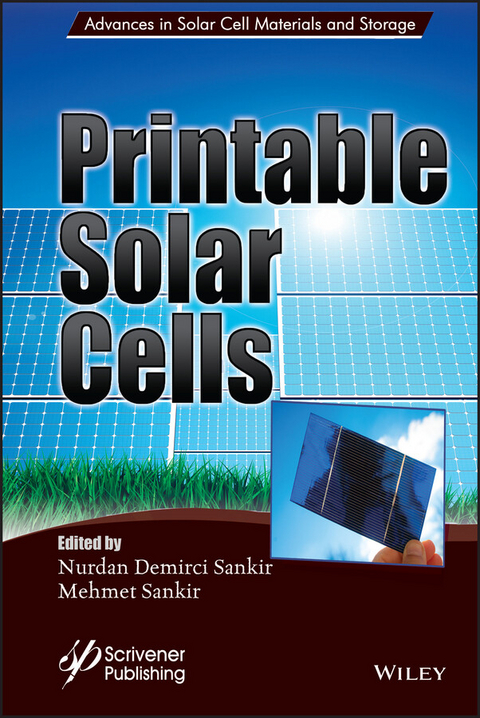
Printable Solar Cells (eBook)
576 Seiten
John Wiley & Sons (Verlag)
978-1-119-28374-4 (ISBN)
The book brings together the recent advances, new and cutting edge materials from solution process and manufacturing techniques that are the key to making photovoltaic devices more efficient and inexpensive.
Printable Solar Cells provides an overall view of the new and highly promising materials and thin film deposition techniques for printable solar cell applications. The book is organized in four parts. Organic and inorganic hybrid materials and solar cell manufacturing techniques are covered in Part I. Part II is devoted to organic materials and processing technologies like spray coating. This part also demonstrates the key features of the interface engineering for the printable organic solar cells. The main focus of Part III is the perovskite solar cells, which is a new and promising family of the photovoltaic applications. Finally, inorganic materials and solution based thin film formation methods using these materials for printable solar cell application is discussed in Part IV.
Audience
The book will be of interest to a multidisciplinary group of fields, in industry and academia, including physics, chemistry, materials science, biochemical engineering, optoelectronic information, photovoltaic and renewable energy engineering, electrical engineering, mechanical and manufacturing engineering.
Nurdan Demirci Sankir is currently an Associate Professor in the Materials Science and Nanotechnology Engineering Department at the TOBB University of Economics and Technology, Ankara, Turkey. She received her M.Eng and PhD degrees in Materials Science and Engineering from the Virginia Polytechnic and State University, USA in 2005. She then joined NanoSonic Inc. in Virginia, USA as R&D engineer and program manager, and in 2007 she enrolled at TOBB ETU where she established the Energy Research and Solar Cell Laboratories. Nurdan has actively carried out research activities in many areas including solar driven water splitting, photocatalytic degradation and nanostructured semiconductors. Mehmet Sankir received his PhD in Macromolecular Science and Engineering from the Virginia Polytechnic and State University, USA in 2005. He is currently an Associate Professor in the Department of Materials Science and Nanotechnology Engineering, TOBB University of Economics and Technology, Ankara, Turkey and group leader of Advanced Membrane Technologies Laboratory. Mehmet has actively carried out research and consulting activities in the areas of membranes for fuel cells, flow batteries, hydrogen generation and desalination.
| Erscheint lt. Verlag | 25.4.2017 |
|---|---|
| Reihe/Serie | Advances in Hydrogen Production and Storage (AHPS) | Advances in Hydrogen Production and Storage (AHPS) |
| Sprache | englisch |
| Themenwelt | Naturwissenschaften ► Chemie |
| Naturwissenschaften ► Physik / Astronomie | |
| Technik ► Elektrotechnik / Energietechnik | |
| Technik ► Maschinenbau | |
| Schlagworte | Batterien u. Brennstoffzellen • Batteries & Fuel Cells • Chemie • Chemistry • Energie • Energy • Materialien f. Energiesysteme • Materials for Energy Systems • Materials Science • Materialwissenschaften • Solarenergie u. Photovoltaik • Solar Energy & Photovoltaics |
| ISBN-10 | 1-119-28374-4 / 1119283744 |
| ISBN-13 | 978-1-119-28374-4 / 9781119283744 |
| Informationen gemäß Produktsicherheitsverordnung (GPSR) | |
| Haben Sie eine Frage zum Produkt? |
 EPUB (Adobe DRM)
Kopierschutz: Adobe-DRM
Adobe-DRM ist ein Kopierschutz, der das eBook vor Mißbrauch schützen soll. Dabei wird das eBook bereits beim Download auf Ihre persönliche Adobe-ID autorisiert. Lesen können Sie das eBook dann nur auf den Geräten, welche ebenfalls auf Ihre Adobe-ID registriert sind.
Details zum Adobe-DRM
Dateiformat: EPUB (Electronic Publication)
EPUB ist ein offener Standard für eBooks und eignet sich besonders zur Darstellung von Belletristik und Sachbüchern. Der Fließtext wird dynamisch an die Display- und Schriftgröße angepasst. Auch für mobile Lesegeräte ist EPUB daher gut geeignet.
Systemvoraussetzungen:
PC/Mac: Mit einem PC oder Mac können Sie dieses eBook lesen. Sie benötigen eine
eReader: Dieses eBook kann mit (fast) allen eBook-Readern gelesen werden. Mit dem amazon-Kindle ist es aber nicht kompatibel.
Smartphone/Tablet: Egal ob Apple oder Android, dieses eBook können Sie lesen. Sie benötigen eine
Geräteliste und zusätzliche Hinweise
Buying eBooks from abroad
For tax law reasons we can sell eBooks just within Germany and Switzerland. Regrettably we cannot fulfill eBook-orders from other countries.
aus dem Bereich