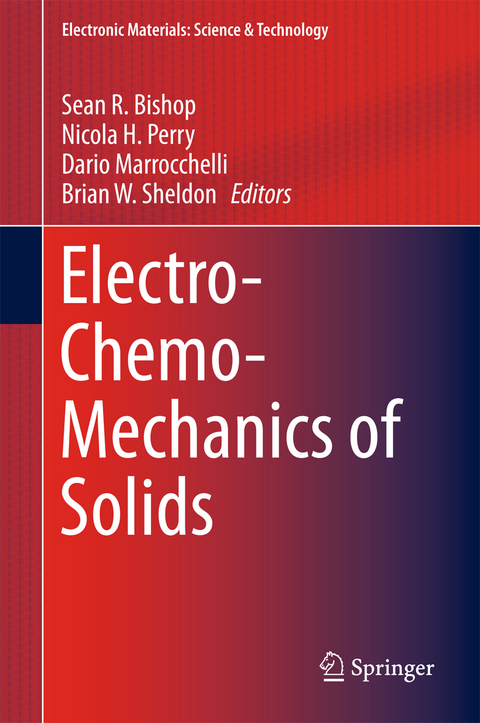
Electro-Chemo-Mechanics of Solids (eBook)
IX, 192 Seiten
Springer International Publishing (Verlag)
978-3-319-51407-9 (ISBN)

Preface 6
Contents 8
1 Introduction 9
References 11
2 Conventional Methods for Measurements of Chemo-Mechanical Coupling 12
2.1 Methods for Measuring Oxygen Content and Analysis of the Defect Structure of Oxide Materials 13
2.1.1 TG Analysis (with Examples) 13
2.1.2 Coulometric Titration in Solid State Electrolyte Cell (with Examples) 15
2.1.3 Determination of the Absolute Value of Oxygen Nonstoichiometry 17
2.1.3.1 Direct Reduction of Oxide Sample by Hydrogen 18
2.1.3.2 Iodometric Determination of the Absolute Oxygen Nonstoichiometry 18
2.1.4 Some Examples of the Study of Oxygen Nonstoichiometry by TG and Coulometric Titration Methods 19
2.2 Analysis of the Oxide Defect Structure Using Data on Oxygen Content 21
2.2.1 Doped Lanthanum Chromites {{/bf La}}_{{ 1{-}x}} {{/bf Me}}_{x} {{/bf Cr}}_{{ 1{-}y{-}z}} {{/bf Al}}_{z} /left( {{{/bf Mg}}} /right)_{y} {{/bf O}}_{ 3- /delta } /left( {{{/bf Me}} = {{/bf Ca}}, /, {{/bf Sr}}} /right) 22
2.2.2 Perovskite Structured Oxides {{/bf La}}_{{ 1- {/varvec y}}} {{/bf Sr}}_{{/varvec y}} {{/bf B}}_{{ 1{-}{/varvec x}}} {{/bf B}}_{{/varvec x}}^{{{/bf /}}} {{/bf O}}_{{{{/bf 3 - }}{/varvec /delta}}} /left( {{{/bf B}}{{/bf = }}{{/bf Mn}}, /, {{/bf Fe}}, /, {{/bf Co}}, /, {{/bf and}} /, {{/bf Ni}} /, {{/bf B}}^{{{/bf /}}} {{/bf = }}{{/bf Other}}/,{{/bf 3d{-}}}{{/bf Metal}}} /right)
2.3 Methods for Measuring Thermal and Chemical Expansion of Oxide Materials 27
2.3.1 Dilatometric Measurements in Air 27
2.3.2 Dilatometric Measurements in Gas Atmosphere with Controlled Oxygen Partial Pressure 29
2.4 Application of the Oxide Defect Structure for the Chemical Expansion Estimation 31
2.4.1 Doped Lanthanum Chromites {{/bf La}}_{{{{/bf 1}}{/rm - }{/varvec x}}} {{/bf Me}}_{{/varvec x}} {{/bf Cr}}_{{{{/bf 1 - }}{/varvec y}{{/bf - }}{/varvec z}}} {{/bf Al}}_{{/varvec z}} {{/bf Mg}}_{{/varvec y}} {{/bf O}}_{{{{/bf 3 - }}{/varvec /delta}}} /left( {{{/bf Me = Ca}},{{/bf Sr}}} /right) 34
2.4.2 Perovskite Structured Oxides {{/bf La}}_{{ 1- {/varvec y}}} {{/bf Sr}}_{{/varvec y}} {{/bf B}}_{{ 1- {/varvec x}}} {{/bf B}}_{{/varvec x}}^{{{/bf /}}} {{/bf O}}_{{{{/bf 3 - }}/delta }} /left( {{{/bf B}}{{/bf = }}{{/bf Mn}}, /, {{/bf Fe}}, /, {{/bf and}} /, {{/bf Co}} /, {{/bf B}}^{{{/bf /}}} {{/bf = }} {{/bf 3d}}{{/bf -}}{{/bf Metal}}} /right)
2.5 Summary 39
References 39
3 In Situ High-Temperature X-ray Diffraction of Thin Films: Chemical Expansion and Kinetics 41
3.1 Introduction 41
3.1.1 Sources of Strain in Thin Films 42
3.2 In Situ XRD of Chemical Expansion in Polycrystalline and Epitaxial Films 45
3.3 Experimental Methods for In Situ High-Temperature XRD 47
3.3.1 Measuring Methodology for Thin Films 49
3.4 Time-Resolved XRD Measurements: Oxygen Surface Exchange Rate Determination 51
3.5 Oxygen Surface Exchange Modified by Voltage Bias 57
3.5.1 Kinetics 58
3.6 In Situ XRD of Chemical Expansion in Multi-layered Heterostructures 60
3.7 XRD Observation of Anisotropic Chemical Expansion in Layered Oxide Compounds 62
3.8 Summary 64
Acknowledgements 64
References 64
4 In-Situ Neutron Diffraction Experiments 67
4.1 General Introduction 67
4.1.1 Powder Diffraction Principles 68
4.1.2 Powder Diffraction from ‘Real’ Materials 69
4.1.3 Data Analysis 70
4.1.4 Neutrons and X-Rays 70
4.1.5 Energy Materials 72
4.2 In-Situ Neutron Powder Diffraction 73
4.2.1 Neutron Sources 73
4.2.2 Neutron Powder Diffractometers 74
4.2.3 In-Situ Studies 75
4.3 In-Situ Studies of Battery Materials 77
4.3.1 LixMn2O4 Cathode Material 79
4.3.2 LixNiO2, LixCoO2 and LiMnO2 Cathode Materials 81
4.3.3 LiFePO4 Cathode Materials 82
4.3.4 Anode Materials for Lithium Batteries 84
4.3.5 Other Battery Types 85
4.4 In-Situ Studies of Fuel Cell Materials 87
4.4.1 Electrolytes for SOFCs 87
4.4.2 Electrodes for SOFCs 90
4.4.3 Proton Conductors 92
4.4.4 In-Situ Conductivity Measurements 93
4.5 Summary and Future Prospects 95
References 97
5 In Situ Wafer Curvature Relaxation Measurements to Determine Surface Exchange Coefficients and Thermo-chemically Induced Stresses 108
5.1 Introduction 110
5.2 Technique Overview 110
5.3 Extracting Film Stress from Bilayer Wafer Curvature 113
5.4 Extracting Oxygen Surface Exchange Coefficients from Bilayer Wafer Curvature Relaxation 116
5.5 Curvature Measurement with a Multi-Beam Optical Sensor 121
5.6 High Temperature, Controlled Atmosphere Curvature Measurements 122
5.7 System Costs 122
5.8 Comparisons to Other Oxygen Surface Exchange Coefficient Measurement Techniques 125
5.9 Limitations and Sample Requirements of the Curvature Relaxation Technique 125
5.10 Conclusions 129
Acknowledgements 129
Appendix 1: Sample Film Stress and Bilayer Curvature MATLAB Code 130
Appendix 2: Relating Normalized Oxygen Concentration and Film Strain Changes 135
References 137
6 Exploring Electro-Chemo-Mechanical Phenomena on the Nanoscale Using Scanning Probe Microscopy 142
6.1 Introduction 142
6.2 A Novel Approach to Probing Reactions on the Nanoscale: Electrochemical Strain Microscopy 144
6.2.1 Dynamic Electrochemical Strain Microscopy of Oxygen Evolution/Reduction Reactions 145
6.2.2 Dynamic ESM: Differentiating Thermodynamics and Kinetics Controlled Processes on the Nanoscale 146
6.2.3 Spatially Resolved Mapping of Electrochemical Activity and Reactivity Mapping Near a Triple Phase Boundary 150
6.2.4 Probing Surface and Bulk Electrochemical Processes on LaAlO3–SrTiO3 Surface 151
6.2.4.1 Time Dependent Electrochemical Strain Spectroscopy of LAO–STO 152
6.2.4.2 Analysis of Electrochemical Processes in LAO–STO System 155
6.2.5 Irreversible Electrochemical Processes in Perovskites 157
6.3 Mechanical Writing in Oxides Systems and Its Origins 159
6.3.1 Ionically Mediated Electromechanical Phenomena in Oxides 159
6.3.2 Piezochemical Phenomena in Oxides 160
6.4 Conclusions and Outlook 162
References 163
7 Continuum Level Transport and Electro-Chemo-Mechanics Coupling—Solid Oxide Fuel Cells and Lithium Ion Batteries 166
7.1 Introduction 166
7.2 Continuum Modelling in Electrochemistry 167
7.2.1 Continuum Hypothesis 167
7.2.2 Poisson–Nernst–Planck (PNP) Equations 168
7.2.3 Kinetics at the Boundary 169
7.2.3.1 Charge Transfer Reactions 169
7.2.3.2 Space Charge Region at the Boundary 171
7.3 Continuum Level Transport for ECM Coupling 174
7.3.1 Addition of Stress-Dependent Component to the Chemical Potential 174
7.3.2 Kinematics and Solid Mechanics of Chemical Induced-Deformation 177
7.3.2.1 Kinematics 177
7.3.2.2 Mechanical Equilibrium 179
7.4 Applications 181
7.4.1 Continuum Modelling for Electrode Materials for LIBs 181
7.4.1.1 Single-Particle Model 181
7.4.1.2 Macrohomogeneous Electrode Models 182
7.4.2 Continuum Modelling for Oxides for SOFC 185
7.5 Conclusion 187
References 188
8 Erratum to: Electro-Chemo-Mechanics of Solids 195
Erratum to:& #6
Index 196
| Erscheint lt. Verlag | 18.3.2017 |
|---|---|
| Reihe/Serie | Electronic Materials: Science & Technology | Electronic Materials: Science & Technology |
| Zusatzinfo | IX, 192 p. 71 illus., 50 illus. in color. |
| Verlagsort | Cham |
| Sprache | englisch |
| Themenwelt | Naturwissenschaften ► Chemie |
| Technik ► Bauwesen | |
| Technik ► Maschinenbau | |
| Schlagworte | Carbon Neutral Energy • dielectrics • Electrochemistry Batteries • Electrochemomechanics • Energy Storage Research • Ionically Conductive Ceramics • Nanoscale YSZ Thin Films • Nonstoichiometric Oxides • Si Nanotubes • Y-doped Ceria |
| ISBN-10 | 3-319-51407-5 / 3319514075 |
| ISBN-13 | 978-3-319-51407-9 / 9783319514079 |
| Informationen gemäß Produktsicherheitsverordnung (GPSR) | |
| Haben Sie eine Frage zum Produkt? |
 PDF (Wasserzeichen)
DRM: Digitales Wasserzeichen
Dieses eBook enthält ein digitales Wasserzeichen und ist damit für Sie personalisiert. Bei einer missbräuchlichen Weitergabe des eBooks an Dritte ist eine Rückverfolgung an die Quelle möglich.
Dateiformat: PDF (Portable Document Format)
Mit einem festen Seitenlayout eignet sich die PDF besonders für Fachbücher mit Spalten, Tabellen und Abbildungen. Eine PDF kann auf fast allen Geräten angezeigt werden, ist aber für kleine Displays (Smartphone, eReader) nur eingeschränkt geeignet.
Systemvoraussetzungen:
PC/Mac: Mit einem PC oder Mac können Sie dieses eBook lesen. Sie benötigen dafür einen PDF-Viewer - z.B. den Adobe Reader oder Adobe Digital Editions.
eReader: Dieses eBook kann mit (fast) allen eBook-Readern gelesen werden. Mit dem amazon-Kindle ist es aber nicht kompatibel.
Smartphone/Tablet: Egal ob Apple oder Android, dieses eBook können Sie lesen. Sie benötigen dafür einen PDF-Viewer - z.B. die kostenlose Adobe Digital Editions-App.
Buying eBooks from abroad
For tax law reasons we can sell eBooks just within Germany and Switzerland. Regrettably we cannot fulfill eBook-orders from other countries.
aus dem Bereich