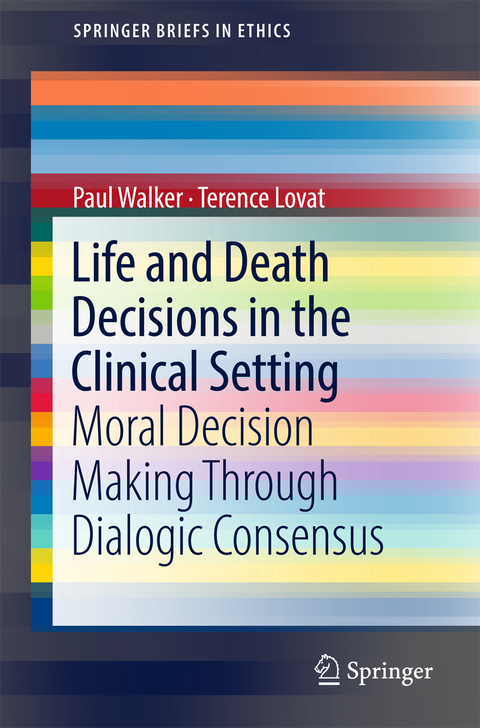
Life and Death Decisions in the Clinical Setting (eBook)
X, 68 Seiten
Springer Singapore (Verlag)
978-981-10-4301-7 (ISBN)
Paul Walker is Conjoint Associate Professor in Surgery and the Clinical Unit in Ethics and Health Law, Faculty of Health and Medicine, the University of Newcastle, Australia, and a practicing paediatric otolaryngologist. Paul's research examines moral decision-making in medicine, including its implications for medical education. He is a Fellow of the Royal Australasian College of Surgeons and of the American College of Surgeons, a member of the Royal Australasian College of Surgeons Ethics Committee, the Australian and New Zealand Society of Paediatric Otolaryngology (President-elect), the American Society of Pediatric Otolaryngology, the Australian Association of Bioethics and Health Law and the Australian Association of Philosophy.
Terence Lovat is Emeritus Professor and Postgraduate Theology Convenor in the School of Humanities and Social Science, the University of Newcastle, Australia, and Honorary Research Fellow at Oxford University, UK. Terry is a former Pro Vice
-Chancellor, Dean and Chair of the University's Human Research Ethics Committee. He has served on the Board of the Australian Council of Deans of Education, including as President, as an Executive member of the Deans of Arts Social Sciences and Humanities, on the Executive of the NSW Teacher Education Council, including as President, on the inaugural Board of the Carrick Institute for Learning and Teaching in Higher Education (later ALTC) and the National Inquiry into the Teaching of Literacy. Terry teaches and researches in the discipline areas of philosophy, religion and theology, ethics and education, and has a particular interest in matters of Islamic versus Judaeo-Christian theology, religion, ethics and values in their application to education, moral philosophy and bioethics. His earlier work (with Mitchell and Kerridge), Bioethics and Clinical Ethics for Health Care Professionals (1996), became a standard text in many medical and healthcare training programs.This book moves away from the frameworks that have traditionally guided ethical decision-making in the Western clinical setting, towards an inclusive, non-coercive and, reflective dialogic approach to moral decision-making. Inspired in part by Jurgen Habermas's discourse theory of morality and principles of communicative action, the book offers a proportionist approach as a way of balancing out the wisdom in traditional frameworks, set in the actual reality of the clinical situation at hand. Putting this approach into practice requires having a conversation, a dialogue or a discourse, with collaboration amongst all the stakeholders. The aim of the dialogue is to reach consensus in the decision, via mutual understanding of the values held by the patient and others whom they see as significant. This book aims to underscore the moral philosophical foundations for having a meaningful conversation. Life and Death Decision in the Clinical Setting is especially relevant in our contemporary era, characterised medically by an ever-increasing armamentarium of life-sustaining technology, but also by increasing multiculturalism, a multiplicity of faiths, and increasing value pluralism.
Paul Walker is Conjoint Associate Professor in Surgery and the Clinical Unit in Ethics and Health Law, Faculty of Health and Medicine, the University of Newcastle, Australia, and a practicing paediatric otolaryngologist. Paul’s research examines moral decision-making in medicine, including its implications for medical education. He is a Fellow of the Royal Australasian College of Surgeons and of the American College of Surgeons, a member of the Royal Australasian College of Surgeons Ethics Committee, the Australian and New Zealand Society of Paediatric Otolaryngology (President-elect), the American Society of Pediatric Otolaryngology, the Australian Association of Bioethics and Health Law and the Australian Association of Philosophy.Terence Lovat is Emeritus Professor and Postgraduate Theology Convenor in the School of Humanities and Social Science, the University of Newcastle, Australia, and Honorary Research Fellow at Oxford University, UK. Terry is a former Pro Vice-Chancellor, Dean and Chair of the University’s Human Research Ethics Committee. He has served on the Board of the Australian Council of Deans of Education, including as President, as an Executive member of the Deans of Arts Social Sciences and Humanities, on the Executive of the NSW Teacher Education Council, including as President, on the inaugural Board of the Carrick Institute for Learning and Teaching in Higher Education (later ALTC) and the National Inquiry into the Teaching of Literacy. Terry teaches and researches in the discipline areas of philosophy, religion and theology, ethics and education, and has a particular interest in matters of Islamic versus Judaeo-Christian theology, religion, ethics and values in their application to education, moral philosophy and bioethics. His earlier work (with Mitchell and Kerridge), Bioethics and Clinical Ethics for Health Care Professionals (1996), became a standard text in many medical and healthcare training programs.
Chapter 1: Introduction: The current dilemma and the need for moral philosophy.- Chapter 2: Traditional approaches to ethical decision-making.- Chapter 3: Balancing old and new approaches: Principlism versus Proportionism.- Chapter 4: The foundations and benefits of discourse consensus.- Chapter 5: Challenges facing discourse consensus.- Chapter 6: Conclusion: Looking to the future of moral decision-making in clinical settings.
| Erscheint lt. Verlag | 20.3.2017 |
|---|---|
| Reihe/Serie | SpringerBriefs in Ethics | SpringerBriefs in Ethics |
| Zusatzinfo | X, 68 p. |
| Verlagsort | Singapore |
| Sprache | englisch |
| Themenwelt | Geisteswissenschaften ► Philosophie ► Allgemeines / Lexika |
| Geisteswissenschaften ► Philosophie ► Ethik | |
| Medizin / Pharmazie ► Allgemeines / Lexika | |
| Medizin / Pharmazie ► Studium ► 1. Studienabschnitt (Vorklinik) | |
| Naturwissenschaften ► Biologie | |
| Sozialwissenschaften ► Pädagogik | |
| Schlagworte | Consensus in clinical decision-making • Deontology and life and death • Dialogic consensus in clinical decision-making • Discourse ethics in clinical settings • Discourse morality in clinical settings • Ethical decisions in the clinical context • Ethical frameworks in medicine • Ethics of life and death • Impact of medical technology on medical ethics • Impact of multiculturalism on medicine • Jürgen Habermas • Life-prolonging technologies and moral decision making • Medical morality • Moral aspects of clinical practice • Proportionalism in medicine • Proportionalism vs Principalism • Teleology and life and death • Value pluralism in clinical settings • Virtue ethics in medicine |
| ISBN-10 | 981-10-4301-9 / 9811043019 |
| ISBN-13 | 978-981-10-4301-7 / 9789811043017 |
| Informationen gemäß Produktsicherheitsverordnung (GPSR) | |
| Haben Sie eine Frage zum Produkt? |
 PDF (Wasserzeichen)
DRM: Digitales Wasserzeichen
Dieses eBook enthält ein digitales Wasserzeichen und ist damit für Sie personalisiert. Bei einer missbräuchlichen Weitergabe des eBooks an Dritte ist eine Rückverfolgung an die Quelle möglich.
Dateiformat: PDF (Portable Document Format)
Mit einem festen Seitenlayout eignet sich die PDF besonders für Fachbücher mit Spalten, Tabellen und Abbildungen. Eine PDF kann auf fast allen Geräten angezeigt werden, ist aber für kleine Displays (Smartphone, eReader) nur eingeschränkt geeignet.
Systemvoraussetzungen:
PC/Mac: Mit einem PC oder Mac können Sie dieses eBook lesen. Sie benötigen dafür einen PDF-Viewer - z.B. den Adobe Reader oder Adobe Digital Editions.
eReader: Dieses eBook kann mit (fast) allen eBook-Readern gelesen werden. Mit dem amazon-Kindle ist es aber nicht kompatibel.
Smartphone/Tablet: Egal ob Apple oder Android, dieses eBook können Sie lesen. Sie benötigen dafür einen PDF-Viewer - z.B. die kostenlose Adobe Digital Editions-App.
Buying eBooks from abroad
For tax law reasons we can sell eBooks just within Germany and Switzerland. Regrettably we cannot fulfill eBook-orders from other countries.
aus dem Bereich