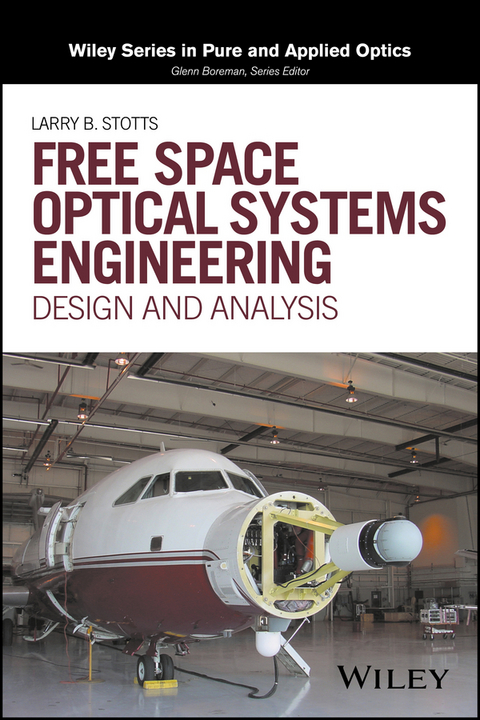
Free Space Optical Systems Engineering (eBook)
528 Seiten
Wiley (Verlag)
978-1-119-27904-4 (ISBN)
Gets you quickly up to speed with the theoretical and practical aspects of free space optical systems engineering design and analysis
One of today's fastest growing system design and analysis disciplines is free space optical systems engineering for communications and remote sensing applications. It is concerned with creating a light signal with certain characteristics, how this signal is affected and changed by the medium it traverses, how these effects can be mitigated both pre- and post-detection, and if after detection, it can be differentiated from noise under a certain standard, e.g., receiver operating characteristic. Free space optical systems engineering is a complex process to design against and analyze. While there are several good introductory texts devoted to key aspects of optics-such as lens design, lasers, detectors, fiber and free space, optical communications, and remote sensing-until now, there were none offering comprehensive coverage of the basics needed for optical systems engineering. If you're an upper-division undergraduate, or first-year graduate student, looking to acquire a practical understanding of electro-optical engineering basics, this book is intended for you. Topics and tools are covered that will prepare you for graduate research and engineering in either an academic or commercial environment. If you are an engineer or scientist considering making the move into the opportunity rich field of optics, this all-in-one guide brings you up to speed with everything you need to know to hit the ground running, leveraging your experience and expertise acquired previously in alternate fields. Following an overview of the mathematical fundamentals, this book provides a concise, yet thorough coverage of, among other crucial topics:
- Maxwell Equations, Geometrical Optics, Fourier Optics, Partial Coherence theory
- Linear algebra, Basic probability theory, Statistics, Detection and Estimation theory, Replacement Model detection theory, LADAR/LIDAR detection theory, optical communications theory
- Critical aspects of atmospheric propagation in real environments, including commonly used models for characterizing beam, and spherical and plane wave propagation through free space, turbulent and particulate channels
- Lasers, blackbodies/graybodies sources and photodetectors (e.g., PIN, ADP, PMT) and their inherent internal noise sources
The book provides clear, detailed discussions of the basics for free space optical systems design and analysis, along with a wealth of worked examples and practice problems-found throughout the book and on a companion website. Their intent is to help you test and hone your skill set and assess your comprehension of this important area. Free Space Optical Systems Engineering is an indispensable introduction for students and professionals alike.
Larry B. Stotts, Ph.D., is a Resident Consultant at Science and Technology Associates in Arlington, Virginia. He received his B.A. in Applied Physics and Information Sciences and his Ph.D. in Electrical Engineering (Communications Systems), both from the University of California, San Diego. He has more than 40 years' experience in optical communications and remote sensing, optical systems engineering, avionics and optical navigation systems. Dr. Stotts is a Fellow of IEEE and SPIE, and a Senior Member of the Optical Society of America.
Gets you quickly up to speed with the theoretical and practical aspects of free space optical systems engineering design and analysis One of today's fastest growing system design and analysis disciplines is free space optical systems engineering for communications and remote sensing applications. It is concerned with creating a light signal with certain characteristics, how this signal is affected and changed by the medium it traverses, how these effects can be mitigated both pre- and post-detection, and if after detection, it can be differentiated from noise under a certain standard, e.g., receiver operating characteristic. Free space optical systems engineering is a complex process to design against and analyze. While there are several good introductory texts devoted to key aspects of optics such as lens design, lasers, detectors, fiber and free space, optical communications, and remote sensing until now, there were none offering comprehensive coverage of the basics needed for optical systems engineering. If you're an upper-division undergraduate, or first-year graduate student, looking to acquire a practical understanding of electro-optical engineering basics, this book is intended for you. Topics and tools are covered that will prepare you for graduate research and engineering in either an academic or commercial environment. If you are an engineer or scientist considering making the move into the opportunity rich field of optics, this all-in-one guide brings you up to speed with everything you need to know to hit the ground running, leveraging your experience and expertise acquired previously in alternate fields. Following an overview of the mathematical fundamentals, this book provides a concise, yet thorough coverage of, among other crucial topics: Maxwell Equations, Geometrical Optics, Fourier Optics, Partial Coherence theory Linear algebra, Basic probability theory, Statistics, Detection and Estimation theory, Replacement Model detection theory, LADAR/LIDAR detection theory, optical communications theory Critical aspects of atmospheric propagation in real environments, including commonly used models for characterizing beam, and spherical and plane wave propagation through free space, turbulent and particulate channels Lasers, blackbodies/graybodies sources and photodetectors (e.g., PIN, ADP, PMT) and their inherent internal noise sources The book provides clear, detailed discussions of the basics for free space optical systems design and analysis, along with a wealth of worked examples and practice problems found throughout the book and on a companion website. Their intent is to help you test and hone your skill set and assess your comprehension of this important area. Free Space Optical Systems Engineering is an indispensable introduction for students and professionals alike.
Larry B. Stotts, Ph.D., is a Resident Consultant at Science and Technology Associates in Arlington, Virginia. He received his B.A. in Applied Physics and Information Sciences and his Ph.D. in Electrical Engineering (Communications Systems), both from the University of California, San Diego. He has more than 40 years' experience in optical communications and remote sensing, optical systems engineering, avionics and optical navigation systems. Dr. Stotts is a Fellow of IEEE and SPIE, and a Senior Member of the Optical Society of America.
Preface
Just before graduating from the college, I took a job at a Navy Laboratory because there were not any research grants to help pay for my future graduate school work. As it turned out, it was a very rewarding experience, allowing me to work on many fascinating projects during my time there. They ranged from fiber optic communications, integrated optics in II–VI compounds, optical signal processing, data storage in electro-optical crystals, laser communications, and atmospheric and space remote sensing. Although I had a very good education in undergraduate applied physics from UCSD, many of these projects involved new optical technologies, as well as engineering concepts, that I had not been exposed to previously. My first two years in graduate school concentrated on graduate physics, which also did not cover these areas. Consequently, I had to spend a large amount of time in the library reading books and papers in order to come up to speed in these areas. I often wished that UCSD offered undergraduate and graduate classes in optical system engineering with an accompanying textbook(s) covering the breadth of the engineering basics necessary to tackle these various engineering areas. As it turned out, the mathematical foundations of each area were common, but many times the definitions and concept descriptions of one area masked its commonality with other topics in optics. In addition, the details were often absent and/or hard to find. In the absence of classes, it would have been nice to have an introductory reference to use to review the basic foundation concepts in optics and to find some of the original key references with the derivations of important equations at the time. This would have made it easier to move among a plethora of ever changing engineering projects.
Since then, several comprehensive books on optics have been written, for example, Fundamentals of Photonics by Saleh and Teich, the SPIE Encyclopedia of Optics, Electro-Optics Handbook by Waynant and Ediger. Although excellent in their content, these are written for a conversant researcher who has done graduate work, and/or been working, in optics for several years in order to fill in the blanks or to understand the nuances contained within the text. Unfortunately, this leaves junior, senior, and first/second year graduate students behind the power curve, requiring additional time, work, and consultation with their advisor or seasoned colleague, to understand what is written. Even with the Internet, this can be a formidable task. Thus, it appears that they are in the same situation as I was at the beginning of my career. In looking across the literature, there also are introductory textbooks focused on certain aspects of optics such as lens design, lasers, detectors, optical communications, and remote sensing, but none of which seem to encompass the breadth of free space optical systems engineering at a more basic level.
This textbook is an attempt to fulfill this need. It is intended to be the reference book for the engineer changing fields, and at the same time, to be an introduction to the field of electro-optics for upper division undergraduates and/or graduate students. Many of the original papers for the field are referenced, and an (comprehensive) introduction and overview of the topic has been attempted. Presentation and integration of physical (quantum mechanical), mathematical, and technological concepts, where possible, hopefully assists in the students' understanding.
It has been suggested that this material is too advanced for upper division undergraduate students. I think not for two reasons. First, today's students have been exposed to advanced subjects since middle/junior high school, for example, calculus and differential equations. They are used to being challenged. Second, and more importantly, the book provides the details of complex calculations in the many examples and discussions, so the students can become comfortable with complex mathematical manipulations. I never thought the concepts and calculations described by professors as “obvious to the most casual observer” were, and my fellow students and I struggled because of our lack of confidence, experience, and familiarity in figuring complex things out. Professors Booker and Lohmann independently taught me that if I understood the mathematical details, it would be easier to understand experimental results and to invent and explain complex concepts. This has helped me greatly over my career. However, getting this understanding sooner over a broader range of subjects in optics would have benefited me a lot and I hope to achieve that for readers of this book. I also believe students will be better prepared for graduate school and jobs by seeing complex subjects with this foundation. This book breaks down as follows:
- Chapter 1 provides the background mathematics for the rest of the book. Specific topics include linear algebra, Fourier series, Fourier transforms, Dirac Delta function, and probability theory.
- In Chapter 2, we discuss Fourier Optics, which includes sections on (1) Maxwell Equations, (2) Rayleigh–Sommerfeld–Debye Theory of Diffraction, (3) The Huygens–Fresnel–Kirchhoff Theory of Diffraction, (4) Fresnel Diffraction, and (5) Fraunhofer Diffraction. The Huygens–Fresnel–Kirchhoff formalism is the workhorse of laser propagation analysis, as the reader will soon find out. Examples and comments are also provided, so the reader gets insights on the application of Fourier Optics in typical engineering problems.
- Geometrical Optics uses the concept of rays, which have direction and position but no phase information, to model the way light travels through space or an optical system. This is the subject of Chapter 3. In this chapter, we focus on imaging systems, which cover a broad class of engineering applications. We begin by summarizing the first-order lens design approaches. Key concept and definitions are explained, so the student can understand the key aspects of lens design. We also discuss the basic elements in an optical system such as windows, stops, baffles, and pupils that are sometimes confusing to the new optical engineer.
- In Chapter 4, we outline the field of Radiometry, which is the characterization of the distribution of the optical power or energy in space. It is distinct from the quantum processes such as photon counting because this theory uses “ray tracing” as its means for depicting optical radiation transfer from one point to another. It ignores the dual nature of light.
- Chapter 5 deals with the convolutional theory of image formation. Specifically, the reader will find that convolution process can characterize the effects of an imperfect optical system or those of an optical channel such as the optical scatter channel or turbulent channel on an input distribution. Most of the engineering analyses one finds in the literature exploit this mathematical theory.
- Chapter 6 focuses on partial coherence theory. It covers the situation where the resulting light interference is barely visible, exhibiting only low contrast effects. Partial coherence theory is considered the most difficult subject in optics. Much is written on this subject; sometimes successfully, sometimes not. This chapter looks at this theory from the most basic level, clarifying the definitions and concepts with examples, so the reader will better understand the theory, compared to others, after completing this chapter.
- In Chapter 7, we address the characterization of optical channel effects. We begin a discussion of radiative transfer through particulate media, then move to the development of the mutual coherence function (MCF) for aerosols and molecules, and then turbulence. Finally, we provide a set of engineering equations useful in understanding and characterizing light propagation in those same channels.
- In Chapter 8, we provide a first-order overview of the various optical detector mechanisms and devices. We next look at the possible noise sources in an optical receiver that influence the quality of signal reception. When these detector and noise mechanisms are combined with the received signal, we obtain the arguably key parameter in detection theory, the electrical signal-to-noise ratio (SNR). The construction of this particular metric connects it with RF engineering, so the synergism between the two areas can be easily exploited. Finally, we discuss the various forms of SNR and include some detection sensor/receiver examples to illustrate their variation.
- Chapter 9 reviews the classical statistical detection theory and then shows its applicability to optical communications and remote sensing. This is not found in many introductory optics books and discusses two of the key detection concepts: the probabilities of detection and false alarm. Both the signal-plus-additive-noise and replacement model hypothesis testing approaches are discussed. Examples of the theory's application to communications and remote sensing system are given.
- In the early chapters, we emphasized blackbody sources, which are based on the concept of the spontaneous emission of light from materials such as gases and solids. An alternative source concept was proposed in 1917 by Albert Einstein. It is called the simulated emission of light. Although it was almost 60 years before it became a reality, the laser, which is an acronym for Light Amplification by Stimulated Emission of Radiation, has revolutionized optical system design. The final chapter of this textbook, Chapter 10, provides an overview of the fundamentals of laser theory, the key...
| Erscheint lt. Verlag | 29.3.2017 |
|---|---|
| Reihe/Serie | Wiley Series in Pure and Applied Optics |
| Wiley Series in Pure and Applied Optics | Wiley Series in Pure and Applied Optics |
| Sprache | englisch |
| Themenwelt | Naturwissenschaften ► Physik / Astronomie ► Mechanik |
| Technik ► Elektrotechnik / Energietechnik | |
| Technik ► Nachrichtentechnik | |
| Schlagworte | Electrical & Electronics Engineering • electro-optical systems • electro-optical systems analysis • electro-optical systems design • electro-optical systems engineering • Elektrotechnik u. Elektronik • Fernerkundung • foundations of free space optical systems design • foundations of free space optical systems engineering • foundations of optical systems • free space optical engineering fundamentals • free space optical engineering mathematics • free space optical systems • free space optical systems analysis • free space optical systems design • free space optical systems design and analysis • free space optical systems engineering • free space optical systems engineering basics • free space optical systems engineering introduction • free space optical systems mathematics • introduction to free space optical engineering system design • Optical Communications • Optical Systems • optical systems engineering • optical systems mathematics • Optische Nachrichtentechnik • Photonics & Lasers • Photonik u. Laser • Remote Sensing |
| ISBN-10 | 1-119-27904-6 / 1119279046 |
| ISBN-13 | 978-1-119-27904-4 / 9781119279044 |
| Informationen gemäß Produktsicherheitsverordnung (GPSR) | |
| Haben Sie eine Frage zum Produkt? |
 EPUB (Adobe DRM)
Kopierschutz: Adobe-DRM
Adobe-DRM ist ein Kopierschutz, der das eBook vor Mißbrauch schützen soll. Dabei wird das eBook bereits beim Download auf Ihre persönliche Adobe-ID autorisiert. Lesen können Sie das eBook dann nur auf den Geräten, welche ebenfalls auf Ihre Adobe-ID registriert sind.
Details zum Adobe-DRM
Dateiformat: EPUB (Electronic Publication)
EPUB ist ein offener Standard für eBooks und eignet sich besonders zur Darstellung von Belletristik und Sachbüchern. Der Fließtext wird dynamisch an die Display- und Schriftgröße angepasst. Auch für mobile Lesegeräte ist EPUB daher gut geeignet.
Systemvoraussetzungen:
PC/Mac: Mit einem PC oder Mac können Sie dieses eBook lesen. Sie benötigen eine
eReader: Dieses eBook kann mit (fast) allen eBook-Readern gelesen werden. Mit dem amazon-Kindle ist es aber nicht kompatibel.
Smartphone/Tablet: Egal ob Apple oder Android, dieses eBook können Sie lesen. Sie benötigen eine
Geräteliste und zusätzliche Hinweise
Buying eBooks from abroad
For tax law reasons we can sell eBooks just within Germany and Switzerland. Regrettably we cannot fulfill eBook-orders from other countries.
aus dem Bereich