


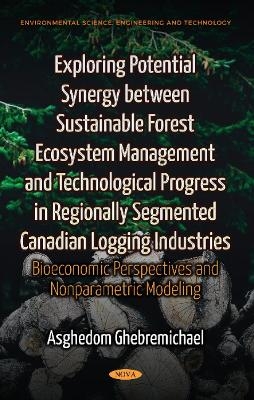
Exploring Potential Synergy between Sustainable Forest Ecosystem Management & Technological Progress in Regionally Segmented Canadian Logging Industries
Bioeconomic Perspectives & Nonparametric Modeling
Seiten
2017
Nova Science Publishers Inc (Verlag)
978-1-5361-1850-6 (ISBN)
Nova Science Publishers Inc (Verlag)
978-1-5361-1850-6 (ISBN)
Explaining the natural limits on the carrying capacity of forest ecosystems to natural and human-induced disturbances underpinned the goal of this study. Hypothesised mutually reinforcing beneficial effects of sustainable forest ecosystem management (SFEM) practices and total factor productivity growth (TFPG) in regionally segmented Canadian logging industries were examined. Two complementary methodologies were applied: (1) A normative bioeconomic analysis of SFEM, and (2) an analysis of TFPG, which is a commonly accepted indicator of technological progress. Sluggish, but upward trends in TFPG appeared to support the hypothesised outcomes that logging operations were technically efficient, that firms in each regional industry had comparative cost advantages in the marketplace, and that the unavoidable adverse effects of logging operations on integrity of forest ecosystems were tolerable, given the economic fact that logging sustains the forest sectors significant role in the overall performance of the national economy. However, low TFPG implied a need for strategic policy that would boost investments in research and development to promote technological progress, so as to ensure environmental quality, sustainable timber supply, and competitiveness in the Canadian forest sector. Society derives multiple benefits from TFPG that include: (i) A synergetic combination of factor accumulation and TFPG, which is one of the engines of economic growth; (ii) a minimisation of the natural capital stock, timber, and depletion; (iii) the mitigation of the wasteful use of scarce-productive resources; (iv) the mitigation of adverse impacts of inflation on economic growth; (v) the maximisation of profits due to economic savings made in production processes; (vi) the reallocation of freed productive resources to the production of other goods and services, leading to technical and economic efficiency; and (vii) the improvements in the competitive position of the Canadian forest sector. Accordingly, this book concluded with a list of policy recommendations.
Introduction; A Taxonomy of Ecological Foundations; Profiling the Canadian Forest Sector; Bioeconomics of Commercial Logging; Carrying Capacity Limits of Ecosystems; Economics of Silvicultural Investments; Sustainable Forest Ecosystem Management; Forest Sector Transformation; Theoretical Framework; Modeling And Estimating Techniques; The Data; Diagnosing The Raw Data; Empirical Results; References; Index.
| Erscheinungsdatum | 02.06.2017 |
|---|---|
| Verlagsort | New York |
| Sprache | englisch |
| Maße | 155 x 230 mm |
| Gewicht | 426 g |
| Themenwelt | Naturwissenschaften ► Biologie ► Ökologie / Naturschutz |
| Weitere Fachgebiete ► Land- / Forstwirtschaft / Fischerei | |
| ISBN-10 | 1-5361-1850-8 / 1536118508 |
| ISBN-13 | 978-1-5361-1850-6 / 9781536118506 |
| Zustand | Neuware |
| Informationen gemäß Produktsicherheitsverordnung (GPSR) | |
| Haben Sie eine Frage zum Produkt? |
Mehr entdecken
aus dem Bereich


aus dem Bereich
Methoden – Lösungen – Anwendungen
Buch | Hardcover (2025)
Hanser (Verlag)
CHF 69,95


