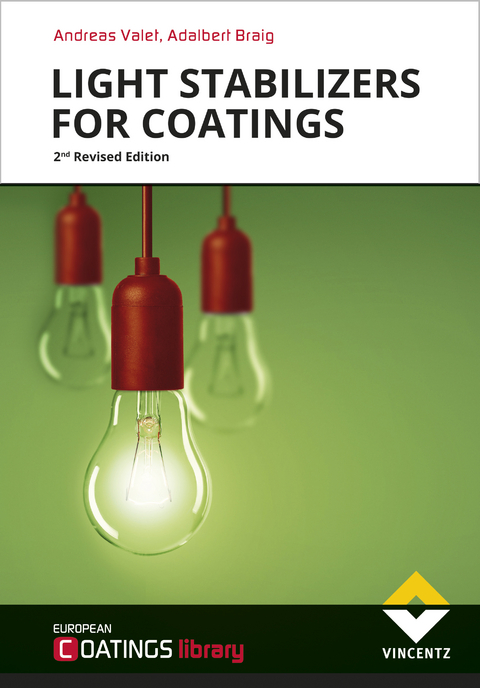
Light Stabilizers for Coatings
Vincentz Network (Verlag)
978-3-86630-128-3 (ISBN)
1Introduction 11
2Light and photo-oxidative degradation 13
2.1Light 13
2.1.1Photo-physical processes 15
2.2Photo-chemical degradation processes 16
3Stabilization options 21
3.1UV absorbent pigments 22
3.2UV absorbers 23
3.2.1UV absorber classes 24
3.2.2Mode of action of UV absorbers 27
3.2.2.1Phenolic UV absorbers 28
3.2.2.2Non-phenolic UV absorbers 30
3.2.3Examples of UV absorbers 30
3.3Free-radical scavengers 36
3.3.1Antioxidants 36
3.3.2Sterically hindered amines 38
3.3.2.1Mode of action of HALS 42
3.4Quenchers 45
3.5Peroxide decomposing agents 46
4Stabilization of coatings 49
4.1Automotive coatings 51
4.2Light stabilization of automotive coatings 52
4.2.1Two-coat systems 53
4.2.2Specific requirements of UV absorbers in coatings 55
4.2.2.1Solubility and compatibility of UV absorbers 56
4.2.2.2Volatility of UV absorbers 59
4.2.2.3Reactable UV absorbers 61
4.2.2.4Effect of UV absorbers on coating colour 63
4.2.2.5Unwelcome side reactions 64
4.2.2.6UV absorbers and photoinitiators 67
4.2.3Specific requirements on HALS in coatings 71
4.2.3.1Solubility and compatibility of HALS 71
4.2.3.2Volatility of HALS 74
4.2.3.3Reactable HALS 75
4.2.3.4Effect of HALS on coating colour 76
4.2.3.5Unwelcome side reactions 77
4.2.4Weathering results for two-coat systems 79
4.2.4.1Weathering tests 79
4.2.4.2Results for solvent-borne clear coats 86
4.2.4.3Results for water-borne clear coats 97
4.2.4.4Results for powder clear coats 100
4.2.4.5Results for UV-curable clear coats 103
4.2.4.6Coatings on plastic substrates 106
4.2.4.7UV protection of epoxy-based fibre reinforced plastics 111
4.2.4.8Effect of additional basecoat stabilization 114
4.2.4.9Exposure results for one-coat finishes 117
4.3Light stabilization of industrial coatings 121
4.3.1Stabilization of paints for metal substrates 122
4.3.2Stabilization of clear wood coatings 125
4.4Stability of light stabilizers 128
4.4.1Photo-chemical stability of UV absorbers 128
4.4.2Long-term stability of HALS 137
5Conclusions 141
6References 143
Authors 151
Index 153
Almost twenty years after the first edition of this book, the editor was asked by colleagues in the coating industry whether it would be possible to publish an up-dated second edition. When the editor asked us whether we would be interested in working on such a second edition, we agreed with great pleasure. Although some time has passed since the first edition, the problems facing the industry are still the same: paint flaking off an object remains a serious concern. The object has lost its protection and is exposed to the elements. It has lost the colour that made it attractive. It has become insignificant and unnoticed. The purpose of this book is to explain the underlying principles of paint degradation, demonstrate, with the help of numerous examples, how paint films can be protected and serve as a practical guide for formulators when selecting light stabilizers for their paint formulation. For a more precise analysis of the mechanism of paint degradation and its prevention, the reader is referred to the extensive bibliography at the end of the book, which covers the subject comprehensively. Hermann Hesse wrote “Blue, yellow, white, red and green – what wonderful colours” [1]. When properly stabilized, colourful finishes ARE wonderful. We would like to take this opportunity to thank our colleagues from the former Ciba Specialty Inc. and BASF Switzerland AG. Without their collaboration and support it would have never been possible to carry out the research, over a period of more than two decades, on which this book is based. We would also to thank Dr. Godwin Berner and Hans-Jürgen Berger who pioneered, built-up and led this successful business for so many years. Special thanks goes to Allan Cunningham for his great support editing our English text. Basle, Switzerland June 2016 Andreas Valet and Adalbert Braig
Almost twenty years after the first edition of this book, the editor was asked by colleagues in the coating industry whether it would be possible to publish an up-dated second edition. When the editor asked us whether we would be interested in working on such a second edition, we agreed with great pleasure. Although some time has passed since the first edition, the problems facing the industry are still the same: paint flaking off an object remains a serious concern. The object has lost its protection and is exposed to the elements. It has lost the colour that made it attractive. It has become insignificant and unnoticed.The purpose of this book is to explain the underlying principles of paint degradation, demonstrate, with the help of numerous examples, how paint films can be protected and serve as a practical guide for formulators when selecting light stabilizers for their paint formulation.For a more precise analysis of the mechanism of paint degradation and its prevention, the reader is referred to the extensive bibliography at the end of the book, which covers the subject comprehensively.Hermann Hesse wrote "Blue, yellow, white, red and green - what wonderful colours" [1]. When properly stabilized, colourful finishes ARE wonderful.We would like to take this opportunity to thank our colleagues from the former Ciba Specialty Inc. and BASF Switzerland AG. Without their collaboration and support it would have never been possible to carry out the research, over a period of more than two decades, on which this book is based. We would also to thank Dr. Godwin Berner and Hans-Jürgen Berger who pioneered, built-up and led this successful business for so many years. Special thanks goes to Allan Cunningham for his great support editing our English text.Basle, Switzerland June 2016Andreas Valet and Adalbert Braig
| Erscheinungsdatum | 28.03.2017 |
|---|---|
| Reihe/Serie | European Coatings |
| Zusatzinfo | zahlreiche, auch farbige Abbildungen |
| Verlagsort | Hannover |
| Sprache | englisch |
| Maße | 1600 x 2300 mm |
| Gewicht | 431 g |
| Einbandart | gebunden |
| Themenwelt | Naturwissenschaften ► Chemie |
| Technik ► Maschinenbau | |
| Schlagworte | Anstrich • Coatings • Lichtschutzmittel • Stabilization of coatings • Stabilization options • Technologie, allgemein |
| ISBN-10 | 3-86630-128-6 / 3866301286 |
| ISBN-13 | 978-3-86630-128-3 / 9783866301283 |
| Zustand | Neuware |
| Informationen gemäß Produktsicherheitsverordnung (GPSR) | |
| Haben Sie eine Frage zum Produkt? |
aus dem Bereich