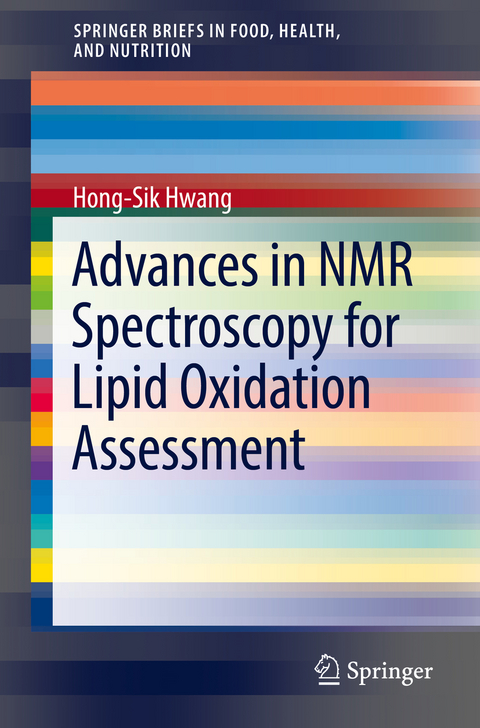
Advances in NMR Spectroscopy for Lipid Oxidation Assessment (eBook)
IX, 59 Seiten
Springer-Verlag
978-3-319-54196-9 (ISBN)
This Brief provides a comprehensive overview of NMR spectroscopy, covering techniques such as 1H, 13C, and 31P NMR, which are reliable tools to determine lipid oxidation level, to identify oxidation products, and to elucidate oxidation mechanism. The Brief shows that 1H NMR spectroscopy continually demonstrates reliability, accuracy, convenience, and advantages over conventional analytical methods in determination of the level of oxidation of edible oil during frying and storage through monitoring changes in several proton signals of oil, including olefinic, bisallylic and allylic protons. This modern analytical method is shown within this text to be used to identify oxidation products, including primary oxidation products such as hydroperoxides and conjugated dienes and secondary products such as aldehydes, ketones, epoxides and their derivatives. By identifying intermediates and final oxidation products, many oxidation mechanisms could be elucidated. A relatively newer method, the text demonstrates that 13C NMR and 31P NMR spectroscopy can also provide additional information on the molecular structure of an oxidation product. Backgrounds, principles, and advantages over conventional methods, most recent advances, and future prospects of these methods are discussed.
Advances in NMR Spectroscopy for Lipid Oxidation Assessment begins by covering the various mechanisms of lipid oxidation, including various methods to determine oxidation products. NMR spectroscopy is then covered, including its applications in foods. The next section focuses on 1H NMR Spectroscopy, including its use for assessment of lipid oxidation during oil storage and frying. The following section focuses on 13C NMR spectroscopy, including its use in determining and identifying oxidation products and mechanisms. A final section focuses on 31<
Dr. Hong-Sik Hwang is a Research Chemist at the National Center for Agricultural Research at the US Department of Agriculture in Peoria, IL, USA.
1. Conventional Analytical Methods to Assess Lipid Oxidation and Their Problems
1.1. Mechanisms of Lipid Oxidation
1.2. Methods to Determine Primary Oxidation Products
1.3. Methods to Determine Oxidation Products
2. Application of NMR Spectroscopy in Foods and Its Advantages
3. 1H NMR Spectroscopy for Assessment of Lipid Oxidation
3.1. Assessment of Oxidation during Oil Storage
3.2. Assessment of Oxidation during Frying
3.3. Comparison between 1H NMR Spectroscopy and Conventional Analytical Methods
4. 1H NMR Spectroscopy for Identification of Oxidation Products and for Elucidation of Reaction Mechanisms
5. 13C NMR spectroscopy for Assessment of Lipid Oxidation
5.1. Use of 13C NMR spectroscopy for Determination of Oxidation
5.2. Use of 13C NMR spectroscopy for Identification of Oxidation Products and Mechanisms
6. 31P NMR spectroscopy for Assessment of Lipid Oxidation
7. Conclusions and Future Prospects
References
Index
| Erscheint lt. Verlag | 16.2.2017 |
|---|---|
| Reihe/Serie | SpringerBriefs in Food, Health, and Nutrition | SpringerBriefs in Food, Health, and Nutrition |
| Zusatzinfo | IX, 59 p. 15 illus. |
| Verlagsort | Cham |
| Sprache | englisch |
| Themenwelt | Naturwissenschaften ► Chemie |
| Technik | |
| Schlagworte | Lipid Oxidation • Lipid Oxidation In Fryong • Lipid Oxidation In Oil Storage • Lipid Oxidation Mechanisms • NMR spectroscopy • Oxidation Products |
| ISBN-10 | 3-319-54196-X / 331954196X |
| ISBN-13 | 978-3-319-54196-9 / 9783319541969 |
| Informationen gemäß Produktsicherheitsverordnung (GPSR) | |
| Haben Sie eine Frage zum Produkt? |
 PDF (Wasserzeichen)
DRM: Digitales Wasserzeichen
Dieses eBook enthält ein digitales Wasserzeichen und ist damit für Sie personalisiert. Bei einer missbräuchlichen Weitergabe des eBooks an Dritte ist eine Rückverfolgung an die Quelle möglich.
Dateiformat: PDF (Portable Document Format)
Mit einem festen Seitenlayout eignet sich die PDF besonders für Fachbücher mit Spalten, Tabellen und Abbildungen. Eine PDF kann auf fast allen Geräten angezeigt werden, ist aber für kleine Displays (Smartphone, eReader) nur eingeschränkt geeignet.
Systemvoraussetzungen:
PC/Mac: Mit einem PC oder Mac können Sie dieses eBook lesen. Sie benötigen dafür einen PDF-Viewer - z.B. den Adobe Reader oder Adobe Digital Editions.
eReader: Dieses eBook kann mit (fast) allen eBook-Readern gelesen werden. Mit dem amazon-Kindle ist es aber nicht kompatibel.
Smartphone/Tablet: Egal ob Apple oder Android, dieses eBook können Sie lesen. Sie benötigen dafür einen PDF-Viewer - z.B. die kostenlose Adobe Digital Editions-App.
Buying eBooks from abroad
For tax law reasons we can sell eBooks just within Germany and Switzerland. Regrettably we cannot fulfill eBook-orders from other countries.
aus dem Bereich