Disaster Epidemiology
Academic Press Inc (Verlag)
978-0-12-809318-4 (ISBN)
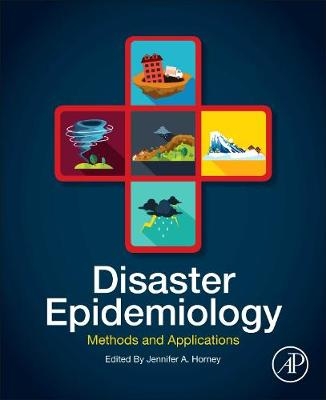
Disaster Epidemiology: Methods and Applications explains how public health surveillance, rapid assessments, and other epidemiologic studies can be conducted in the post-disaster setting to prevent injury, illness, or death; provide accurate and timely information for decisions makers; and improve prevention and mitigation strategies for future disasters. These methods can also be applied to the study of other types of public health emergencies, such as infectious outbreaks, emerging and re-emerging diseases, and refugee health. This book gives both the public health practitioner and researcher the tools they need to conduct epidemiological studies in a disaster setting and can be used as a reference or as part of a course.
Jennifer Horney is a Professor and Founding Director of the Epidemiology Program and Core Faculty at the Disaster Research Center at the University of Delaware. Her research focuses on assessing the health impacts of disasters, including inequitable impacts among physically and socially vulnerable groups. She is currently a member of the Board of Scientific Counselors for the Centers for Disease Control and Prevention’s Center for Preparedness and Response, a member of the National Academies of Sciences’ Gulf Research Program’s Enhancing Community Resilience Committee, and a member of the Publications Board of the American Public Health Association. She has provided technical assistance to public health agencies globally around disasters, emerging infectious disease outbreaks, and pandemic influenza planning and response.
An Introduction to Disaster Epidemiology
Josephine Malilay and Jennifer A. Horney
1. History of Disaster Epidemiology: 1960-2015
Jennifer A. Horney
2. Methods: Surveillance
Kahler Stone
Vignettes: Veterans Health Affairs, Veterans, and Disasters
Tiffany Radcliff, Aram Dobalian and Karen Chu
3. Applications: Informatics: Using Information Systems to Improve Surveillance During Disasters
Laura Edison, Karl Soetebier and Hope Dishman
4. Applications: Shelter Surveillance
Rebecca Jean Heick
Post-Disaster Carbon Monoxide Surveillance
Kanta Sircar and Dorothty Stearns
5. Applications: Mortality Surveillance
Rebecca S. Noe
6. Study Designs in Disaster Epidemiology
Latasha Allen and Jennifer A. Horney
7. Applications: CASPER
Amy Helene Schnall, Amy Wolkin and Tesfaye Mekonnen Bayleyegn
Applications: ACE
Maureen F. Orr and Mary Anne Duncan
Vignettes from Recent Responses: California Geothermal Gas Vents
Svetlana Smorodinsky, Tracy Barreau and Jason Wilken
Vignettes from Recent Responses: California Drought
Jason Wilken, Svetlana Smorodinsky and Tracy Barreau
8. Methods: Questionnaire Development and Interviewing Techniques
Amy Helene Schnall, Amy Wolkin and Nicole Nakata
Vignettes from Recent Responses: Foodborne
Marilyn Felkner, Venessa Cantu and Kevin Mcclaran
9. Applications: Social Vulnerablity to Disaster (Hampton and Hertford Counties - Isabel)
Danielle Spurlock
10. Applications: Responder Safety
Renee Funk
Vignettes from Recent Responses: Pregnant Women and Ebola
Jonetta Johnson Mpofu and Michelle Dynes
11. Methods: Data Analysis
Ashley Conley
12. Applications: Bioterrorism, Biodefense, and Biotechnology
Koya Allen
Vignettes: Natural Disasters and Climate Change
Joel Casey Dietrich
Vignettes: Impacts on People with Pre-existing Chronic Medical Conditions
Pamela Allweiss
13. Applications: Disaster Communication and Community Engagement
Jennifer C. Beggs
Vignette from Recent Responses: Roseburg Oregon Mass Shooting
Akiko M. Saito
14. Discussion and Conclusion - What Disaster Epidemiology Can Contribute to Resilient Communities
Jennifer A. Horney
Appendix: Resources from Disaster Libraries
Suzanne Shurtz Clark
| Erscheinungsdatum | 09.11.2017 |
|---|---|
| Verlagsort | San Diego |
| Sprache | englisch |
| Maße | 191 x 235 mm |
| Gewicht | 430 g |
| Themenwelt | Medizin / Pharmazie ► Physiotherapie / Ergotherapie ► Orthopädie |
| Studium ► Querschnittsbereiche ► Epidemiologie / Med. Biometrie | |
| Naturwissenschaften ► Biologie ► Ökologie / Naturschutz | |
| Technik ► Medizintechnik | |
| ISBN-10 | 0-12-809318-8 / 0128093188 |
| ISBN-13 | 978-0-12-809318-4 / 9780128093184 |
| Zustand | Neuware |
| Informationen gemäß Produktsicherheitsverordnung (GPSR) | |
| Haben Sie eine Frage zum Produkt? |
aus dem Bereich