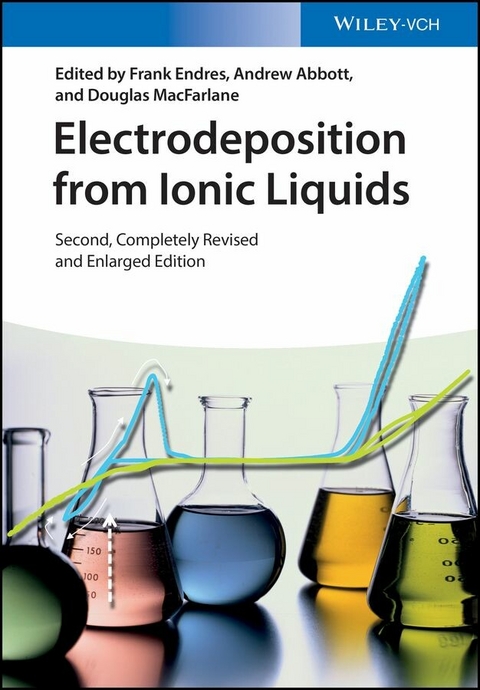
Electrodeposition from Ionic Liquids (eBook)
Wiley-VCH Verlag GmbH & Co. KGaA
978-3-527-68273-7 (ISBN)

This second edition has been completely revised and updated with approximately 20% new content and has been expanded by five chapters to cover the following topics:
-Bulk and Interface Theory
-Nanoscale Imaging including AFM, In situ STM and UHV-STM
-Impedance Spectroscopy
-Process Scale-up including Brighteners
-Speciation and Redox Properties.
The result is essential reading for electrochemists, materials scientists, chemists in industry, physical chemists, chemical engineers, inorganic and organic chemists.
Frank Endres studied chemistry and physics at Saarland University, Germany, gaining his doctorate in 1996. He obtained his lecturing qualification at Karlsruhe University in 2002, since when he has been a full professor at Clausthal University of Technology.
Andrew Abbott gained his PhD in electrochemistry from Southampton University in 1989. Following post-doctoral studies at the universities of Connecticut and Liverpool, he became a lecturer at the University of Leicester in 1993, and Professor of Physical Chemistry there in 2005. Since 1999, Professor Abbott has been Research Director of Scionix Ltd.
Professor Doug MacFarlane leads the Monash Ionic Liquids Group at Monash University. He is currently the holder of an Australian Research Council Laureate Fellowship. He is also the Program Leader of the Energy Program in the Australian Centre of Excellence for Electromaterials Science. His group focuses on a range of aspects of ionic liquids and their application in the energy sciences and sustainable chemistry. Professor MacFarlane was a BSc(Hons) graduate of Victoria University of Wellington, New Zealand and then undertook his graduate work in the Angell group at Purdue University, Indiana, graduating in 1983. After postdoctoral fellowships in France and New Zealand he took up an academic position at Monash. He has been a Professor of Chemistry at Monash since 1995 and was Head of School 2003-2006.
Frank Endres studied chemistry and physics at Saarland University, Germany, gaining his doctorate in 1996. He obtained his lecturing qualification at Karlsruhe University in 2002, since when he has been a full professor at Clausthal University of Technology. Andrew Abbott gained his PhD in electrochemistry from Southampton University in 1989. Following post-doctoral studies at the universities of Connecticut and Liverpool, he became a lecturer at the University of Leicester in 1993, and Professor of Physical Chemistry there in 2005. Since 1999, Professor Abbott has been Research Director of Scionix Ltd. Professor Doug MacFarlane leads the Monash Ionic Liquids Group at Monash University. He is currently the holder of an Australian Research Council Laureate Fellowship. He is also the Program Leader of the Energy Program in the Australian Centre of Excellence for Electromaterials Science. His group focuses on a range of aspects of ionic liquids and their application in the energy sciences and sustainable chemistry. Professor MacFarlane was a BSc(Hons) graduate of Victoria University of Wellington, New Zealand and then undertook his graduate work in the Angell group at Purdue University, Indiana, graduating in 1983. After postdoctoral fellowships in France and New Zealand he took up an academic position at Monash. He has been a Professor of Chemistry at Monash since 1995 and was Head of School 2003-2006.
Cover 1
Title Page 5
Copyright 6
Contents 7
List of Contributors 19
Abbreviations 23
Chapter 1 Why Use Ionic Liquids for Electrodeposition? 35
1.1 Nonaqueous Solutions 36
1.2 Ionic Fluids 37
1.3 What Is an Ionic Liquid? 38
1.4 Technological Potential of Ionic Liquids 40
1.4.1 Removal of Toxic Reagents 40
1.4.2 Water-Sensitive Metals 41
1.4.3 Deposition on Water-Sensitive Substrates 41
1.4.4 Semiconductor Electrodeposition 41
1.4.5 Deposition of Nanoarchitectures 41
1.4.6 Health and Safety 42
1.4.7 Temperature 44
1.4.8 Diluents 44
1.4.9 Cation and Added Electrolytes 44
1.4.10 Anode Material 44
1.4.11 Brighteners 45
1.5 Conclusions 45
References 46
Chapter 2 Synthesis of Ionic Liquids 51
2.1 Nanostructured Metals and Alloys Deposited from Ionic Liquids 51
2.1.1 Introduction 51
2.1.2 Synthesis of Room-Temperature Chloroaluminate-Based Ionic Liquids 52
2.1.3 Physical Data of Haloaluminate-Based Ionic Liquids 58
References 58
2.2 Air- and Water-Stable Ionic Liquids 60
2.2.1 Introduction 60
2.2.2 Tetrafluoroborate and Hexafluorophosphate-Based Ionic Liquids 62
2.2.3 Triflate- and Trifluoroacetate-Based Ionic Liquids 64
2.2.4 Bistriflamide-Based Ionic Liquids 64
2.2.5 Trispentafluoroethyltrifluorophosphate-Based Ionic Liquids 65
2.2.6 Cyano-Based Ionic Liquids 66
2.2.7 Effect of Anion on Ionic Liquid Physicochemical Properties 67
2.2.8 Purity 68
References 69
2.3 Eutectic-Based Ionic Liquids 72
2.3.1 Type 1 Eutectics 74
2.3.2 Type 2 Eutectics 78
2.3.3 Type 3 Eutectics 79
2.3.4 Type 4 Eutectics 81
2.3.5 Modeling Viscosity and Conductivity 82
2.3.6 Conclusions 84
References 84
Chapter 3 Physical Properties of Ionic Liquids for Electrochemical Applications 89
3.1 Introduction 89
3.2 Thermal Properties 89
3.2.1 Melting Point 89
3.2.2 Glass Transition Temperature 94
3.2.3 Thermal Decomposition Temperature 94
3.2.4 Liquid Crystallinity and Solid-Solid Transitions 95
3.2.5 Thermal Conductivity 95
3.2.6 Vapor Pressure 96
3.3 Viscosity 96
3.4 Density 98
3.5 Refractive Index 99
3.6 Polarity 101
3.6.1 Solvatochromism 101
3.6.2 Reichardt's Betaine Dye 101
3.6.3 Kamlet-Taft Parameters 102
3.6.4 Acetylacetonatotetramethylethyldiamine copper (II) 106
3.6.5 Pyrene 107
3.6.6 Nile Red 107
3.7 Solubility of Metal Salts 107
3.8 Electrochemical Properties 110
3.8.1 Electrochemical Window 110
3.8.2 Ionic Conductivity 112
3.8.3 Diffusion Coefficient of Component Ions 116
3.8.4 Ionic Liquids for Specific Ion Conduction 118
3.9 Conclusion and Future Prospects 120
Acknowledgments 120
References 120
Chapter 4 Electrodeposition of Metals 129
4.1 Electrodeposition in AlCl3-Based Ionic Liquids 129
4.1.1 Introduction 129
4.1.2 Group I Metals 129
4.1.3 Group II Metals 133
4.1.4 Group III Metals 134
4.1.5 Group IV Metals 136
4.1.6 Group V Metals 136
4.1.7 Group VI Metals 137
References 137
4.2 Electrodeposition of Refractory Metals from Ionic Liquids 138
4.2.1 Introduction 138
4.2.2 Electrodeposition of Ti, Ta, and Nb from High-Temperature Molten Salts and RTILs 140
4.2.3 Electrodeposition of Chromium, Molybdenum, and Zirconium 147
4.2.4 Conclusions 149
References 149
4.3 Deposition of Metals from Nonchloroaluminate Eutectic Mixtures 153
4.3.1 Introduction 153
4.3.2 Type 1 Eutectics 156
4.3.3 Type 2 Eutectics 159
4.3.4 Type 3 Eutectics 160
4.3.5 Type 4 Eutectics 162
4.3.6 Lewis Acidity Effects on Deposit Morphology 163
4.3.7 Future Developments 163
References 165
4.4 Troublesome Aspects 166
4.4.1 Deposition of Reactive Elements 166
4.4.2 Viscosity/Conductivity 168
4.4.3 Impurities 168
4.4.4 Additives 169
4.4.5 Cation/Anion Effects 169
4.4.6 Price 170
4.4.7 Conclusions 170
References 171
4.5 Complexation and Redox Behavior of Metal Ions in Ionic Liquids 171
4.5.1 Introduction 171
4.5.2 Methods of Determining Metal Speciation in Ionic Media 173
4.5.3 Issues with Overpotentials and Passivation Effects 182
4.5.4 Outlook and Future Challenges 184
References 185
Chapter 5 Electrodeposition of Alloys 191
5.1 Introduction 191
5.2 Electrodeposition of Al-Containing Alloys from Chloroaluminate Ionic Liquids 194
5.2.1 Al-Ti 194
5.2.2 Al-Mo 195
5.2.3 Al-Zr 196
5.2.4 Al-Pt 197
5.2.5 Al-Mg 198
5.2.6 Al-Ce 198
5.2.7 Al-Zn 198
5.2.8 Al-W 199
5.2.9 Al-Mn 199
5.2.10 Al-Hf 199
5.2.11 Al-Mo-Mn 200
5.2.12 Al-Mo-Ti 200
5.2.13 Al-Cr-Ni 201
5.3 Electrodeposition of Zn-Containing Alloys from Chlorozincate Ionic Liquids 201
5.3.1 Alloys of Zn with Cu, Cd, and Sn 201
5.3.2 Zn-Co 202
5.3.3 Zn-Fe 202
5.3.4 Zn-Ni 203
5.3.5 Zn-Mg 203
5.3.6 Pt-Zn 203
5.4 Fabrication of a Porous Metal Surface by Electrochemical Alloying and Dealloying 204
5.5 Nb-Sn 205
5.6 Air- and Water-Stable Ionic Liquids 205
5.6.1 Pd-Au and Pd-Ag 206
5.6.2 Pd-In 206
5.6.3 Pd-Cu 206
5.6.4 Pd-Sn 207
5.6.5 Pd-Ni 207
5.6.6 In-Sn 207
5.6.7 Cu-Sn 208
5.6.8 Zn-Mn 208
5.6.9 Cu-Zn 210
5.6.10 Mg-Li 210
5.6.11 Au-Ag 210
5.6.12 Al-Cu 210
5.6.13 Al-Fe 211
5.7 Deep Eutectic Solvents 212
5.7.1 Co-Pt 212
5.7.2 Ni-Co 212
5.7.3 Ni-Zn 212
5.7.4 Ni-Sn 213
5.7.5 Ni-Cu 213
5.7.6 Zn-Co 213
5.7.7 Zn-Ti 213
5.7.8 Zn-Sn 214
5.7.9 Cu-Ga and Cu-In 215
5.7.10 Fe-Ga 215
5.7.11 Co-Sm 216
5.7.12 Co-Cr 216
5.8 Summary 216
References 217
Chapter 6 Electrodeposition of Semiconductors from Ionic Liquids 221
6.1 Introduction 221
6.2 Group IV Semiconductors 222
6.2.1 Si 223
6.2.2 Ge 225
6.2.3 SixGe1-x and GexSn1-x 229
6.3 II-VI Compound Semiconductors 230
6.3.1 CdTe 230
6.3.2 ZnTe 231
6.3.3 CdSe 231
6.3.4 Metal Oxides (ZnO) 231
6.3.5 Metal Sulfides (CdS, ZnS, and SnS) 232
6.4 III-V Compound Semiconductors 232
6.4.1 GaAs 233
6.4.2 InSb 233
6.4.3 GaSb 233
6.4.4 Al-Containing Semiconductors (AlSb and AlInSb) 234
6.4.5 GaN 235
6.5 Other Compound Semiconductors 235
6.5.1 II-V Compound Semiconductors (ZnSb) 235
6.5.2 Cu-Based Chalcogenide Ternary Semiconductors (CuSbS2) 235
6.6 Conclusions 236
References 238
Chapter 7 Conducting Polymers 245
7.1 Introduction 245
7.2 Electropolymerization - General Experimental Procedures 248
7.2.1 Temperature 249
7.2.2 Electrochemical Techniques 249
7.2.3 Electropolymerization Potential 250
7.2.4 Electrodes 250
7.2.5 Atmosphere and Water Content 251
7.2.6 Choice of IL 251
7.3 Synthesis of Conducting Polymers in Chloroaluminate ILs 253
7.3.1 Poly(pyrrole) 253
7.3.2 Poly(p-phenylene) 254
7.3.3 Poly(thiophene)s and Poly(fluorene) 255
7.3.4 Poly(aniline) 255
7.4 Synthesis of Conducting Polymers in Air- and Water-Stable ILs 255
7.4.1 Poly(pyrrole) 255
7.4.2 Poly(thiophene)s 257
7.4.3 Poly(3,4-ethylenedioxythiophene) 263
7.4.4 Poly(p-phenylene) 266
7.4.5 Poly(aniline) 267
7.4.6 Copolymers, Composites, and Nanostructured Polymers 267
7.5 Characterization 269
7.5.1 Electrochemical Characterization 270
7.5.2 Morphological Characterization 272
7.5.3 Spectroscopic Characterization 275
7.6 Conclusions and Outlook 278
References 279
Chapter 8 Nanostructured Materials 287
8.1 Nanostructured Metals and Alloys Deposited from Ionic Liquids 287
8.1.1 Introduction 287
8.1.2 Pulsed Electrodeposition from Aqueous Electrolytes 289
8.1.3 Special Features of Ionic Liquids as Electrolytes 293
8.1.4 Nanocrystalline Metals and Alloys from Chlorometallate-Based Ionic Liquids 295
8.1.5 Nanocrystalline Metals from Air- and Water-Stable Ionic Liquids 300
8.1.6 Conclusion and Outlook 307
Acknowledgments 307
References 308
8.2 Electrodeposition of Ordered Macroporous Materials from Ionic Liquids 312
8.2.1 Introduction 312
8.2.2 3DOM Germanium and Silicon 313
8.2.3 3DOM Gallium 317
8.2.4 3DOM Silver 318
8.2.5 3DOM Aluminum 318
8.2.6 3DOM Copper 319
8.2.7 3DOM Lithium 319
8.2.8 3DOM Zinc and Zinc Oxide 319
8.2.9 3DOM Conducting Polymer 320
8.2.10 3DOM Bilayer Films 320
8.2.11 Summary 322
References 322
8.3 Electrodeposition of Nanowires from Ionic Liquids 323
8.3.1 Introduction 323
8.3.2 Template-Assisted Electrodeposition of Nanowires 324
8.3.3 Template-Free Electrodeposition of Nanowires 330
8.3.4 Summary 336
Acknowledgment 336
References 337
8.4 Electrochemical Synthesis of Nanowire Electrodes for Lithium Batteries 338
8.4.1 Introduction 338
8.4.2 Template-Assisted Electrodeposition of Nanowires/Tubes 339
8.4.3 Template-Free Electrodeposition of Nanowires 348
8.4.4 Summary 350
Acknowledgments 351
References 351
Chapter 9 Ionic Liquid-Solid Interfaces 355
9.1 Introduction 355
9.2 IL-Au(1 1 1) Interface 356
9.3 IL-HOPG Interface 361
9.4 Influence of Solutes on the IL-Electrode Interfacial Structure 366
9.5 Thin Films of Ionic Liquids in Ultrahigh Vacuum (UHV) 369
9.6 Outlook 373
References 373
Chapter 10 Plasma Electrochemistry with Ionic Liquids 379
10.1 Introduction 379
10.2 Concepts and Principles 380
10.2.1 Plasma Electrochemistry 380
10.2.2 Low-Temperature Plasmas: Electrodes or Electrolytes? 381
10.2.3 The Plasma-Electrolyte Interface 382
10.2.4 Types of Plasmas and Reactors 384
10.3 Early Studies 385
10.4 The Stability of Ionic Liquids in Plasma Experiments 389
10.5 Plasma Electrochemical Metal Deposition in Ionic Liquids 393
10.5.1 Deposition of Silver Metal 394
10.5.2 Deposition of Copper Metal 398
10.5.3 Deposition of Platinum Metal 399
10.5.4 Deposition of Palladium Metal 399
10.6 Conclusions and Outlook 401
Acknowledgments 402
References 402
Chapter 11 Impedance Spectroscopy on Electrode | Ionic Liquid Interfaces 407
11.1 Introduction 407
11.1.1 Fundamentals of Impedance Spectroscopy 408
11.1.2 The Impedance Response of Common Systems 409
11.2 Measurement: Basics and Pitfalls 412
11.2.1 Working Principles of Impedance Analyzers 412
11.2.2 Artifacts in Measurements with More Than Two Electrodes 413
11.2.3 Conclusions 415
11.3 Analysis of Experimental Data 415
11.3.1 Fitting 416
11.3.2 Conclusions 420
11.4 Application: IL Interfaces at Metal Electrodes 421
11.4.1 Introduction 421
11.4.2 Measurement and Data Analysis 423
11.4.3 Experimental Setup 424
11.4.4 Results 425
11.4.5 Conclusions 428
References 429
Chapter 12 Technical Aspects 435
12.1 Metal Dissolution Processes 435
12.1.1 Counter Electrode Reactions 435
References 442
12.2 Reference Electrodes for Use in Room-Temperature Ionic Liquids 442
12.2.1 What Is a Reference Electrode? 442
12.2.2 Essential Characteristics of a Reference Electrode 444
12.2.3 Pseudo-Reference Electrodes and Internal Redox Reference Couples 445
12.2.4 Liquid Junction Potentials 446
12.2.5 Reference Electrodes in RTILs: What Has Been Used? 446
12.2.6 Recommendations and Comments 451
References 456
12.3 Process Scale-Up 458
12.3.1 Chromium 458
12.3.2 Zinc Alloys 458
12.3.3 Immersion Silver 460
12.3.4 Electropolishing 461
12.3.5 General Issues 464
12.3.6 Material Compatibility 464
12.3.7 Pretreatment Protocols 465
12.3.8 Conductivity and Added Electrolytes 466
12.3.9 Conclusions 470
References 470
12.4 Toward Regeneration and Reuse of Ionic Liquids in Electroplating 472
12.4.1 Introduction 473
12.4.2 Recovery, Regeneration, and Reuse of Electrolytes in Electroplating 474
12.4.3 Case Study 482
12.4.4 Conclusions 486
Acknowledgments 487
References 487
12.5 Impurities 491
12.5.1 Origin of Impurities 491
12.5.2 Impurities in Deep Eutectic Solvents 493
12.5.3 Impact of Impurities on Electrochemistry 495
Appendix A 501
A.1 Protocol for the Deposition of Zinc from a Type III Ionic Liquid 501
A.1.1 Preparation of Ionic Liquids 501
A.2 Electroplating Experiment 501
A.2.1 Method 501
A.2.2 Safety Precautions 502
References 502
Chapter 13 Plating Protocols 503
13.1 Electrodeposition of Al from [C2mim]Cl/AlCl3 503
13.1.1 Experimental Setup 503
13.1.2 Chemicals and Preparation 504
13.1.3 Results 504
13.2 Electrodeposition of Al from 1-Butyl-3-methylimidazoliumchloride-AlCl3-Toluene 506
13.2.1 Apparatus, Materials, and Chemicals 506
13.2.2 Preparation of AlCl3-[C4mim]Cl-Toluene Ionic Liquid Mixture ([2 : 1] : 3) 506
13.2.3 Pretreatments 506
13.2.4 Electroplating and Morphology Analysis 507
13.2.5 Results 507
13.3 Electrodeposition of Al from [C2mim] NTf2/AlCl3 507
13.3.1 Experimental Setup 508
13.3.2 Chemicals and Preparation 508
13.3.3 Results 509
13.4 Electrodeposition of Al from [C4mpyr]NTf2/AlCl3 510
13.4.1 Experimental Setup 510
13.4.2 Chemicals and Preparation 510
13.4.3 Results 510
13.5 Electrodeposition of Li from [C4mpyr]NTf2/LiNTf2 511
13.6 Electrodeposition of Ta from [C4mpyr]NTf2 513
13.6.1 Electrodes 513
13.6.2 Chemicals 513
13.6.3 Results 513
13.7 Electrodeposition of Zinc Coatings from a Choline Chloride: Ethylene-Glycol-Based Deep Eutectic Solvent 514
13.7.1 Experimental Setup 514
13.7.2 Pretreatment 514
13.7.3 Results 515
13.8 Electrodeposition of Nickel Coatings from a Choline Chloride: Ethylene-Glycol-Based Deep Eutectic Solvent 515
References 516
Chapter 14 Future Directions and Challenges 517
14.1 Impurities 517
14.2 Counter Electrodes/Compartments 519
14.3 Ionic Liquids for Reactive (Nano)materials 520
14.4 Nanomaterials/Nanoparticles 520
14.5 Cation/Anion Effects 521
14.6 Polymers for Batteries and Solar Cells 521
14.7 Variable-Temperature Studies 522
14.8 Intrinsic Process Safety 522
14.9 Economics (Price, Recycling) 523
14.10 Fundamental Knowledge Gaps 524
Index 525
EULA 539
| Erscheint lt. Verlag | 17.2.2017 |
|---|---|
| Sprache | englisch |
| Themenwelt | Naturwissenschaften ► Chemie ► Physikalische Chemie |
| Technik | |
| Schlagworte | abbreviations contributors • andwaterstable • Chemie • Chemistry • Conclusions • Dünne Schichten, Oberflächen u. Grenzflächen • Electrochemistry • Electrodeposition • Elektrochemie • Farben, Pigmente, Beschichtungen, Farbstoffe • ionic • liquid • Liquids • List • Materials Science • Materialwissenschaften • nanostructured • Paints, Pigments, Coatings, Dyes • Polymertechnologie • Potential • References • synthesis • Thin Films, Surfaces & Interfaces • tom beyersdorff • use ionic |
| ISBN-10 | 3-527-68273-2 / 3527682732 |
| ISBN-13 | 978-3-527-68273-7 / 9783527682737 |
| Informationen gemäß Produktsicherheitsverordnung (GPSR) | |
| Haben Sie eine Frage zum Produkt? |
 PDF (Adobe DRM)
Kopierschutz: Adobe-DRM
Adobe-DRM ist ein Kopierschutz, der das eBook vor Mißbrauch schützen soll. Dabei wird das eBook bereits beim Download auf Ihre persönliche Adobe-ID autorisiert. Lesen können Sie das eBook dann nur auf den Geräten, welche ebenfalls auf Ihre Adobe-ID registriert sind.
Details zum Adobe-DRM
Dateiformat: PDF (Portable Document Format)
Mit einem festen Seitenlayout eignet sich die PDF besonders für Fachbücher mit Spalten, Tabellen und Abbildungen. Eine PDF kann auf fast allen Geräten angezeigt werden, ist aber für kleine Displays (Smartphone, eReader) nur eingeschränkt geeignet.
Systemvoraussetzungen:
PC/Mac: Mit einem PC oder Mac können Sie dieses eBook lesen. Sie benötigen eine
eReader: Dieses eBook kann mit (fast) allen eBook-Readern gelesen werden. Mit dem amazon-Kindle ist es aber nicht kompatibel.
Smartphone/Tablet: Egal ob Apple oder Android, dieses eBook können Sie lesen. Sie benötigen eine
Geräteliste und zusätzliche Hinweise
Buying eBooks from abroad
For tax law reasons we can sell eBooks just within Germany and Switzerland. Regrettably we cannot fulfill eBook-orders from other countries.
aus dem Bereich