


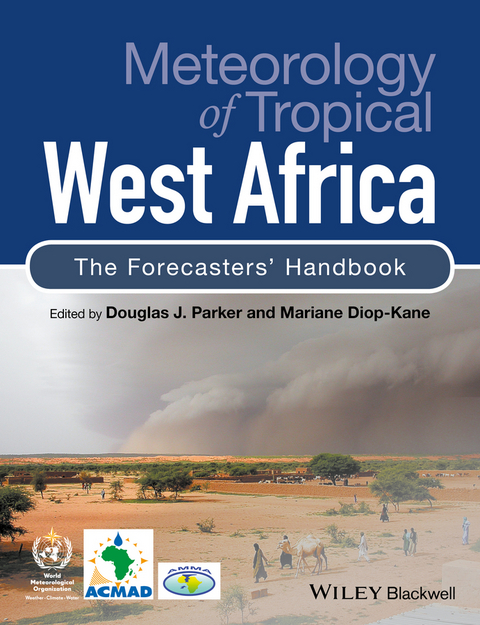
Meteorology of Tropical West Africa (eBook)
496 Seiten
Wiley (Verlag)
978-1-118-39128-0 (ISBN)
Douglas J Parker is the Met Office Professor of Meteorology at the University of Leeds. Mariane Diop-Kane heads the Research and Development Department in the Senegalese weather service (ANACIM).
Contributors xiii
Foreword xiv
Preface xv
Acknowledgements xvii
Acronyms xviii
1 Mean Climate and Seasonal Cycle 1
1.1 Introduction 1
1.2 Rainfall and Evaporation Climatologies 3
1.3 Water Vapour and Clouds 12
1.4 Radiation, Dust, Sunshine Duration, Vegetation and Soil Water 14
1.5 Pressure, Temperature, Humidity and Wind at the Surface 18
1.6 Upper Air Wind, Mass and Humidity Fields 22
1.7 Summary Schematics of the January and July West African Monsoon System 33
2 Synoptic Systems 40
2.1 Scientific Background 40
2.2 Operational Methods and Canonical Synoptic Patterns 71
3 Deep Convection 90
3.1 Scientific Background 90
3.2 Operational Methods 115
4 Local Weather 130
4.1 Scientific Background 130
4.2 Operational Methods 160
5 Dust 175
5.1 Scientific Background 175
5.2 Operational Methods 188
6 Nowcasting 204
6.1 Scientific Background 204
6.2 Operational Methods for Nowcasting Severe Weather 221
7 Subseasonal Forecasting 255
7.1 Scientific Background 255
7.2 Operational Methods 277
8 Seasonal Forecasting 289
8.1 Scientific Background 289
8.2 Operational Methods 316
9 Remote Sensing 323
9.1 Scientific Background 323
9.2 Operational Methods 362
9.3 Case Study, Presentations and Other Resources 373
10 Numerical Weather Prediction over Africa 380
10.1 Scientific Background 380
10.2 Operational Numerical Weather Prediction over Africa 397
11 West African Synthetic Analysis and Forecast: WASA/F 423
11.1 Introduction 423
11.2 The intertropical discontinuity/intertropical front, or intertropical boundary in Ghana 425
11.3 The Heat Low or Thermal Depression 426
11.4 The Subtropical Jet 429
11.5 Features Associated with Mid?]latitudes 430
11.6 Mid?]level Dry Air 431
11.7 The Tropical Easterly Jet 431
11.8 The African Easterly Jet 433
11.9 African Easterly Waves and Cyclonic Vortices 435
11.10 The African Monsoon Layer and the Monsoon Trough 441
11.11 Dust or Sand 444
11.12 Convection 444
Preface
This book aims to synthesise the latest knowledge of West African meteorology with operational tools and methods for weather forecasting in the region. We hope that it will be valuable for the training of weather forecasters in West Africa, for weather forecasters around the world having an interest in tropical predictions, and for students of meteorology. It is our intention that the material should appeal to students who have an interest both in tropical dynamics and operational forecasting, and the book is targeted at both the undergraduate and postgraduate levels. A basic meteorological knowledge is assumed.
The book is particularly demanded by national meteorological services, whose general forecasting services are still in their early stages. For many years, focus has been on forecasting for aviation, but with climate change and its associated hazards and impacts, there is increasing demand for specific meteorological forecasts at a wider range of time and space scales. The main users need predictions for agriculture and food security, water resources, civil protection and disaster risk reduction, and health. Although the book does not address these issues directly, the phenomena needed to issue such forecasts at the required timescales have been covered throughout the book, with the aim of giving the forecaster enough materials to extrapolate and deliver such weather and climate services. The book also gives some insight for further research needed.
The book emerged from discussions between the two editors and Chris Thorncroft about West African forecasting for the JET2000 experiment in 2000. For that campaign, we were flight‐planning for the UK research aircraft and trying to use modern numerical weather prediction (NWP) products alongside the conceptual models known to operational forecasters in the region. It was clear that there has been a lack of documentation of the basic meteorology of West Africa, a lack of documentation of forecasting methods (a more widespread problem for the tropics), and a lack of communication between the research and forecasting communities (again, not a problem unique to West Africa).
The African Monsoon Multidisciplinary Analysis (AMMA, 2002 onwards) offered an opportunity to deal with some of these problems, and a forecasting programme was integrated with the intensive AMMA field campaigns of 2006. The AMMA Operational Centre (AOC) included a team of forecasters selected from different national meteorological services in West Africa, and hosted by the African Centre of Meteorological Applications for Development (ACMAD) in Niamey. This group worked on the production of systematic, standardised daily forecasts and analyses for presentation in the daily briefings at the AOC. The AOC forecasting programme was led by Jean Philippe Lafore and Zilore Mumba, and achieved some significant successes: a network of forecasters and researchers was created, important dialogues were initiated, and the standardisation of diagnostic plots, in the form of the West African Synthetic Analysis/Forecast (WASA/F), was put in place. However, the AOC forecasting also highlighted (at least for the academics involved) the massive challenge of developing reliable daily forecasts in the region, especially of convective systems.
Following the AOC forecasting, further development of WASA/F was conducted by ACMAD and the Centre National de Recherches Météorologiques, Météo‐France (CNRM) over the next couple of years. We regard this framework for consistent plotting of weather features to be an essential part of the scientific development of forecasting in this region. There are a number of important conceptual models of weather systems in West Africa (African easterly waves (AEWs) and so on), and it is necessary to analyse, monitor, track and predict the behaviour of such features. By demarking relatively simple structures, such as an AEW trough, other aspects of the same phenomenon can be implied, if the user knows the typical configuration of such features: in the case of an AEW, the user can infer likely areas of rainfall, and rainfall type, relative to the trough location. In order for this conceptual framework to be useful it is necessary that there is scientific rigour to the process, and a great deal of the effort undertaken in creating this book has gone into the consideration of these principles. Features to be drawn schematically should correspond to agreed measures and thresholds in observational or model data, so that in principle those measures could be inferred within quantitative limits from the schematic features. The plots should also be ‘repeatable’, in the sense that another forecaster making the same chart would produce the same result. Considerable effort has been put into the achievement of these goals; a summary of the rules for plotting of weather features on the WASA/F maps is provided in Chapter 11.
Preparation and writing of the book began formally in October 2009 at a workshop hosted by the International Centre for Theoretical Physics (ICTP) and co‐funded by the World Meteorological Organization’s (WMO’s) World Weather Research Programme (WWRP) in association with THORPEX‐Africa. A one‐day workshop was used to explore some processes of interaction between researchers and forecasters, and the outcome was a structured plan of chapters and their content (including, importantly, the list of lead authors). This workshop also formalised the Editorial Committee for the project, and led to the agreement of the basic modus operandi of the preparation of the book.
Given that the important results to be documented are universal, and mainly are not country dependent, it was agreed that we could work with a small core group of forecasters alongside the various academics who were participating. Some other principles were at this point agreed:
- The Handbook will always describe the state of the art, assuming the availability of a full set of tools. This will give forecasters at the main centres the best information on the current state of knowledge, and will serve to drive demand for such tools.
- The Handbook will also describe pragmatic approaches to forecasting, including for example the plotting of synoptic charts from regional observations and the computation of stability indices from upper air data.
- Methods that are untested may be included in the Handbook, if there is good reason to do so, such as demonstrated success of the method in another part of the world. This approach will allow forecasters to perform the necessary testing for their region.
- Most chapters are separated into two parts: background scientific knowledge and operational methods.
Each chapter has one or two lead authors, plus a group of contributing authors. All chapters were peer reviewed by one or more people. In one or two cases the reviewer made substantial and specific contributions to the material and was invited to join the list of contributing authors.
An extended workshop was held in Leeds in the period October to December 2012. A forecaster core group worked together for 8 weeks with various European and African academics and forecasters visiting for shorter periods. This activity was the main opportunity to make progress on intensive collaboration over scientific details.
A final workshop co‐funded by WMO, Met Office and ACMAD was hosted by Mariane Diop‐Kane at Agence Nationale de l’Aviation Civile et de la Météorologie du Sénégal (ANACIM) in Dakar in March 2013, with the aim of allowing the whole West African forecasting community (with representatives from eight national forecasting agencies, Agence pour la Securite de la Navigation Aerienne en Afrique et a Madagascar (ASECNA) and West African Universities) to scrutinise and review the handbook material in order that we could move to completion of the book within a short time after this. In fact, completion of the book took another 2 years, due to iterations needed in resolving some of the ideas raised at that workshop.
Given that West African meteorology involves many interacting processes and spatio‐temporal scales, while prior knowledge has hitherto been dispersed among many sources, organisation of the material has been quite complicated, and we have had to make a few choices. In particular, we have made deliberate decisions regarding the terminology of some of the main climatological features. We decided against using the term ITCZ (intertropical convergence zone) over land, because the convergence structure varies significantly with height and this causes confusion in the literature. While we retain ‘ITCZ’ over the ocean, over the continent we refer, when needed, to specific observable features such as the zone of maximum precipitation. At the same time, we have chosen to retain both of the terms ITD and ITF (intertropical discontinuity and intertropical front). These terms are interchangeable and are each used very widely in the literature and in operational centres. Similarly, we use both tephigrams and skew‐T diagrams in the presentation of thermodynamic profiles, since both are in common use and the student should be prepared for this.
The main challenges in the preparation of this work have been the limited contributor time available, the need for scientific discourse in order to agree and approve the material to be presented, and the effort needed in ensuring cross‐consistency between chapters. We are very grateful to the funding agencies that have supported us, and the time contributed by many scientists.
Chapter 1 presents an overview of the West...
| Erscheint lt. Verlag | 13.2.2017 |
|---|---|
| Sprache | englisch |
| Themenwelt | Naturwissenschaften ► Geowissenschaften ► Meteorologie / Klimatologie |
| Technik | |
| Schlagworte | Acronyms • African • contributors • convection • Deep • earth sciences • Foreword • Geowissenschaften • january • Meteorologie • meteorology • Methods • monsoon • operational methods • operational methods local • Patterns • schematics • sensing • subseasonal • Surface • Synoptic • System • Systems • Weather |
| ISBN-10 | 1-118-39128-4 / 1118391284 |
| ISBN-13 | 978-1-118-39128-0 / 9781118391280 |
| Informationen gemäß Produktsicherheitsverordnung (GPSR) | |
| Haben Sie eine Frage zum Produkt? |
 EPUB (Adobe DRM)
Kopierschutz: Adobe-DRM
Adobe-DRM ist ein Kopierschutz, der das eBook vor Mißbrauch schützen soll. Dabei wird das eBook bereits beim Download auf Ihre persönliche Adobe-ID autorisiert. Lesen können Sie das eBook dann nur auf den Geräten, welche ebenfalls auf Ihre Adobe-ID registriert sind.
Details zum Adobe-DRM
Dateiformat: EPUB (Electronic Publication)
EPUB ist ein offener Standard für eBooks und eignet sich besonders zur Darstellung von Belletristik und Sachbüchern. Der Fließtext wird dynamisch an die Display- und Schriftgröße angepasst. Auch für mobile Lesegeräte ist EPUB daher gut geeignet.
Systemvoraussetzungen:
PC/Mac: Mit einem PC oder Mac können Sie dieses eBook lesen. Sie benötigen eine
eReader: Dieses eBook kann mit (fast) allen eBook-Readern gelesen werden. Mit dem amazon-Kindle ist es aber nicht kompatibel.
Smartphone/Tablet: Egal ob Apple oder Android, dieses eBook können Sie lesen. Sie benötigen eine
Geräteliste und zusätzliche Hinweise
Buying eBooks from abroad
For tax law reasons we can sell eBooks just within Germany and Switzerland. Regrettably we cannot fulfill eBook-orders from other countries.
aus dem Bereich


