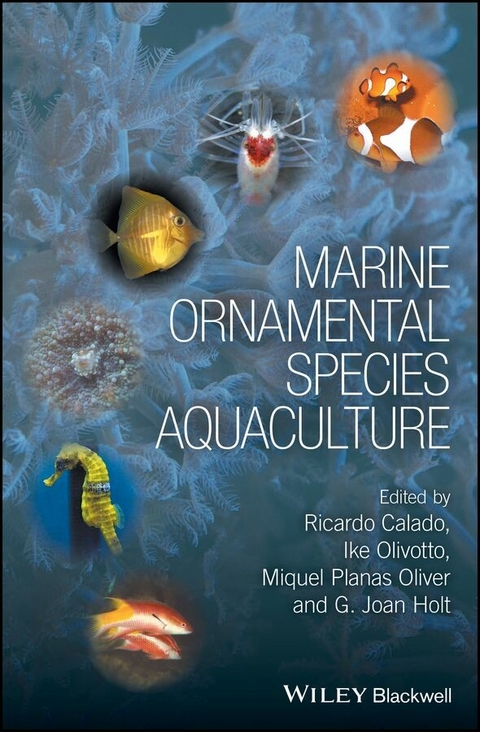
Marine Ornamental Species Aquaculture (eBook)
712 Seiten
Wiley-Blackwell (Verlag)
978-1-119-30701-3 (ISBN)
The global trade of aquatic organisms for home and public aquariums, along with associated equipment and accessories, has become a multi-billion dollar industry. Aquaculture of marine ornamental species, still in its infancy, is recognized as a viable alternative to wild collection as it can supplement or replace the supply of wild caught specimens and potentially help recover natural populations through restocking.
This book collects into a single work the most up-to-date information currently available on the aquaculture of marine ornamental species. It includes the contributions of more than 50 leading scientists and experts on different topics relevant for the aquaculture of the most emblematic groups of organisms traded for reef aquariums. From clownfish, to angelfish, tangs and seahorses, as well as corals, anemones, shrimps, giant clams and several other reef organisms, all issues related with the husbandry, breeding, and trade are addressed, with explanatory schemes and illustrations being used to help in understanding the most complex topics addressed.
Marine Ornamental Species Aquaculture is a key reference for scientists and academics in research institutes and universities, public and private aquaria, as well as for hobbyists. Entrepreneurs will also find this book an important resource, as the culture of marine ornamental species is analyzed from a business oriented perspective, highlighting the risks and opportunities of commercial scale aquaculture of marine ornamentals.
About the Editors
Ricardo Calado, Departamento de Biologia & CESAM, Universidade de Aveiro, Portugal
Ike Olivotto, Dipartimento di Scienze della Vita e dell'Ambiente, Università Politecnica delle Marche, Italy Instituto de Investigaciones Marinas (CSIC), Spain
G.Joan Holt, Marine Science Institute, University of Texas, USA
About the Editors Ricardo Calado, Departamento de Biologia & CESAM, Universidade de Aveiro, Portugal Ike Olivotto, Dipartimento di Scienze della Vita e dell'Ambiente, Università Politecnica delle Marche, Italy Instituto de Investigaciones Marinas (CSIC), Spain G.Joan Holt, Marine Science Institute, University of Texas, USA
Title Page 5
Copyright Page 6
Contents 9
List of Contributors 27
Foreword 33
References 34
Part I Overview of Marine Ornamental Species Aquaculture 35
Chapter 1 The Marine Ornamental Species Trade 37
1.1 Introduction 37
1.2 History 38
1.3 Economics of Trade 39
1.4 Species of Trade 39
1.5 Organization of Trade 40
1.6 Environmental Impact 41
1.7 Marine Ornamentals Aquaculture 43
1.8 Conclusions 46
Acknowledgements 46
References 46
Chapter 2 The Need for Cultured Specimens 49
2.1 Introduction 49
2.2 Should All Marine Ornamental Species be Cultured? 50
2.3 Highly Demanded Marine Ornamental Species Cultured in Captivity 52
2.4 Conclusions 54
References 55
Chapter 3 Life Cycles in Marine Ornamental Species – Fishes as a Case Study 57
3.1 Introduction 57
3.2 Patterns of Sexuality in Fish 58
3.2.1 Gonochoristic Fish 58
3.2.1.1 Differentiated Gonochoristics 58
3.2.1.2 Undifferentiated Gonochoristics 58
3.2.1.3 Secondary Gonochoristics 58
3.2.2 Hermaphrodite Fish 58
3.2.2.1 Synchronous Hermaphrodites 59
3.2.2.2 Sequential Hermaphrodites 59
3.2.3 Unisexual fish 61
3.3 Sex Determination and Sex Differentiation in Fish 62
3.4 Molecular Markers of Sex Differentiation 63
3.5 Transcriptomic Studies on Fish Sex Differentiation 63
3.6 Demersal Spawners 64
3.7 Pelagic Spawners 68
3.8 Conclusions 72
Acknowledgements 73
References 73
Chapter 4 Early Culture Trials and an Overview on U.S. Marine Ornamental Species Trade 85
4.1 Introduction 85
4.2 Import Data and the Marine Aquarium Trade 86
4.2.1 Reducing the Data Deficiency 88
4.2.2 General Trends in the Trade of Marine Aquarium Species 88
4.3 Aquaculture for the Marine Aquarium Trade: Bottlenecks and Opportunities 92
4.4 Constraints and Opportunities for the Commercial Production of Marine Aquarium Species 93
4.4.1 Life History Characteristics as Constraints to Commercial Production 93
4.4.2 Economic and Regulatory Constraints to Commercial Production 95
The Banggai Cardinalfish 95
Mandarin dragonets 96
CITES and ESA as constraints and opportunities in Aquaculture Production 97
4.5 Risks and Benefits of Aquaculture Production 97
4.5.1 Ecological Risk and Aquaculture Production as a Source of Nonindigenous and Invasive Marine Species 98
4.5.2 Economic Benefits of Aquaculture in Reef Side Communities 99
4.5.3 Reducing Bottlenecks and Opportunities for Growth 99
Species selection 99
Live Feed Bottlenecks 99
4.6 Conclusions 100
Acknowledgements 100
References 100
Part II Facilities, Culture Systems and Other Specific Requirements 105
Chapter 5 Location 109
5.1 Introduction 109
5.2 In Situ Culture 110
5.3 Ex Situ Culture 111
5.4 Licensing and Other Legal Issues 111
5.5 Conclusions 112
References 112
Chapter 6 Broodstock Systems 115
6.1 Introduction 115
6.2 Broodstock Management and Reproduction 116
6.3 Systems Design and Planning 116
6.3.1 Biological Requirements of Cultured Species 117
6.3.2 Broodstock infrastructures 119
6.3.2.1 System Operation Regime 120
6.3.2.2 Broodstock Tank Design and Dimensions 120
6.3.2.3 Technical equipment 124
6.3.3 Operational Costs and Market Value of Cultivated Species 129
6.4 Conclusions 130
Acknowledgements 131
References 131
Chapter 7 Larviculture Systems 135
7.1 Introduction 135
7.2 Microcosms 136
7.3 Mesocosms 139
7.4 Conclusions 142
Acknowledgements 143
References 143
Chapter 8 Live Prey Production Systems 145
8.1 Introduction 145
8.2 Microalgae 146
8.3 Rotifers 147
8.4 Artemia 149
8.4.1 Cyst Disinfection 150
8.4.2 Cyst decapsulation 150
8.4.3 Cyst incubation and hatching 150
8.4.4 Enrichment 151
8.5 Copepods 152
8.6 Other Prey 155
8.6.1 Mysid shrimp (Mysidaceans) 155
8.6.2 Grass shrimp Palaemonetes spp. 155
8.6.3 Trocophora larvae 155
8.6.4 Caprellids (Amphipoda) 155
8.6.5 Other organisms 156
8.7 Conclusions 156
Acknowledgements 156
References 156
Chapter 9 Larval Diets and Nutrition 159
9.1 Larval Nutritional Requirements 159
9.2 Microalgae 161
9.3 Rotifers, Artemia and Ciliates 163
9.4 Copepods 165
9.5 Inert Diets (Dry Food and Preserved Copepods) 167
9.6 Conclusions 168
References 168
Chapter 10 Growout and Broodstock Nutrition 173
10.1 Introduction 173
10.2 Nutritional Components 174
10.2.1 Complete Feeds 174
10.2.2 Proteins 175
10.2.3 Lipids 176
10.2.4 Vitamins 177
10.2.5 Minerals 177
10.2.6 Carotenoids (coloration) 178
10.2.7 Spirulina 178
10.3 Broodstock Nutrition 179
10.3.1 Spawn Quality 179
10.3.2 Feeding and Nutrition 180
10.3.3 Marine Ornamentals Examples 181
10.3.3.1 Amphiprion 181
10.3.3.2 Centropyge 182
10.3.3.3 Dunckerocampus 182
10.3.3.4 Genicanthus 182
10.3.3.5 Hippocampus 182
10.3.3.6 Liopropoma 182
10.3.3.7 Pseudanthias 183
10.3.3.8 Oxymonacanthus 183
10.4 Probiotics 183
10.4.1 Application of probiotics in ornamental fish 184
10.4.2 Genes Controlling Fish Growth and Development 185
10.4.3 Clownfish example 185
10.5 Conclusions 186
References 187
Chapter 11 Considerations for Developing a Marine Ornamental Hatchery 193
11.1 Introduction 193
11.2 Hatchery Location 194
11.3 Facility Layout 194
11.4 Water Sources 194
11.4.1 Saltwater 195
11.4.2 Freshwater 195
11.5 Electricity 196
11.6 Lighting 197
11.7 Tanks and Aquariums 197
11.7.1 Broodstock Setup 198
11.7.2 Growout Setup 200
11.8 Diet and Nutrition 201
11.9 Quarantine 202
11.10 Filtration 203
11.11 Market Assessment 204
11.12 Quality Control 205
11.13 Other Considerations 205
11.14 Conclusions 206
Acknowledgements 206
References 206
Part III Marine Ornamental Fishes Aquaculture 209
Chapter 12 Clownfish 211
12.1 Introduction 211
12.2 Social Structure 213
12.3 Sex Reversal in Clownfish 214
12.3.1 Histological and Molecular Mechanisms of Sex Change 214
12.3.2 Socially-Induced Sex Differentiation 215
12.4 Broodstock Nutrition 216
12.5 Broodstock Tanks and Establishing Pairs 217
12.6 Spawning 219
12.6.1 Nest Cleaning and Courtship 219
12.6.2 Nest Care 219
12.6.3 Embryo Development 220
12.7 Hatching, Larval Tanks and First Feeding 221
12.8 Early Trials 224
12.9 Conclusions 227
Acknowledgements 228
References 228
Chapter 13 Mouthbrooders – The Banggai Cardinalfish 235
13.1 Introduction 235
13.2 The Reproductive Biology of Pterapogon kauderni 237
13.2.1 General Characteristics and Ontogenetic Terminology 237
13.2.2 Courtship Behaviours and Pair Formation 239
13.2.3 Mating, and Egg?Clutch Transfer 240
13.2.4 Post-Mating Behaviours 240
13.3 General Ecological Characteristics of Pterapogon kauderni 241
13.3.1 Habitat, Microhabitat and Community Associations 242
13.4 Captive Breeding of Pterapogon kauderni 243
13.4.1 Broodstock 244
13.4.1.1 Gender Determination 244
13.4.1.2 Feeding 246
13.4.2 Reproduction and Incubation 247
13.4.2.1 Environmental Requirements 247
13.4.2.2 Tank Choices 247
13.4.3 Juvenile Rearing 249
13.5 Nutritional Aspects and Diseases 250
13.5.1 Shock Syndrome 250
13.5.2 A New Viral Disease 252
13.6 Conclusions 253
Acknowledgements 253
References 253
Chapter 14 Other Demersal Spawners and Mouthbrooders 257
14.1 Introduction 257
14.2 Gobies (Gobiidae) 258
14.2.1 Reproduction 259
14.2.2 Spawning 260
14.2.3 Larval Rearing 261
14.3 Blennies (Blenniidae) 262
14.3.1 Reproduction 263
14.3.2 Spawning 264
14.3.3 Larval Rearing 264
14.4 Dottybacks (Pseudochromidae) 265
14.4.1 Reproduction and Behaviour 265
14.4.2 Broodstock and Spawning 266
14.4.3 Larval Rearing 268
14.5 Damselfishes (Pomacentridae) 270
14.5.1 Reproduction and Behaviour 270
14.5.2 Broodstock and Spawning 271
14.5.3 Larval Rearing 273
14.6 Other Demersal Spawning Families 274
14.6.1 Grammatidae 274
14.6.2 Plesiopidae 275
14.6.3 Microdesmidae 275
14.7 Other Mouthbrooders 276
14.7.1 Apogonidae 276
14.7.2 Plesiopidae 276
14.7.3 Opistognathidae 277
14.8 Conclusions 277
Acknowledgements 277
References 277
Chapter 15 Large Angelfish and Other Pelagic Spawners 285
15.1 Introduction 285
15.1.1 Sexual Patterns 286
15.1.2 Size Matters 286
15.1.3 Conformity 287
15.1.4 Exceptions 287
15.1.5 What can go Wrong? 288
15.2 Serranidae 288
15.2.1 Reef Basslets (Liopropoma spp.) 288
15.2.1.1 Broodstock and Spawning 288
15.2.1.2 Larval Rearing 289
15.2.1.3 Additional Information 289
15.2.2 Hamlets (Hypoplectrus spp.) 289
15.2.3 Harlequin Bass (Serranus tigrinus) 289
15.2.3.1 Broodstock and Spawning 289
15.2.3.2 Larval Rearing 290
15.2.4 Yellow Anthias (Odontanthias fuscipinnis) 290
15.3 Lutjanidae 291
15.3.1 Bluestripe Snapper (Lutjanus kasmira) 291
15.3.2 Five-lined Snapper (Lutjanus quinquelineatus) 291
15.3.2.1 Broodstock and Spawning 291
15.3.2.2 Larval Rearing 291
15.3.3 Yellowtail Snapper (Ocyurus chrysurus) 292
15.3.3.1 Broodstock and Spawning 292
15.3.3.2 Larval Rearing 292
15.4 Haemulidae 292
15.4.1 French Grunt (Haemulon flavolineatum) 293
15.4.1.1 Broodstock and Spawning 293
15.4.1.2 Larval Rearing 293
15.4.2 Indian Ocean Oriental Sweetlips (Plectorhinchus vittatus) 293
15.4.2.1 Broodstock and Spawning 293
15.4.2.2 Larval Rearing 293
15.5 Sciaenidae 294
15.5.1 Jackknife Fish (Equatus lanceolatus) 294
15.5.1.1 Broodstock and Spawning 294
15.5.1.2 Larval Rearing 294
15.5.1.3 Additional Information 294
15.5.2 High-Hat (Pareques acuminatus) 294
15.5.3 Cubbyu (Pareques umbrosus) 295
15.5.3.1 Broodstock and Spawning 295
15.5.3.2 Larval Rearing 295
15.6 Chaetodontidae 296
15.6.1 Millet (Milletseed) Butterflyfish (Chaetodon miliaris) 296
15.6.1.1 Broodstock and Spawning 296
15.6.1.2 Larval Rearing 296
15.6.2 Schooling Bannerfish (Heniochus diphreutes) 296
15.7 Pomacanthidae 296
15.7.1 Bandit Angel (Apolemichthys arcuatus) 297
15.7.2 Bluestriped Angelfish (Chaetodontoplus septentrionalis) 297
15.7.2.1 Broodstock and Spawning 297
15.7.2.2 Larval Rearing 297
15.7.2.3 Additional Information 298
15.7.3 Semicircle Angelfish (Pomacanthus semicirculatus) 298
15.7.3.1 Broodstock and Spawning 298
15.7.3.2 Larval Rearing 298
15.8 Labridae 298
15.8.1 Spotfin (Cuban) Hogfish (Bodianus pulchellus) 299
15.8.1.1 Broodstock and Spawning 299
15.8.1.2 Larval Rearing 299
15.8.2 Clown Wrasse (Halichores maculipinna) 300
15.8.2.1 Broodstock and Spawning 300
15.8.2.2 Larval Rearing 300
15.8.3 Bluestreak Cleaner Wrasse (Labroides dimidiatus) 300
15.8.3.1 Broodstock and Spawning 300
15.8.3.2 Larval Rearing 301
15.8.4 Bluehead Wrasse (Thalassoma bifasciatum) 301
15.8.4.1 Broodstock and Spawning 301
15.8.4.2 Larval Rearing 301
15.8.4.3 Additional Information 301
15.9 Callionymidae 302
15.9.1 Lancer Dragonet (Callionymus bairdi) 302
15.9.1.1 Larval Rearing 302
15.9.1.2 Additional Information 302
15.9.2 Mandarin Fish (Synchiropus splendidus) 302
15.9.2.1 Broodstock and Spawning 302
15.9.2.2 Larval Rearing 302
15.9.2.3 Additional Information 303
15.10 Ephippidae 303
15.10.1 Spadefish (Chaetodipterus faber) 303
15.10.2 Orbiculate batfish (Platax orbicularis) 303
15.10.3 Longfin Batfish (Platax teira) 303
15.10.3.1 Broodstock and Spawning 303
15.10.3.2 Larval rearing 304
15.11 Acanthuridae 304
15.11.1 Palette Surgeonfish (Paracanthurus hepatus) 304
15.11.1.1 Broodstock and Spawning 304
15.11.1.2 Larval Rearing 304
15.11.2 Yellow Tang (Zebrasoma flavescens) 305
15.11.2.1 Broodstock and Spawning 305
15.11.2.2 Larval Rearing 305
15.12 Conclusions 307
Acknowledgements 307
References 308
Chapter 16 Dwarf Angelfish 313
16.1 Introduction 313
16.2 Broodstock 316
16.2.1 Social Organization 316
16.2.2 Diet 317
16.2.3 Tank Parameters (Size, Height and Shelter) 317
16.2.4 Water Quality 319
16.2.5 Lighting and Water Temperature 319
16.2.6 Broodstock Summary 319
16.3 Larval Rearing 320
16.3.1 Rearing Systems 320
16.3.2 Water Temperature 320
16.3.3 Live Feeds 320
16.3.4 Microalgae 321
16.3.5 Lighting 322
16.3.6 Circulation 322
16.3.7 Water Quality and Maintenance 322
16.3.8 Larval Biology 323
16.3.9 Study Results 326
16.3.10 Larvae Summary 326
16.4 Juvenile Growout 327
16.4.1 Growout Conditions 328
16.4.2 Juvenile Summary 329
16.5 Conclusions 329
Acknowledgements 330
References 330
Chapter 16 Seahorses and Pipefish 333
17.1 Introduction 333
17.2 Anatomy and General Biology 334
17.3 Reproduction and Mating System 335
17.4 Husbandry 337
17.4.1 Habitat 337
17.4.2 Tank Mates 338
17.4.3 Feeding 338
17.4.4 Breeding 340
17.4.5 Color 340
17.5 Rearing Systems 341
17.6 Diseases 345
17.7 Rearing of Selected Seahorse Species 348
17.7.1 Pacific Seahorse Hippocampus ingens 348
17.7.2 Lined Seahorse Hippocampus erectus 348
17.7.3 Slender or Longsnout Seahorse Hippocampus reidi 350
17.7.4 European Long-snouted Seahorse Hippocampus guttulatus 350
17.7.5 Pot-belly Seahorse Hippocampus abdominalis 351
17.7.6 Dwarf Seahorse Hippocampus zosterae 351
17.8 Rearing of Selected Pipefish 351
17.8.1 Genus Corythoichthys 353
17.8.2 Genus Doryrhamphus 353
17.8.3 Genus Dunckerocampus 353
17.8.4 Genus Solenostomus (Ghost Pipefish) 353
17.8.5 Genus Syngnathus (Seaweed Pipefish) 354
17.8.6 Genus Haliichthys (Haliichthys taeniophorus, Ribboned Pipehorse) 354
17.9 Rearing of Seadragons 354
17.9.1 Leafy Seadragon, Phycodurus eques 355
17.9.2 Weedy Seadragon, Phyllopteryx taeniolatus 355
17.10 Conclusions 356
Acknowledgements 356
References 356
Chapter 18 Post-larval Capture and Culture of Ornamental Fishes 361
18.1 Introduction 361
18.2 PCC Versus Fish Life Cycle 362
18.3 Features Determining Species Suitability to the Marine Aquarium Trade 364
18.3.1 Catch Efficiency 364
18.3.2 High Quality of Fishes 365
18.3.3 Consistency 365
18.3.4 Species Requested by the Market 366
18.3.5 The Best Site on the Planet? 369
18.4 Hobbyist Responsibilities 369
18.5 PCC Experiences 373
18.6 Conclusions 376
Acknowledgements 377
References 377
Chapter 19 Common Diseases in Marine Ornamental Fishes 381
19.1 Introduction 381
19.2 Parasitic Diseases 383
19.2.1 Amyloodinium ocellatum 384
19.2.2 Cryptocaryon irritans 385
19.2.3 Scuticociliatida 388
19.2.4 Brooklynella hostilis 389
19.2.5 Other Potentially Pathogenic Ciliates 389
19.2.6 Myxozoans 389
19.2.7 Monogeneans 390
19.2.8 Other Potentially Pathogenic Helminthes 391
19.3 Mycotic Diseases 392
19.3.1 Microsporidiosis 392
19.3.2 Exophialosis 393
19.3.3 Fusariomycosis 393
19.4 Bacterial Diseases 394
19.4.1 Vibriosis 394
19.4.2 Tenacibaculosis 395
19.4.3 Streptococcosis 396
19.4.4 Mycobacteriosis 397
19.4.5 Control of Bacterial Diseases 398
19.5 Viral Diseases 399
19.5.1 Viral Encephalopathy and Retinopathy (VER) 399
19.5.2 Infections Due to Iridoviridae 400
19.5.3 Lymphocystis 400
19.5.4 Megalocytivirus 401
19.5.5 Damselfish Neurofibromatosis 402
19.6 Conclusions 402
Acknowledgements 402
References 403
Part IV Marine Ornamental Invertebrates Aquaculture 415
Chapter 20 Live Rock 419
20.1 Introduction 419
20.2 Trade of Live Rock: A Bit of History 421
20.3 Types of Live Rock 422
20.4 Principal Recipes to Make Your Own Aquacultured Live Rock 425
20.5 Decoration Versus Filtration: Myth or Reality? 426
20.6 Problems in Use 427
20.7 Financial Issues? 428
20.8 Observations on the Differences of Live Rock 429
20.8.1 Experiments with Different Types of Rock and Maturation Times 429
20.8.2 Experiments with Different Level of Porosity 431
20.9 Conclusions 433
Acknowledgements 433
References 433
Chapter 21.Cnidarians 437
References 438
21.1 Corals 440
21.1.1 Introduction 440
21.1.2 CoralPropagation 442
21.1.2.1 Asexual 442
21.1.2.2 Sexual 444
21.1.3 CoralProductivity 448
21.1.4 CoralQuality 450
21.1.5 ManipulatingCoral Quality and Growth 452
21.1.5.1 Light 452
21.1.5.2 Nutrition 456
21.1.5.3 Water Flow 460
21.1.5.4 Others 461
21.1.6 Conclusions 462
References 463
21.2 Sea Anemones 471
21.2.1 Introduction 471
21.2.2 ReproductiveModes of Sea Anemones 473
21.2.2.1 Sexual Reproductive Strategies 474
21.2.2.2 Asexual Reproductive Strategies 474
21.2.3 CulturingHost Sea Anemones 475
21.2.3.1 Captive Breeding using Sexual Reproduction 476
21.2.3.1.1 Spawning 476
21.2.3.1.2 Embryogenesis and Larval Rearing 478
21.2.3.1.3 Settlement and Metamorphosis 480
21.2.3.2 Captive Breeding using Asexual Reproduction 480
21.2.4 Conclusions 482
Acknowledgements 482
References 482
21.3 Jellyfish 491
21.3.1 Introduction 491
21.3.2 Anatomyof Moon Jellyfish Medusae 492
21.3.3 Lifecycleof Moon Jellyfish 493
21.3.4 EnvironmentalRequirements 495
21.3.5 NutritionalRequirements and Feeding 496
21.3.6 TheChain of Production 498
21.3.7 JellyfishAcquisition 499
21.3.8 Transportationof Moon Jellies 501
21.3.9 Maintenanceand Disease of Moon Jellies 502
21.3.10 Conclusions 504
Acknowledgements 505
References 505
Chapter 22 Decapod Crustaceans 509
References 510
22.1 Shrimp 511
22.1.1 Introduction 511
22.1.2 BroodstockMaintenance and Maturation 514
22.1.3 Larviculture 518
22.1.4 Growout 521
22.1.5 Collectionof Post-Larvae from the Wild 523
22.1.6 Conclusions 524
References 525
22.2 Other Marine Ornamental Decapods 530
22.2.1 Introduction 530
22.2.2 MarineOrnamental Porcelain Crabs 531
22.2.3 MarineOrnamental Hermit Crabs 532
22.2.4 MarineOrnamental Crabs 533
22.2.5 MarineOrnamental Lobsters 535
22.2.6 Conclusions 537
References 538
Chapter 23 Molluscs 541
References 542
23.1 Giant Clams 544
23.1.1 Introduction 544
23.1.2 Collectedand Traded Species 545
23.1.3 Habitat 548
23.1.4 Importanceof Trade 548
23.1.5 Anatomy 549
23.1.6 Reproduction 551
23.1.7 Diseases 552
23.1.8 EcologicalAspects 554
23.1.8.1 Ontogeny 554
23.1.8.2 Feeding and Nutrition 556
23.1.8.3 Symbiosis 556
23.1.9 Aquaculture 557
23.1.9.1 Systems 557
23.1.9.2 Broodstock 559
23.1.9.3 Induced Spawning 559
23.1.9.4 Larval Rearing 560
23.1.9.5 Metamorphosis and Growout 561
23.1.10 Conclusions 562
Acknowledgements 563
References 563
23.2 Snails, Slugs and Cephalopods 570
23.2.1 Introduction 570
23.2.2 SeaSnails 574
23.2.2.1 Broodstock 574
23.2.2.2 Embryonic and Larval Development 575
23.2.2.3 Juvenile Growout 577
23.2.3 SeaSlugs 578
23.2.3.1 Broodstock Husbandry 578
23.2.3.2 Embryonic and Larval Development 580
23.2.3.3 Juvenile Growout 582
23.2.4 Cephalopods 582
23.2.4.1 Broodstock Husbandry 583
23.2.4.2 Embryonic Development 584
23.2.4.3 Hatchling Rearing 585
23.2.4.4 Juvenile Growout 587
23.2.5 Conclusions 588
Acknowledgements 588
References 588
Chapter 24 Polychaetes 599
24.1 Introduction 599
24.2 Worms Sold in the Trade 601
24.3 An Introduction on Ornamental Polychaete Culture 601
24.4 Sexual Reproduction as a Method of Culture 602
24.4.1 Sexual Reproduction: Culture Status and Success 602
24.4.2 Sexual Reproduction: Culture Obstacles 604
24.4.3 Sexual Reproduction: The Future 604
24.5 Asexual Reproduction and Regeneration as Methods of Culture 605
24.5.1 Regeneration: Culture Methodology 606
24.5.2 Regeneration: Culture Status and Success 607
24.5.3 Regeneration: Culture Obstacles 608
24.5.4 Regeneration: The Future 608
24.6 Conclusions 609
Acknowledgements 610
References 610
Chapter 25 Other Invertebrates and Macroalgae 615
25.1 Introduction 615
25.2 Sponges 616
25.3 Tunicates 617
25.4 Echinoderms 617
25.5 Macroalgae 623
25.6 Conclusions 624
References 625
Part V Other Issues in Marine Ornamental Species Aquaculture 629
Chapter 26 Packing and Shipping 631
26.1 Introduction 631
26.2 Packing 632
26.2.1 Container Size and Shape 632
26.2.2 Water Parameters 633
26.2.2.1 Dissolved Oxygen 633
26.2.2.2 Temperature 634
26.2.2.3 pH and Ammonia 634
26.2.3 Filtration 634
26.2.4 Chemical Agents 635
26.2.5 Fasting 636
26.3 Shipping 636
26.3.1 Road, Air, Sea Transport 636
26.3.1.1 Road Transport 636
26.3.1.2 Air transport 637
26.3.1.3 Sea Transport 638
26.3.2 Administrative Issues 639
26.3.2.1 CITES 639
26.3.2.2 Veterinarian Certificate 639
26.3.2.3 Certificate of Origin 639
26.3.2.4 Customs Documents 639
26.4 Conclusions 640
Acknowledgements 640
References 640
27 The Role of Public and Private Aquaria in the Culture and Conservation of Marine Ornamentals 643
References 644
27.1 Public Aquaria 645
27.1.1 Introduction 645
27.1.2 Increasingthe Sustainability of Animal Collections – the Overlap with the Ornamental Trade 646
27.1.3 Conservation– In Situ Fisheries Improvements and Ecosystem Preservation 647
27.1.4 Culture– Ex Situ Conservation and Improvements to Husbandry and Breeding 649
27.1.5 Creatinga Comprehensive Collections Plan 653
27.1.6 Conclusions 654
References 654
27.2 Interaction Between Public and Private Aquaria 657
27.2.1 Introduction 657
27.2.2 MarineFish in the Hobby Industry 658
27.2.3 MarineFish in Public Aquaria 660
27.2.4 OpportunitiesThrough Collaboration 661
27.2.5 ProductionResearch 663
27.2.6 TechnologyTransfer and Communication 665
27.2.7 Opportunitiesand Challenges for Conservation 665
27.2.8 Conclusions 666
Acknowledgements 666
References 666
Chapter 28 How Nano Tanks can Foster the Demand for Bred and Cultured Marine Ornamentals 669
28.1 Introduction 669
28.2 The Need 671
28.3 Where We are Now 672
28.4 Challenges 673
28.5 Solutions 675
28.6 Conclusions 679
Acknowledgements 679
References 679
Part 6 Future Challenges and Concluding Remarks 681
Glossary 685
Appendix 689
Index 697
Supplemental Images 712
EULA 736
| Erscheint lt. Verlag | 15.2.2017 |
|---|---|
| Sprache | englisch |
| Themenwelt | Naturwissenschaften ► Biologie |
| Technik | |
| Weitere Fachgebiete ► Land- / Forstwirtschaft / Fischerei | |
| Schlagworte | Aquaculture • Aquaculture, Fisheries & Fish Science • Aquakultur • Aquakultur, Fischereiwesen u. Fischforschung • Fisch u. Fischfang • Fish & Fisheries |
| ISBN-10 | 1-119-30701-5 / 1119307015 |
| ISBN-13 | 978-1-119-30701-3 / 9781119307013 |
| Informationen gemäß Produktsicherheitsverordnung (GPSR) | |
| Haben Sie eine Frage zum Produkt? |
 PDF (Adobe DRM)
Kopierschutz: Adobe-DRM
Adobe-DRM ist ein Kopierschutz, der das eBook vor Mißbrauch schützen soll. Dabei wird das eBook bereits beim Download auf Ihre persönliche Adobe-ID autorisiert. Lesen können Sie das eBook dann nur auf den Geräten, welche ebenfalls auf Ihre Adobe-ID registriert sind.
Details zum Adobe-DRM
Dateiformat: PDF (Portable Document Format)
Mit einem festen Seitenlayout eignet sich die PDF besonders für Fachbücher mit Spalten, Tabellen und Abbildungen. Eine PDF kann auf fast allen Geräten angezeigt werden, ist aber für kleine Displays (Smartphone, eReader) nur eingeschränkt geeignet.
Systemvoraussetzungen:
PC/Mac: Mit einem PC oder Mac können Sie dieses eBook lesen. Sie benötigen eine
eReader: Dieses eBook kann mit (fast) allen eBook-Readern gelesen werden. Mit dem amazon-Kindle ist es aber nicht kompatibel.
Smartphone/Tablet: Egal ob Apple oder Android, dieses eBook können Sie lesen. Sie benötigen eine
Geräteliste und zusätzliche Hinweise
Buying eBooks from abroad
For tax law reasons we can sell eBooks just within Germany and Switzerland. Regrettably we cannot fulfill eBook-orders from other countries.
aus dem Bereich