


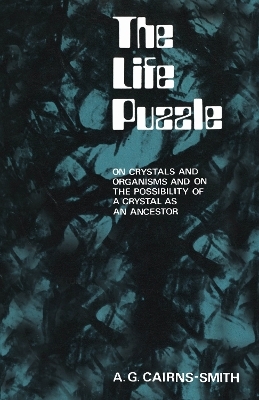
The Life Puzzle
On Crystals and Organisms and on the Possibility of a Crystal As an Ancestor
Seiten
1971
University of Toronto Press (Verlag)
978-1-4426-3889-1 (ISBN)
University of Toronto Press (Verlag)
978-1-4426-3889-1 (ISBN)
- Titel ist leider vergriffen;
keine Neuauflage - Artikel merken
This book does not fall into either the classical Haldane or
Oparin schools of thought on the origin of life, but advances a thesis of its own,
which, according to Professor C.H. Waddington, is one of the most important recent
intellectual developments in this field.
What is the origin of life? Molecular biology shows us one kind, but in thinking about it we must consider those generalised aspects of living organisation that are common to all conceivable forms of life. The author believes that only a combination of general biological theory and particular chemical knowledge can solve the problems of the origin and re-creation of life. This book does not fall into either the classical Haldane or Oparin schools of thought on the origin of life, but advances a thesis of its own, which, according to Professor C.H. Waddington, is one of the most important recent intellectual developments in this field.
Part I considers the role of molecular biology in formulating a view of life as it exists now. Part II turns to more general aspects of the organisation of matter. In Part III the author advances his own theories on the origin of life-theories which are both revolutionary and reactionary. As he remarks, 'If my conclusions are correct it may be difficult to find the right system, but it would be easy to make a very simple organism once we have.'
Oparin schools of thought on the origin of life, but advances a thesis of its own,
which, according to Professor C.H. Waddington, is one of the most important recent
intellectual developments in this field.
What is the origin of life? Molecular biology shows us one kind, but in thinking about it we must consider those generalised aspects of living organisation that are common to all conceivable forms of life. The author believes that only a combination of general biological theory and particular chemical knowledge can solve the problems of the origin and re-creation of life. This book does not fall into either the classical Haldane or Oparin schools of thought on the origin of life, but advances a thesis of its own, which, according to Professor C.H. Waddington, is one of the most important recent intellectual developments in this field.
Part I considers the role of molecular biology in formulating a view of life as it exists now. Part II turns to more general aspects of the organisation of matter. In Part III the author advances his own theories on the origin of life-theories which are both revolutionary and reactionary. As he remarks, 'If my conclusions are correct it may be difficult to find the right system, but it would be easy to make a very simple organism once we have.'
Dr. Cairns-Smith was educated at Edinburgh University and is now an Honorary Senior Research Fellow in the Chemistry Department at Glasgow University.
| Erscheinungsdatum | 16.02.2017 |
|---|---|
| Reihe/Serie | Heritage |
| Verlagsort | Toronto |
| Sprache | englisch |
| Maße | 140 x 216 mm |
| Gewicht | 220 g |
| Themenwelt | Naturwissenschaften ► Biologie ► Genetik / Molekularbiologie |
| Naturwissenschaften ► Chemie ► Physikalische Chemie | |
| Naturwissenschaften ► Physik / Astronomie ► Atom- / Kern- / Molekularphysik | |
| ISBN-10 | 1-4426-3889-3 / 1442638893 |
| ISBN-13 | 978-1-4426-3889-1 / 9781442638891 |
| Zustand | Neuware |
| Informationen gemäß Produktsicherheitsverordnung (GPSR) | |
| Haben Sie eine Frage zum Produkt? |
Mehr entdecken
aus dem Bereich
aus dem Bereich
Theorien, Modelle, Methoden
Buch | Softcover (2024)
Springer Fachmedien (Verlag)
CHF 34,90


