


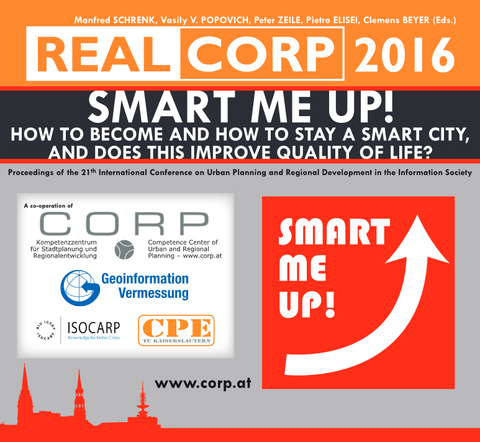
SMART ME UP! How to become and how to stay a Smart City, and does this improve quality of life?
Proceedings of the 21st International Conference on Urban Planning, Regional Development and Information Society
Seiten
2016
|
400. Auflage
CORP - COnsulting Research Projects (Hersteller)
9783950417302 (ISBN)
CORP - COnsulting Research Projects (Hersteller)
9783950417302 (ISBN)

- Titel nicht im Sortiment
- Artikel merken
Smart cities go hand in hand with evolvement and improvement of digital technology. They are a post-industrial reaction to the economic, social and political changes and challenges the world has been facing throughout the last decade – like the demographic change, the financial crisis or scarcity of resources.
In cities there are plenty of players with very different tasks and interests. Many of them are trying to own the term "Smart city". It is somehow fascinating to compare the different interpretations of this label – from a geographic point of view (for example in Europe, USA, China, ...), through its perspective (humans and quality of life or technology and efficieny as centre point?), or generally from an economic position (potential savings on the one hand, rapidly growing business field on the other hand) and via approaches to standardisation of the city and its services.
There are lots of methods to achieve smartness, and there are lots of approaches to define proper smart indicators that tell us something about the smartness of a city. What are their advantages or disadvantages, which approach may claim to be the right one – and why? Smart Cities entstehen Hand in Hand mit der Entwicklung und Verbesserung digitaler Technologie. Sie sind eine post-industrielle Reaktion zu den wirtschaftlichen, sozialen und politischen Änderungen und Herausforderungen, denen sich die Welt innerhalb des letzten Jahrzehnts zu stellen hatte – wie demographischer Wandel, Finanzkrise oder Ressourcenknappheit.
In Städten gibt es zahllose Akteure mit unterschiedlichsten Aufgaben und Interessen. Viele davon versuchen heute, den Begriff "Smart City" für sich zu vereinnahmen. Es ist durchaus faszinierend, die unterschiedlichen Interpretationen gegenüberzustellen – sei es nun vom geographischen Standpunkt (z. B. Europa, USA, China, ...), seien es die Sichtweisen (Mensch und Lebensqualität oder Technologie und Effizienz als Mittelpunkt?) oder seien es die ökonomischen Aspekte (potenzielle Einsparungen einerseits, riesiges rasant wachsendes Geschäftsfeld andererseits) und Ansätze zur Standardisierung und Normung von Städten und ihrer Services.
Es gibt viele Herangehensweisen an Smartness und auch ebensoviele Versuche, passende smarte Indikatoren zu entwickeln, die uns mehr über die Smartness einer Stadt sagen können. Was sind ihre Vor- und Nachteile, welcher Ansatz könnte der beste sein – und warum?
In cities there are plenty of players with very different tasks and interests. Many of them are trying to own the term "Smart city". It is somehow fascinating to compare the different interpretations of this label – from a geographic point of view (for example in Europe, USA, China, ...), through its perspective (humans and quality of life or technology and efficieny as centre point?), or generally from an economic position (potential savings on the one hand, rapidly growing business field on the other hand) and via approaches to standardisation of the city and its services.
There are lots of methods to achieve smartness, and there are lots of approaches to define proper smart indicators that tell us something about the smartness of a city. What are their advantages or disadvantages, which approach may claim to be the right one – and why? Smart Cities entstehen Hand in Hand mit der Entwicklung und Verbesserung digitaler Technologie. Sie sind eine post-industrielle Reaktion zu den wirtschaftlichen, sozialen und politischen Änderungen und Herausforderungen, denen sich die Welt innerhalb des letzten Jahrzehnts zu stellen hatte – wie demographischer Wandel, Finanzkrise oder Ressourcenknappheit.
In Städten gibt es zahllose Akteure mit unterschiedlichsten Aufgaben und Interessen. Viele davon versuchen heute, den Begriff "Smart City" für sich zu vereinnahmen. Es ist durchaus faszinierend, die unterschiedlichen Interpretationen gegenüberzustellen – sei es nun vom geographischen Standpunkt (z. B. Europa, USA, China, ...), seien es die Sichtweisen (Mensch und Lebensqualität oder Technologie und Effizienz als Mittelpunkt?) oder seien es die ökonomischen Aspekte (potenzielle Einsparungen einerseits, riesiges rasant wachsendes Geschäftsfeld andererseits) und Ansätze zur Standardisierung und Normung von Städten und ihrer Services.
Es gibt viele Herangehensweisen an Smartness und auch ebensoviele Versuche, passende smarte Indikatoren zu entwickeln, die uns mehr über die Smartness einer Stadt sagen können. Was sind ihre Vor- und Nachteile, welcher Ansatz könnte der beste sein – und warum?
| Erscheint lt. Verlag | 24.6.2016 |
|---|---|
| Verlagsort | Wien |
| Sprache | englisch; deutsch |
| Maße | 142 x 124 mm |
| Gewicht | 101 g |
| Einbandart | Jewelcase |
| Themenwelt | Naturwissenschaften ► Geowissenschaften ► Geografie / Kartografie |
| Schlagworte | Nachhaltigkeit • Smart City • Stadtplanung • sustainability • urban planning |
| ISBN-13 | 9783950417302 / 9783950417302 |
| Zustand | Neuware |
| Informationen gemäß Produktsicherheitsverordnung (GPSR) | |
| Haben Sie eine Frage zum Produkt? |


