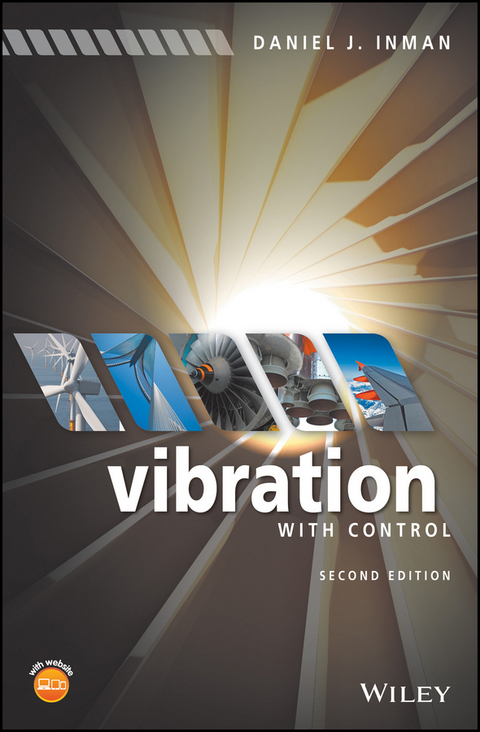
Vibration with Control (eBook)
John Wiley & Sons (Verlag)
978-1-119-10823-8 (ISBN)
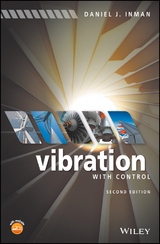
An advanced look at vibration analysis with a focus on active vibration suppression
As modern devices, from cell phones to airplanes, become lighter and more flexible, vibration suppression and analysis becomes more critical. Vibration with Control, 2nd Edition includes modelling, analysis and testing methods. New topics include metastructures and the use of piezoelectric materials, and numerical methods are also discussed. All material is placed on a firm mathematical footing by introducing concepts from linear algebra (matrix theory) and applied functional analysis when required.
Key features:
- Combines vibration modelling and analysis with active control to provide concepts for effective vibration suppression.
- Introduces the use of piezoelectric materials for vibration sensing and suppression.
- Provides a unique blend of practical and theoretical developments.
- Examines nonlinear as well as linear vibration analysis.
- Provides Matlab instructions for solving problems.
- Contains examples and problems.
- PowerPoint Presentation materials and digital solutions manual available for instructors.
Vibration with Control, 2nd Edition is an ideal reference and textbook for graduate students in mechanical, aerospace and structural engineering, as well as researchers and practitioners in the field.
Daniel J. Inman, University of Michigan, USA
An advanced look at vibration analysis with a focus on active vibration suppression As modern devices, from cell phones to airplanes, become lighter and more flexible, vibration suppression and analysis becomes more critical. Vibration with Control, 2nd Edition includes modelling, analysis and testing methods. New topics include metastructures and the use of piezoelectric materials, and numerical methods are also discussed. All material is placed on a firm mathematical footing by introducing concepts from linear algebra (matrix theory) and applied functional analysis when required. Key features: Combines vibration modelling and analysis with active control to provide concepts for effective vibration suppression. Introduces the use of piezoelectric materials for vibration sensing and suppression. Provides a unique blend of practical and theoretical developments. Examines nonlinear as well as linear vibration analysis. Provides Matlab instructions for solving problems. Contains examples and problems. PowerPoint Presentation materials and digital solutions manual available for instructors. Vibration with Control, 2nd Edition is an ideal reference and textbook for graduate students in mechanical, aerospace and structural engineering, as well as researchers and practitioners in the field.
Daniel J. Inman, University of Michigan, USA
Vibration with Control 3
Contents 9
Preface 13
About the Companion Website 15
1 Single Degree of Freedom Systems 17
1.1 Introduction 17
1.2 Spring-Mass System 17
1.3 Spring-Mass-Damper System 22
1.4 Forced Response 26
1.5 Transfer Functions and Frequency Methods 33
1.6 Complex Representation and Impedance 39
1.7 Measurement and Testing 41
1.8 Stability 44
1.9 Design and Control of Vibrations 47
1.10 Nonlinear Vibrations 51
1.11 Computing and Simulation in Matlab™ 54
Chapter Notes 59
References 60
Problems 62
2 Lumped Parameter Models 65
2.1 Introduction 65
2.2 Modeling 68
2.3 Classifications of Systems 72
2.4 Feedback Control Systems 73
2.5 Examples 75
2.6 Experimental Models 80
2.7 Nonlinear Models and Equilibrium 81
Chapter Notes 83
References 84
Problems 84
3 Matrices and the Free Response 87
3.1 Introduction 87
3.2 Eigenvalues and Eigenvectors 87
3.3 Natural Frequencies and Mode Shapes 93
3.4 Canonical Forms 102
3.5 Lambda Matrices 107
3.6 Eigenvalue Estimates 110
3.7 Computation Eigenvalue Problems in Matlab 117
3.8 Numerical Simulation of the Time Response in Matlab™ 120
Chapter Notes 122
References 123
Problems 124
4 Stability 129
4.1 Introduction 129
4.2 Lyapunov Stability 129
4.3 Conservative Systems 132
4.4 Systems with Damping 133
4.5 Semidefinite Damping 134
4.6 Gyroscopic Systems 135
4.7 Damped Gyroscopic Systems 137
4.8 Circulatory Systems 138
4.9 Asymmetric Systems 139
4.10 Feedback Systems 144
4.11 Stability in the State Space 147
4.12 Stability of Nonlinear Systems 149
Chapter Notes 153
References 154
Problems 155
5 Forced Response of Lumped Parameter Systems 159
5.1 Introduction 159
5.2 Response via State Space Methods 159
5.3 Decoupling Conditions and Modal Analysis 164
5.4 Response of Systems with Damping 168
5.5 Stability of the Forced Response 171
5.6 Response Bounds 173
5.7 Frequency Response Methods 174
5.8 Stability of Feedback Control 177
5.9 Numerical Simulations in Matlab 179
Chapter Notes 181
References 182
Problems 183
6 Vibration Suppression 187
6.1 Introduction 187
6.2 Isolators and Absorbers 188
6.3 Optimization Methods 191
6.4 Metastructures 195
6.5 Design Sensitivity and Redesign 197
6.6 Passive and Active Control 200
6.7 Controllability and Observability 204
6.8 Eigenstructure Assignment 209
6.9 Optimal Control 212
6.10 Observers (Estimators) 219
6.11 Realization 224
6.12 Reduced-Order Modeling 226
6.13 Modal Control in State Space 232
6.14 Modal Control in Physical Space 235
6.15 Robustness 240
6.16 Positive Position Feedback Control 242
6.17 Matlab Commands for Control Calculations 245
Chapter Notes 249
References 250
Problems 253
7 Distributed Parameter Models 257
7.1 Introduction 257
7.2 Equations of Motion 257
7.3 Vibration of Strings 263
7.4 Rods and Bars 268
7.5 Vibration of Beams 272
7.6 Coupled Effects 279
7.7 Membranes and Plates 283
7.8 Layered Materials 287
7.9 Damping Models 289
7.10 Modeling Piezoelectric Wafers 292
Chapter Notes 297
References 297
Problems 299
8 Formal Methods of Solutions 303
8.1 Introduction 303
8.2 Boundary Value Problems and Eigenfunctions 303
8.3 Modal Analysis of the Free Response 306
8.4 Modal Analysis in Damped Systems 308
8.5 Transform Methods 310
8.6 Greens Functions 312
Chapter Notes 316
References 317
Problems 317
9 Operators and the Free Response 319
9.1 Introduction 319
9.2 Hilbert Spaces 320
9.3 Expansion Theorems 324
9.4 Linear Operators 325
9.5 Compact Operators 331
9.6 Theoretical Modal Analysis 333
9.7 Eigenvalue Estimates 334
9.8 Enclosure Theorems 337
Chapter Notes 340
References 340
Problems 341
10 Forced Response and Control 343
10.1 Introduction 343
10.2 Response by Modal Analysis 343
10.3 Modal Design Criteria 346
10.4 Combined Dynamical Systems 348
10.5 Passive Control and Design 352
10.6 Distributed Modal Control 354
10.7 Nonmodal Distributed Control 356
10.8 State Space Control Analysis 357
10.9 Vibration Suppression using Piezoelectric Materials 358
Chapter Notes 360
References 361
Problems 362
11 Approximations of Distributed Parameter Models 365
11.1 Introduction 365
11.2 Modal Truncation 365
11.3 Rayleigh-Ritz-Galerkin Approximations 367
11.4 Finite Element Method 370
11.5 Substructure Analysis 375
11.6 Truncation in the Presence of Control 377
11.7 Impedance Method of Truncation and Control 385
Chapter Notes 387
References 387
Problems 388
12 Vibration Measurement 391
12.1 Introduction 391
12.2 Measurement Hardware 392
12.3 Digital Signal Processing 395
12.4 Random Signal Analysis 399
12.5 Modal Data Extraction (Frequency Domain) 403
12.6 Modal Data Extraction (Time Domain) 406
12.7 Model Identification 411
12.8 Model Updating 413
12.9 Verification and Validation 414
Chapter Notes 416
References 417
Problems 418
A Comments on Units 421
Reference 424
B Supplementary Mathematics 425
B.1 Vector Space 425
B.2 Rank 425
B.3 Inverses 426
References 428
Index 429
EULA 442
| Erscheint lt. Verlag | 30.1.2017 |
|---|---|
| Sprache | englisch |
| Themenwelt | Naturwissenschaften ► Physik / Astronomie ► Mechanik |
| Technik ► Maschinenbau | |
| Schlagworte | Active Control • Adaptive Control • Analysis • Applications • Bauingenieur- u. Bauwesen • boundary element methods • Civil Engineering & Construction • Code • Control Systems Technology • Course • Design • eigenvalue problems • Electrical & Electronics Engineering • Elektrotechnik u. Elektronik • Energy • Festkörpermechanik • Festkörpermechanik • fundamental • graduate • Laplace transform • Manual • Maschinenbau • MATLAB • Measurement • mechanical engineering • metastructures • Methods • modal analysis • Modal Testing • Modeling • non linear vibration • Passive Control • Piezoelectric • PowerPoint Slides • Practical • problems examples • Regelungstechnik • Robustness • solid mechanics • Solution • Solutions • Structures • Textbook • theory • Tragwerke • Validation • verification • Vibration • Vibration Suppression • Website |
| ISBN-10 | 1-119-10823-3 / 1119108233 |
| ISBN-13 | 978-1-119-10823-8 / 9781119108238 |
| Informationen gemäß Produktsicherheitsverordnung (GPSR) | |
| Haben Sie eine Frage zum Produkt? |
 PDF (Adobe DRM)
Kopierschutz: Adobe-DRM
Adobe-DRM ist ein Kopierschutz, der das eBook vor Mißbrauch schützen soll. Dabei wird das eBook bereits beim Download auf Ihre persönliche Adobe-ID autorisiert. Lesen können Sie das eBook dann nur auf den Geräten, welche ebenfalls auf Ihre Adobe-ID registriert sind.
Details zum Adobe-DRM
Dateiformat: PDF (Portable Document Format)
Mit einem festen Seitenlayout eignet sich die PDF besonders für Fachbücher mit Spalten, Tabellen und Abbildungen. Eine PDF kann auf fast allen Geräten angezeigt werden, ist aber für kleine Displays (Smartphone, eReader) nur eingeschränkt geeignet.
Systemvoraussetzungen:
PC/Mac: Mit einem PC oder Mac können Sie dieses eBook lesen. Sie benötigen eine
eReader: Dieses eBook kann mit (fast) allen eBook-Readern gelesen werden. Mit dem amazon-Kindle ist es aber nicht kompatibel.
Smartphone/Tablet: Egal ob Apple oder Android, dieses eBook können Sie lesen. Sie benötigen eine
Geräteliste und zusätzliche Hinweise
Buying eBooks from abroad
For tax law reasons we can sell eBooks just within Germany and Switzerland. Regrettably we cannot fulfill eBook-orders from other countries.
aus dem Bereich