


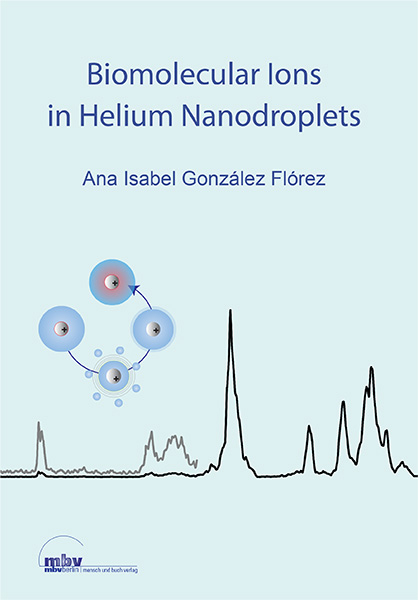
Biomolecular Ions in Super uid Helium Nanodroplets
Seiten
2016
|
1. Aufl.
Mensch & Buch (Verlag)
9783863877668 (ISBN)
Mensch & Buch (Verlag)
9783863877668 (ISBN)
- Keine Verlagsinformationen verfügbar
- Artikel merken
The function of a biological molecule is closely related to its structure. As a result, understanding and predicting biomolecular structure has become the focus of an extensive field of research. However, the investigation of molecular structure can be hampered by two main dificulties: the inherent complications that may arise from studying biological molecules in their native environment, and the potential congestion of the experimental results as a consequence of the large number of degrees of freedom present in these molecules.
In this work, a new experimental setup has been developed and established in order to overcome the afore mentioned limitations combining structure-sensitive gas-phase methods with superfluid helium droplets. First, biological molecules are ionised and brought into the gas phase, often referred to as a clean-room environment, where the species of interest are isolated from their surroundings and, thus, intermolecular interactions are absent. The mass-to-charge selected biomolecules are then embedded inside clusters of superfluid helium with an equilibrium temperature of ~ 0.37 K. As a result, the internal energy of the molecules is lowered, thereby reducing the number of populated quantum states. Finally, the local hydrogen bonding patterns of the molecules are investigated by probing specific vibrational modes using the Fritz Haber Institute's free electron laser as a source of infrared radiation.
Although the structure of a wide variety of molecules has been studied making use of the sub-Kelvin environment provided by superfluid helium droplets, the suitability of this method for the investigation of biological molecular ions was still unclear. However, the experimental results presented in this thesis demonstrate the applicability of this experimental approach in order to study the structure of intact, large biomolecular ions and the first vibrational spectrum of the protonated pentapeptide leu-enkephalin embedded in helium droplets has been recorded. The experimental results show well resolved spectra, which are in good agreement with theoretical calculations. Moreover, the weakly interacting nature of helium droplets is confirmed by the excellent agreement obtained with the available gas-phase data.
Using standard gas-phase mass spectrometry techniques allows to study the molecular ions as a function of charge state. As a result, the role of the interplay between Coulomb repulsion and hydrogen bonding in the secondary structure of the target molecules can be investigated. For this purpose, the infrared spectra of the proteins ubiquitin and cytochrome c embedded in helium droplets were recorded. The experimental results are interpreted in terms of a chargeinduced unzipping of the proteins, where a structural transition from helical into extended C5-type hydrogen bonded structures occurs. This interpretation is supported by simple energy considerations, as well as by quantum chemical calculations on model peptides. The transition in secondary structure observed here is most likely universal for isolated proteins in the gas phase.
Embedding positively charged ions inside helium droplets also offers the possibility to directly investigate the intrinsic properties of helium droplets. One fundamental characteristic of helium droplets is their unique ability to pick up the species with which they collide. In order to gain more insight into this process, the presence of an electrical charge was used to accelerate and detect the ion-doped droplets as a function of the mass and size of the dopant. A systematic investigation of the pick-up probability demonstrates the existence of a dopant dependent minimum droplet size below which no pick-up occurs. As a result, different hypotheses and theoretical models are proposed and discussed in order to shed more light into the constraints and limitations of the pick-up process.
In this work, a new experimental setup has been developed and established in order to overcome the afore mentioned limitations combining structure-sensitive gas-phase methods with superfluid helium droplets. First, biological molecules are ionised and brought into the gas phase, often referred to as a clean-room environment, where the species of interest are isolated from their surroundings and, thus, intermolecular interactions are absent. The mass-to-charge selected biomolecules are then embedded inside clusters of superfluid helium with an equilibrium temperature of ~ 0.37 K. As a result, the internal energy of the molecules is lowered, thereby reducing the number of populated quantum states. Finally, the local hydrogen bonding patterns of the molecules are investigated by probing specific vibrational modes using the Fritz Haber Institute's free electron laser as a source of infrared radiation.
Although the structure of a wide variety of molecules has been studied making use of the sub-Kelvin environment provided by superfluid helium droplets, the suitability of this method for the investigation of biological molecular ions was still unclear. However, the experimental results presented in this thesis demonstrate the applicability of this experimental approach in order to study the structure of intact, large biomolecular ions and the first vibrational spectrum of the protonated pentapeptide leu-enkephalin embedded in helium droplets has been recorded. The experimental results show well resolved spectra, which are in good agreement with theoretical calculations. Moreover, the weakly interacting nature of helium droplets is confirmed by the excellent agreement obtained with the available gas-phase data.
Using standard gas-phase mass spectrometry techniques allows to study the molecular ions as a function of charge state. As a result, the role of the interplay between Coulomb repulsion and hydrogen bonding in the secondary structure of the target molecules can be investigated. For this purpose, the infrared spectra of the proteins ubiquitin and cytochrome c embedded in helium droplets were recorded. The experimental results are interpreted in terms of a chargeinduced unzipping of the proteins, where a structural transition from helical into extended C5-type hydrogen bonded structures occurs. This interpretation is supported by simple energy considerations, as well as by quantum chemical calculations on model peptides. The transition in secondary structure observed here is most likely universal for isolated proteins in the gas phase.
Embedding positively charged ions inside helium droplets also offers the possibility to directly investigate the intrinsic properties of helium droplets. One fundamental characteristic of helium droplets is their unique ability to pick up the species with which they collide. In order to gain more insight into this process, the presence of an electrical charge was used to accelerate and detect the ion-doped droplets as a function of the mass and size of the dopant. A systematic investigation of the pick-up probability demonstrates the existence of a dopant dependent minimum droplet size below which no pick-up occurs. As a result, different hypotheses and theoretical models are proposed and discussed in order to shed more light into the constraints and limitations of the pick-up process.
| Erscheinungsdatum | 27.01.2017 |
|---|---|
| Verlagsort | Berlin |
| Sprache | englisch |
| Maße | 148 x 210 mm |
| Einbandart | gebunden |
| Themenwelt | Naturwissenschaften ► Physik / Astronomie ► Angewandte Physik |
| Naturwissenschaften ► Physik / Astronomie ► Theoretische Physik | |
| Schlagworte | biological molecules • Biomolecular Ions • Superfluid Helium Nanodroplets |
| ISBN-13 | 9783863877668 / 9783863877668 |
| Zustand | Neuware |
| Informationen gemäß Produktsicherheitsverordnung (GPSR) | |
| Haben Sie eine Frage zum Produkt? |
Mehr entdecken
aus dem Bereich



aus dem Bereich


