


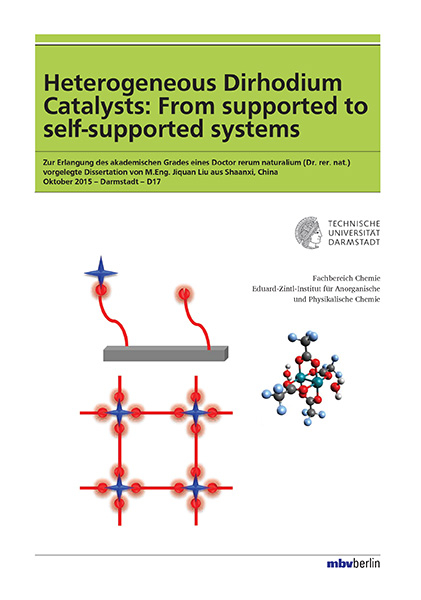
Heterogeneous Dirhodium Catalysts: From supported to self-supported systems
Seiten
2016
|
1. Aufl.
Mensch & Buch (Verlag)
9783863877521 (ISBN)
Mensch & Buch (Verlag)
9783863877521 (ISBN)
- Keine Verlagsinformationen verfügbar
- Artikel merken
To further the goal of sustainable chemistry, this thesis is focused on the development of heterogenized dirhodium catalysts which can be applied in carbene transfer reactions such as cyclopropanation. Two series of heterogenized dirhodium catalysts are developed, namely supported and self-supported dirhodium catalysts by employing dirhodium complexes as precursors (e.g. rhodium trifluoroacetate dimer (Rh2(TFA)4) and rhodium acetate dimer (Rh2(OAc)4)).
In the case of supported dirhodium catalysts, bi-functional SBA-15 with both amine and carboxyl groups is synthesized. The presence of functional ligands on SBA-15 is studied by 29Si CP MAS NMR and 13C CP MAS NMR. The covalent binding via amine and/or carboxyl groups is investigated by 15N CP MAS DNP NMR and 13C CP MAS DNP NMR (or 13C CP MAS NMR). Evidence is given that the dirhodium unit may be bound via both carboxyl and amine groups by 13C NMR and X-ray photoelectron spectroscopy (XPS) where the signals for carboxyl-amine ion pairs changes after introducing Rh2(TFA)4. Quantitative 19F MAS NMR spectra are recorded to identify the chemical environment of fluorine and number of exchanged ligands. Additionally, the physical structure of both carriers and corresponding immobilized catalysts are investigated by N2 adsorption-desorption isotherm, small angle X-ray diffraction (SAXRD) and transmission electron microscope (TEM). The morphology is studied by scanning electron microscope (SEM).
As a second example of supported dirhodium catalysts, one type of abundant natural nanoparticles namely cellulose nanocrystals (CNC) with large surface area and enriched carboxyl groups are used to anchor Rh2(TFA)4 via ligand substitution. The carboxyl binding site is confirmed by 13C CP MAS NMR. The residual trifluoroacetate group is confirmed by 19F MAS NMR. Both pristine CNC and immobilized catalyst are investigated by SEM and atomic force microscope (AFM).
In the case of self-supported dirhodium catalyst, terephthalic acid is employed to synthesize a dirhodium coordination polymer (Rh2-T) via ligand exchange. In a following case study, various types of modified terephthalic acids are introduced to bridge the dirhodium units (Rh2-TOR). 13C CP MAS NMR and XPS are performed to confirm the carboxyl binding sites. Then, diffuse reflectance ultraviolet-visible spectroscopy (DR-UV-vis) and XPS are arranged to reveal the stability of the dirhodium units during the formation of the coordination polymer. The 3D structured solid is studied by X-ray diffraction (XRD) and SEM.
The standard cyclopropanation reaction between styrene and ethyl diazoacetate (EDA) is employed to evaluate the performance of all the heterogenized dirhodium catalysts. The diastereoselectivity of the reaction is monitored by GC analysis. Finally, leaching and recyclability tests are conducted to study the stability of the binding and the reusability feature of the catalysts. Zur Förderung des Zieles der nachhaltigen Chemie setzt diese Arbeit ihren Schwerpunkt auf die Entwicklung heterogener Dirhodiumkatalysatoren, welche in Carbentransfer- sowie Cyclopropanierungsreaktionen Anwendung finden. Zwei Serien von heterogenen Katalysatoren werden entwickelt, geträgerte und „self-supported“ Dirhodiumkatalysatoren. Dabei kommen homogene Dirhodiumkomplexe wie z.B. Dirhodiumtrifluoroacetat (Rh2(TFA)4) und Dirhodiumacetat (Rh2(OAc)4)) als Precurser zum Einsatz.
Im Falle der geträ gerten Dirhodiumkatalysatoren wird zunächst bifunktionales SBA-15 Material synthetisiert, welches sowohl Amin- als auch Carboxyl-Linker an der Oberfläche enthält. Die Struktur und Bindung der Liganden wird mittels 29Si CP MAS und 13C CP MAS NMR untersucht.
Die kovalente Anbindung des Katalysators über Amin- und /oder Carboxyl-Gruppen wird mittels 15N CP MAS DNP und 13C CP MAS DNP NMR (oder 13C CP MAS NMR) analysiert. Anschließend wird die Möglichkeit der Anbindung der Dirhodium-Einheit über Carboxyl und Amin-Gruppen durch 13C NMR und X-Ray Elektronenspektroskopie (XPS) verdeutlicht, in denen sich die Signale der Carboxyl-Amine-Ionenpaare nach Anbindung von Rh2(TFA)4 drastisch ändern. Quantitative 19F MAS NMR Spektren werden aufgenommen um die chemische Umgebung des Fluors und die Anzahl der ausgetauschten Liganden zu bestimmen. Zusätzlich wird die physikalische Struktur des Trägermaterials und des zugehörigen immobilisierten Katalysators mittels Stickstoff-Adsorption-Desorptionsmessungen, Small Angle X-ray Diffraction (SAXRD) und Transmissionselektronenmikroskopie untersucht. Die Morphologie wird mittels Scanning Electron Microscopy (SEM) bestimmt.
Als zweites Beispiel werden natürlich vorkommende Nanopartikel, basierend auf Cellulose Nanokristallen (CNCs) mit großen Oberflächen und Anzahl an Carboxylgruppen verwendet um Rh2(TFA)4 durch Ligandensubstitution anzubinden. Die Carboxylanbindung wird mittels 13C CP MAS NMR untermauert. Der Nachweis vorhandener Trifluoracetatgruppen wird mittels 19F MAS NMR erbracht. Sowohl das reine CNC Material als auch der immobilisierte Katalysator werden mittels SEM und Atomic Force Microscopy (AFM) untersucht.
Im Falle der “self-supported” Dirhodiumkatalysatoren wird Terephtalsäure verwendet, um das Dirhodiumkoordinationspolymer (Rh2-T) durch Ligandenaustausch zu synthetisieren. In der folgenden Fallstudie, werden verschiedene Arten von modifizierten Terephtalsäurederivaten eingesetzt um die Dirhodiumeinheiten zu verknüpfen (Rh2-TOR). 13C CP MAS und XPS Experimente werden durchgeführt um die Carboxylanbindung zu validieren. Daneben werden Diffuse Reflectance Ultraviolet-Visible Spektroskopie (DR-UV-vis) und XPS durchgeführt um die Stabilität der Dirhodiumeinheiten während der Bildung des Koordinationspolymers zu ü berprüfen. Die 3D Struktur des Feststoffes wird mittels X-Ray Diffraction (XRD) und SEM untersucht.
Als Standardreaktion wird die Cyclopropanierung zwischen Styren und Etyldiazoacetat (EDA) verwendet, um die katalytischen Eigenschaften aller heterogenen Katalysatoren zu untersuchen. Die Diasteroselektivität der Reaktion wird mittels Gaschromatographie (GC) verfolgt. Zuletzt werden Analysen zum „Leaching“ und zur Wiederverwendbarkeit der Katalysatoren durchgeführt.
In the case of supported dirhodium catalysts, bi-functional SBA-15 with both amine and carboxyl groups is synthesized. The presence of functional ligands on SBA-15 is studied by 29Si CP MAS NMR and 13C CP MAS NMR. The covalent binding via amine and/or carboxyl groups is investigated by 15N CP MAS DNP NMR and 13C CP MAS DNP NMR (or 13C CP MAS NMR). Evidence is given that the dirhodium unit may be bound via both carboxyl and amine groups by 13C NMR and X-ray photoelectron spectroscopy (XPS) where the signals for carboxyl-amine ion pairs changes after introducing Rh2(TFA)4. Quantitative 19F MAS NMR spectra are recorded to identify the chemical environment of fluorine and number of exchanged ligands. Additionally, the physical structure of both carriers and corresponding immobilized catalysts are investigated by N2 adsorption-desorption isotherm, small angle X-ray diffraction (SAXRD) and transmission electron microscope (TEM). The morphology is studied by scanning electron microscope (SEM).
As a second example of supported dirhodium catalysts, one type of abundant natural nanoparticles namely cellulose nanocrystals (CNC) with large surface area and enriched carboxyl groups are used to anchor Rh2(TFA)4 via ligand substitution. The carboxyl binding site is confirmed by 13C CP MAS NMR. The residual trifluoroacetate group is confirmed by 19F MAS NMR. Both pristine CNC and immobilized catalyst are investigated by SEM and atomic force microscope (AFM).
In the case of self-supported dirhodium catalyst, terephthalic acid is employed to synthesize a dirhodium coordination polymer (Rh2-T) via ligand exchange. In a following case study, various types of modified terephthalic acids are introduced to bridge the dirhodium units (Rh2-TOR). 13C CP MAS NMR and XPS are performed to confirm the carboxyl binding sites. Then, diffuse reflectance ultraviolet-visible spectroscopy (DR-UV-vis) and XPS are arranged to reveal the stability of the dirhodium units during the formation of the coordination polymer. The 3D structured solid is studied by X-ray diffraction (XRD) and SEM.
The standard cyclopropanation reaction between styrene and ethyl diazoacetate (EDA) is employed to evaluate the performance of all the heterogenized dirhodium catalysts. The diastereoselectivity of the reaction is monitored by GC analysis. Finally, leaching and recyclability tests are conducted to study the stability of the binding and the reusability feature of the catalysts. Zur Förderung des Zieles der nachhaltigen Chemie setzt diese Arbeit ihren Schwerpunkt auf die Entwicklung heterogener Dirhodiumkatalysatoren, welche in Carbentransfer- sowie Cyclopropanierungsreaktionen Anwendung finden. Zwei Serien von heterogenen Katalysatoren werden entwickelt, geträgerte und „self-supported“ Dirhodiumkatalysatoren. Dabei kommen homogene Dirhodiumkomplexe wie z.B. Dirhodiumtrifluoroacetat (Rh2(TFA)4) und Dirhodiumacetat (Rh2(OAc)4)) als Precurser zum Einsatz.
Im Falle der geträ gerten Dirhodiumkatalysatoren wird zunächst bifunktionales SBA-15 Material synthetisiert, welches sowohl Amin- als auch Carboxyl-Linker an der Oberfläche enthält. Die Struktur und Bindung der Liganden wird mittels 29Si CP MAS und 13C CP MAS NMR untersucht.
Die kovalente Anbindung des Katalysators über Amin- und /oder Carboxyl-Gruppen wird mittels 15N CP MAS DNP und 13C CP MAS DNP NMR (oder 13C CP MAS NMR) analysiert. Anschließend wird die Möglichkeit der Anbindung der Dirhodium-Einheit über Carboxyl und Amin-Gruppen durch 13C NMR und X-Ray Elektronenspektroskopie (XPS) verdeutlicht, in denen sich die Signale der Carboxyl-Amine-Ionenpaare nach Anbindung von Rh2(TFA)4 drastisch ändern. Quantitative 19F MAS NMR Spektren werden aufgenommen um die chemische Umgebung des Fluors und die Anzahl der ausgetauschten Liganden zu bestimmen. Zusätzlich wird die physikalische Struktur des Trägermaterials und des zugehörigen immobilisierten Katalysators mittels Stickstoff-Adsorption-Desorptionsmessungen, Small Angle X-ray Diffraction (SAXRD) und Transmissionselektronenmikroskopie untersucht. Die Morphologie wird mittels Scanning Electron Microscopy (SEM) bestimmt.
Als zweites Beispiel werden natürlich vorkommende Nanopartikel, basierend auf Cellulose Nanokristallen (CNCs) mit großen Oberflächen und Anzahl an Carboxylgruppen verwendet um Rh2(TFA)4 durch Ligandensubstitution anzubinden. Die Carboxylanbindung wird mittels 13C CP MAS NMR untermauert. Der Nachweis vorhandener Trifluoracetatgruppen wird mittels 19F MAS NMR erbracht. Sowohl das reine CNC Material als auch der immobilisierte Katalysator werden mittels SEM und Atomic Force Microscopy (AFM) untersucht.
Im Falle der “self-supported” Dirhodiumkatalysatoren wird Terephtalsäure verwendet, um das Dirhodiumkoordinationspolymer (Rh2-T) durch Ligandenaustausch zu synthetisieren. In der folgenden Fallstudie, werden verschiedene Arten von modifizierten Terephtalsäurederivaten eingesetzt um die Dirhodiumeinheiten zu verknüpfen (Rh2-TOR). 13C CP MAS und XPS Experimente werden durchgeführt um die Carboxylanbindung zu validieren. Daneben werden Diffuse Reflectance Ultraviolet-Visible Spektroskopie (DR-UV-vis) und XPS durchgeführt um die Stabilität der Dirhodiumeinheiten während der Bildung des Koordinationspolymers zu ü berprüfen. Die 3D Struktur des Feststoffes wird mittels X-Ray Diffraction (XRD) und SEM untersucht.
Als Standardreaktion wird die Cyclopropanierung zwischen Styren und Etyldiazoacetat (EDA) verwendet, um die katalytischen Eigenschaften aller heterogenen Katalysatoren zu untersuchen. Die Diasteroselektivität der Reaktion wird mittels Gaschromatographie (GC) verfolgt. Zuletzt werden Analysen zum „Leaching“ und zur Wiederverwendbarkeit der Katalysatoren durchgeführt.
| Erscheinungsdatum | 23.01.2017 |
|---|---|
| Verlagsort | Berlin |
| Sprache | englisch |
| Maße | 148 x 210 mm |
| Einbandart | gebunden |
| Themenwelt | Naturwissenschaften ► Chemie ► Anorganische Chemie |
| Schlagworte | CNCs • Heterogeneous Dirhodium Catalysts • Sustainable chemistry |
| ISBN-13 | 9783863877521 / 9783863877521 |
| Zustand | Neuware |
| Informationen gemäß Produktsicherheitsverordnung (GPSR) | |
| Haben Sie eine Frage zum Produkt? |
Mehr entdecken
aus dem Bereich
aus dem Bereich


