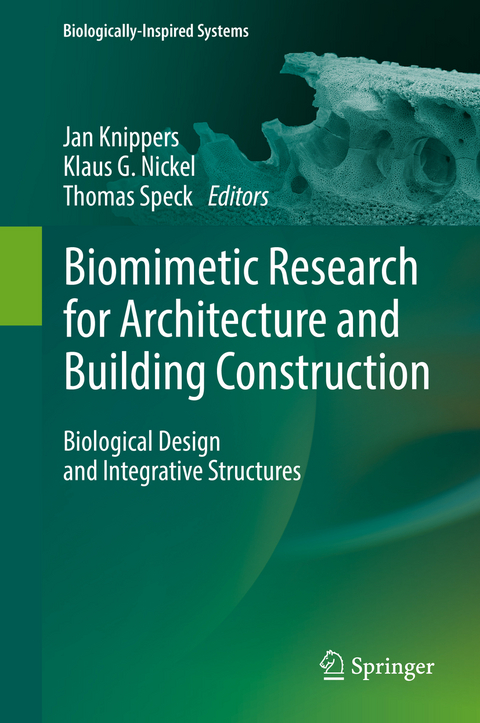
Biomimetic Research for Architecture and Building Construction (eBook)
XIII, 408 Seiten
Springer International Publishing (Verlag)
978-3-319-46374-2 (ISBN)
This book comprises a first survey of the Collaborative Research Center SFB-TRR 141 'Biological Design and Integrative Structures - Analysis, Simulation and Implementation in Architecture', funded by the Deutsche Forschungsgemeinschaft since October 2014. The SFB-TRR 141 provides a collaborative framework for architects and engineers from the University of Stuttgart, biologists and physicists from the University of Freiburg and geoscientists and evolutionary biologists from the University of Tübingen. The programm is conceptualized as a dialogue between the disciplines and is based on the belief that that biomimetic research has the potential to lead everyone involved to new findings far beyond his individual reach. During the last few decades, computational methods have been introduced into all fields of science and technology. In architecture, they enable the geometric differentiation of building components and allow the fabrication of porous or fibre-based materials with locally adjusted physical and chemical properties. Recent developments in simulation technologies focus on multi-scale models and the interplay of mechanical phenomena at various hierarchical levels. In the natural sciences, a multitude of quantitative methods covering diverse hierarchical levels have been introduced. These advances in computational methods have opened a new era in biomimetics: local differentiation at various scales, the main feature of natural constructions, can for the first time not only be analysed, but to a certain extent also be transferred to building construction. Computational methodologies enable the direct exchange of information between fields of science that, until now, have been widely separated. As a result they lead to a new approach to biomimetic research, which, hopefully, contributes to a more sustainable development in architecture and building construction.
Jan Knippers (corresponding editor), University of Stuttgart, Stuttgart, Germany Klaus G. Nickel, University of Tübingen, Tübingen, GermanyThomas Speck, University of Freiburg, Freiburg, Germany
1. Biomimetic Research: a Dialogue Between the DisciplinesJan Knippers, Thomas Speck and Klaus G. Nickel2. From Minimal Surfaces to Integrative Structures – The SFB-TRR 141 in the Light of the Legacy of Frei Otto and the SFB 230 ‘Natürliche Konstruktionen’Jan Knippers3. Bionics and Biodiversity – Bio-inspired Technical Innovation for a Sustainable FutureWilhelm Barthlott, M. Daud Rafiqpoor and Walter R. Erdelen4. Insect-Inspired Architecture – Insects and other arthropods as a source for creative design in architectureStanislav N. Gorb and Elena V. Gorb5. In Search of some Principles of Bio-Mimetics in Structural EngineeringBill Addis6. Fundamentals of Heat and Mass Transport in Frost-Resistant Plant TissuesLukas Eurich, Rena Schott, Arndt Wagner, Anita Roth-Nebelsick and Wolfgang Ehlers7. Plants and Animals as Source of Inspiration for Energy Dissipation in Load Bearing Systems and FacadesKatharina Klang, Georg Bauer, Nicu Toader, Christoph Lauer, Kathrin Termin, Stefanie Schmier, Daria Kovaleva, Walter Haase, Christoph Berthold, Klaus G. Nickel, Thomas Speck and Werner Sobek8. Adaptive Stiffness and Joint-Free Kinematics – Actively Actuated Rod-Shaped Structures in Plants and Animals and their Biomimetic Potential in Architecture and EngineeringOliver Betz, Annette Birkhold, Marco Caliaro, Benjamin Eggs, Anja Mader, Jan Knippers, Oliver Röhrle and Olga Speck9. Compliant Mechanisms in Plants and ArchitectureSimon Poppinga, Axel Körner, Renate Sachse, Larissa Born, Anna Westermeier, Linnea Hesse, Jan Knippers, Manfred Bischoff, Götz Gresser and Thomas Speck10. Branched Structures in Plants and ArchitectureLarissa Born, Florian A. Jonas, Katharina Bunk, Tom Masselter, Thomas Speck, Jan Knippers and Götz T. Gresser11. The Skeleton of the Sand Dollar as a Biological Role Model for Segmented Shells in Building Construction: a Research Review Tobias B. Grun, Layla Koohi, Tobias Schwinn, Daniel Sonntag, Malte von Scheven, Manfred Bischoff, Jan Knippers, Achim Menges and James H. Nebelsick12. Continuous Fused Deposition Modelling of Architectural Envelopes Based on the Shell Formation of Molluscs: a Research ReviewJames H. Nebelsick, Christoph Allgaier, Benjamin Felbrich, Daniel Coupek, Renate Reiter, Günter Reiter, Achim Menges, Armin Lechler and Karl-Heinz Wurst13. Analysis of Physcomitrella Chloroplasts to Reveal Adaption Principles Leading to Structural Stability at the Nano-ScalePouyan Asgharzadeh, Bugra Özdemir, Stefanie J. Müller, Oliver Röhrle and Ralf Reski14. Developing the Experimental Basis for an Evaluation of Scaling Properties of Brittle and "Quasi-Brittle" Biological MaterialsStefanie Schmier, Christoph Lauer, Immanuel Schäfer, Katharina Klang, Georg Bauer, Marc Thielen, Kathrin Termin, Christoph Berthold, Siegfried Schmauder, Thomas Speck and Klaus Nickel15. Evolutionary Processes as Models for Exploratory DesignLong Nguyen, Daniel Lang, Nico van Gessel, Anna K. Beike, Achim Menges, Ralf Reski and Anita Roth-Nebelsick16. Fabrication of Biomimetic and Biologically Inspired (Modular) Structures for Use in the Construction IndustrieDaniel Coupek, Daria Kovaleva, Hans Christoph, Karl-Heinz Wurst, Alexander Verl, Werner Sobek, Walter Haase, Götz Gresser and Armin Lechler17. Structural Design with Biological Methods: Optimality, Multi-Functionality and RobustnessDebdas Paul, Layla Koohi Fayegh Dehkordi, Malte von Scheven, Manfred Bischoff and Nicole Radde18. Bio-Inspired Sustainability Assessment – a Conceptual FrameworkRafael Horn, Johannes Gantner, Ludmila Widmer, Klaus Peter Sedlbauer and Olga Speck19. Making Life “Visible”: Organism Concepts in Biology and Architecture as the Basis for an Interdisciplinary Synopsis of Constructional BiomimeticsGerd de Bruyn, Oliver Betz, James H. Nebelsick, Manfred Drack, Mirco Limpinsel20. Perceptual Orientation and Spatial Navigation in Dense Urban EnvironmentsPatrik Schumacher
| Erscheint lt. Verlag | 19.12.2016 |
|---|---|
| Reihe/Serie | Biologically-Inspired Systems | Biologically-Inspired Systems |
| Zusatzinfo | XIII, 408 p. 197 illus., 115 illus. in color. |
| Verlagsort | Cham |
| Sprache | englisch |
| Themenwelt | Naturwissenschaften ► Biologie |
| Technik | |
| Schlagworte | Architecture • Biologically-inspired design • Biomimetics • Building Construction • sustainability |
| ISBN-10 | 3-319-46374-8 / 3319463748 |
| ISBN-13 | 978-3-319-46374-2 / 9783319463742 |
| Informationen gemäß Produktsicherheitsverordnung (GPSR) | |
| Haben Sie eine Frage zum Produkt? |
 PDF (Wasserzeichen)
DRM: Digitales Wasserzeichen
Dieses eBook enthält ein digitales Wasserzeichen und ist damit für Sie personalisiert. Bei einer missbräuchlichen Weitergabe des eBooks an Dritte ist eine Rückverfolgung an die Quelle möglich.
Dateiformat: PDF (Portable Document Format)
Mit einem festen Seitenlayout eignet sich die PDF besonders für Fachbücher mit Spalten, Tabellen und Abbildungen. Eine PDF kann auf fast allen Geräten angezeigt werden, ist aber für kleine Displays (Smartphone, eReader) nur eingeschränkt geeignet.
Systemvoraussetzungen:
PC/Mac: Mit einem PC oder Mac können Sie dieses eBook lesen. Sie benötigen dafür einen PDF-Viewer - z.B. den Adobe Reader oder Adobe Digital Editions.
eReader: Dieses eBook kann mit (fast) allen eBook-Readern gelesen werden. Mit dem amazon-Kindle ist es aber nicht kompatibel.
Smartphone/Tablet: Egal ob Apple oder Android, dieses eBook können Sie lesen. Sie benötigen dafür einen PDF-Viewer - z.B. die kostenlose Adobe Digital Editions-App.
Buying eBooks from abroad
For tax law reasons we can sell eBooks just within Germany and Switzerland. Regrettably we cannot fulfill eBook-orders from other countries.
aus dem Bereich