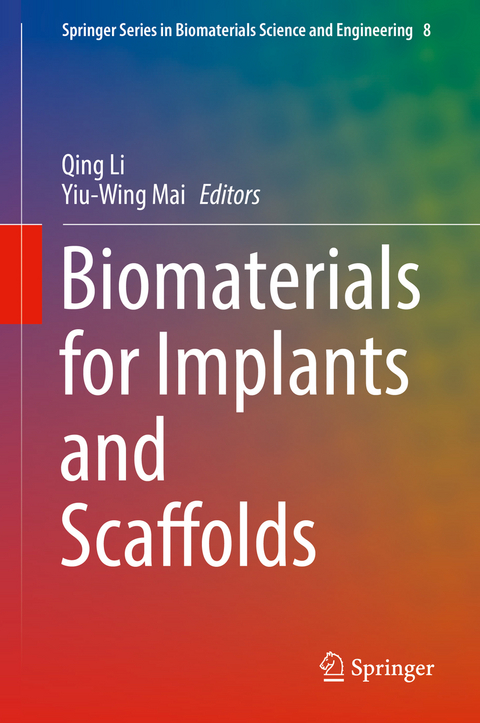
Biomaterials for Implants and Scaffolds (eBook)
XIII, 466 Seiten
Springer Berlin Heidelberg (Verlag)
978-3-662-53574-5 (ISBN)
This book highlights the latest, cutting-edge advances in implantable biomaterials. It brings together a class of advanced biomaterials in two highly active research areas, namely implants and tissue scaffolds, to underline their respective functional requirements for further development. It is unique in providing a full range of methodological procedures, including materials syntheses, characterisation, cellular tests and mathematical modelling. Covering metallic, ceramic, polymeric and composite materials commonly used in biological applications and clinical therapeutics, it is a valuable resource for anyone wanting to further their understanding of the latest developments in implantable biomaterials. Focusing on biomedical applications in implants and scaffolds, it provides methodological guides to this rapidly growing field.
Qing Li and Yiu-Wing Mai are both professors at the University of Sydney, School of Aerospace, Mechanical and Mechatronic Engineering.
Dr. Qing Li received his PhD from the University of Sydney, Australia in 2000. He previously worked at Cornell University (USA) and James Cook University (Australia). Qing Li is currently a Professor in biomedical engineering at the University of Sydney. Dr. Qing Li has proven expertise in computational biomechanics and biomaterials with focuses on implants and scaffolds. In his career, he has been awarded an Australian Postdoctoral Fellowship (2001-03) and a Future Fellowship (2013-17), respectively, by Australian Research Council.
Professor Yiu-Wing Mai is a mechanical engineering alumnus of the University of Hong Kong graduated BSc (Eng) & Williamson Prizeman in 1969, PhD in 1972 and DSc in 1999. He also obtained DEng from the University of Sydney in 1999. He previously worked in the US (University of Michigan and NIST), the UK (Imperial College) and Hong Kong (HKUST, CityU, HKU and PolyU). Prof Mai is currently University Chair and Professor of Mechanical Engineering at the University of Sydney. Prof Mai is a highly cited researcher in materials science and is distinguished for his seminal work on fracture mechanics and advanced composite materials. He has published a number of papers on wound healing, biomaterials for implants and scaffolds. He is Fellow of the Royal Society, the Royal Academy of Engineering, the Australian Academy of Science, and the Australian Academy of Technological Sciences and Engineering.
Dr. Qing Li received his PhD from the University of Sydney, Australia in 2000. He previously worked at Cornell University (USA) and James Cook University (Australia). Qing Li is currently a Professor in biomedical engineering at the University of Sydney. Dr. Qing Li has proven expertise in computational biomechanics and biomaterials with focuses on implants and scaffolds. In his career, he has been awarded an Australian Postdoctoral Fellowship (2001-03) and a Future Fellowship (2013-17), respectively, by Australian Research Council. Professor Yiu-Wing Mai is a mechanical engineering alumnus of the University of Hong Kong graduated BSc (Eng) & Williamson Prizeman in 1969, PhD in 1972 and DSc in 1999. He also obtained DEng from the University of Sydney in 1999. He previously worked in the US (University of Michigan and NIST), the UK (Imperial College) and Hong Kong (HKUST, CityU, HKU and PolyU). Prof Mai is currently University Chair and Professor of Mechanical Engineering at the University of Sydney. Prof Mai is a highly cited researcher in materials science and is distinguished for his seminal work on fracture mechanics and advanced composite materials. He has published a number of papers on wound healing, biomaterials for implants and scaffolds. He is Fellow of the Royal Society, the Royal Academy of Engineering, the Australian Academy of Science, and the Australian Academy of Technological Sciences and Engineering.
Multiscale Modelling and Simulation of Musculoskeletal Tissues for Orthopaedics.- Performance Evaluation of Bone-Implant System during Implantation Process - Dynamic Modelling and Analysis.- Multiscale Remodelling and Topographical Optimisation for Porous Implant Surface Morphology Design.- Implant Surface Modifications and Osseointegration.- Advances in Bioglass and Glass Ceramics for Biomedical Applications.- Clinical Resurfacing of Feldspar and Leucite Glass Ceramics Using Dental Handpieces and Burs.- Polymer Blends and Composites for Biomedical Applications.- Electrospun Polymer Scaffolds: Their biomedical and Mechanical Properties.- Electrospun Nanofibrous Scaffolds for Soft Tissue Regeneration.- Biomimic Design of Periosteum: Construction Strategies, Scaffold Design and Cell Sources.- Characterisation of Hydrogel Scaffolds under Compression.- Computational Design for Scaffold Tissue Engineering.- Bioactive Scaffolds with Multifunctional Properties for Hard Tissue Regenerations.- Challenges for Cartilage Regeneration.
| Erscheint lt. Verlag | 30.11.2016 |
|---|---|
| Reihe/Serie | Springer Series in Biomaterials Science and Engineering | Springer Series in Biomaterials Science and Engineering |
| Zusatzinfo | XIII, 466 p. 187 illus., 90 illus. in color. |
| Verlagsort | Berlin |
| Sprache | englisch |
| Themenwelt | Naturwissenschaften ► Biologie |
| Technik ► Bauwesen | |
| Technik ► Maschinenbau | |
| Wirtschaft | |
| Schlagworte | biodegradation • Bioglass and glass ceramics • Biomimic design • Electrospun polymer scaffolds • Hydrogel scaffolds • Implant surface modifications • Multiscale modelling and remodelling • Osseointegration • Polymer blends and composites • Scaffold tissue engineering |
| ISBN-10 | 3-662-53574-2 / 3662535742 |
| ISBN-13 | 978-3-662-53574-5 / 9783662535745 |
| Informationen gemäß Produktsicherheitsverordnung (GPSR) | |
| Haben Sie eine Frage zum Produkt? |
 PDF (Wasserzeichen)
DRM: Digitales Wasserzeichen
Dieses eBook enthält ein digitales Wasserzeichen und ist damit für Sie personalisiert. Bei einer missbräuchlichen Weitergabe des eBooks an Dritte ist eine Rückverfolgung an die Quelle möglich.
Dateiformat: PDF (Portable Document Format)
Mit einem festen Seitenlayout eignet sich die PDF besonders für Fachbücher mit Spalten, Tabellen und Abbildungen. Eine PDF kann auf fast allen Geräten angezeigt werden, ist aber für kleine Displays (Smartphone, eReader) nur eingeschränkt geeignet.
Systemvoraussetzungen:
PC/Mac: Mit einem PC oder Mac können Sie dieses eBook lesen. Sie benötigen dafür einen PDF-Viewer - z.B. den Adobe Reader oder Adobe Digital Editions.
eReader: Dieses eBook kann mit (fast) allen eBook-Readern gelesen werden. Mit dem amazon-Kindle ist es aber nicht kompatibel.
Smartphone/Tablet: Egal ob Apple oder Android, dieses eBook können Sie lesen. Sie benötigen dafür einen PDF-Viewer - z.B. die kostenlose Adobe Digital Editions-App.
Buying eBooks from abroad
For tax law reasons we can sell eBooks just within Germany and Switzerland. Regrettably we cannot fulfill eBook-orders from other countries.
aus dem Bereich