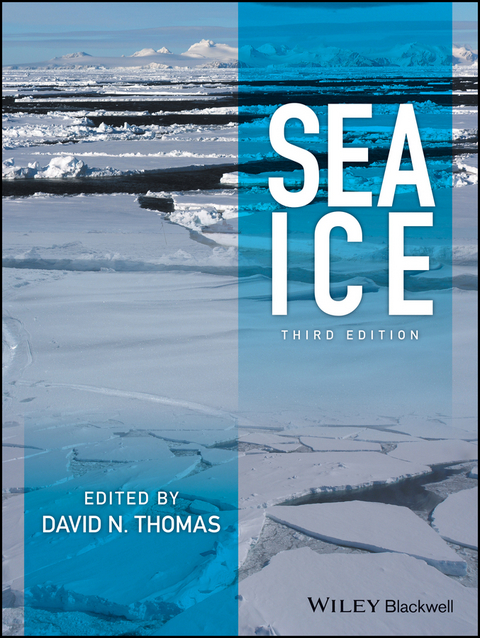
Sea Ice (eBook)
John Wiley & Sons (Verlag)
978-1-118-77835-7 (ISBN)
Over the past 20 years the study of the frozen Arctic and Southern Oceans and sub-arctic seas has progressed at a remarkable pace. This third edition of Sea Ice gives insight into the very latest understanding of the how sea ice is formed, how we measure (and model) its extent, the biology that lives within and associated with sea ice and the effect of climate change on its distribution. How sea ice influences the oceanography of underlying waters and the influences that sea ice has on humans living in Arctic regions are also discussed.
Featuring twelve new chapters, this edition follows two previous editions (2001 and 2010), and the need for this latest update exhibits just how rapidly the science of sea ice is developing. The 27 chapters are written by a team of more than 50 of the worlds' leading experts in their fields. These combine to make the book the most comprehensive introduction to the physics, chemistry, biology and geology of sea ice that there is.
This third edition of Sea Ice will be a key resource for all policy makers, researchers and students who work with the frozen oceans and seas.David N. Thomas is Professor of Marine Biology and Head of the School of Ocean Sciences at Bangor University, Menai Bridge, UK. He is also a visiting Research Professor at the Marine Research Centre of the Finnish Environment Institute (SYKE), Helsinki, Finland.
Over the past 20 years the study of the frozen Arctic and Southern Oceans and sub-arctic seas has progressed at a remarkable pace. This third edition of Sea Ice gives insight into the very latest understanding of the how sea ice is formed, how we measure (and model) its extent, the biology that lives within and associated with sea ice and the effect of climate change on its distribution. How sea ice influences the oceanography of underlying waters and the influences that sea ice has on humans living in Arctic regions are also discussed. Featuring twelve new chapters, this edition follows two previous editions (2001 and 2010), and the need for this latest update exhibits just how rapidly the science of sea ice is developing. The 27 chapters are written by a team of more than 50 of the worlds leading experts in their fields. These combine to make the book the most comprehensive introduction to the physics, chemistry, biology and geology of sea ice that there is. This third edition of Sea Ice will be a key resource for all policy makers, researchers and students who work with the frozen oceans and seas.
David N. Thomas is Professor of Marine Biology and Head of the School of Ocean Sciences at Bangor University, Menai Bridge, UK. He is also a visiting Research Professor at the Marine Research Centre of the Finnish Environment Institute (SYKE), Helsinki, Finland.
List of contributors vii
Preface xi
1 Overview of sea ice growth and properties 1
Chris Petrich and Hajo Eicken
2 Sea ice thickness distribution 42
Christian Haas
3 Snow in the sea ice system: friend or foe? 65
Matthew Sturm and Robert A. Massom
4 Sea ice and sunlight 110
Donald K. Perovich
5 The sea ice-ocean boundary layer 138
Miles G. McPhee
6 The atmosphere over sea ice 160
Ola Persson and Timo Vihma
7 Sea ice and Arctic Ocean oceanography 197
Finlo Cottier, Michael Steele and Frank Nilsen
8 Oceanography and sea ice in the Southern Ocean 216
Michael P. Meredith and Mark A. Brandon
9 Methods of satellite remote sensing of sea ice 239
Gunnar Spreen and Stefan Kern
10 Gaining (and losing) Antarctic sea ice: variability, trends and mechanisms 261
Sharon Stammerjohn and Ted Maksym
11 Losing Arctic sea ice: observations of the recent decline and the long-term context 290
Walter N. Meier
12 Sea ice in Earth system models 304
Dirk Notz and Cecilia M. Bitz
13 Sea ice as a habitat for Bacteria, Archaea and viruses 326
Jody W. Deming and R. Eric Collins
14 Sea ice as a habitat for primary producers 352
Kevin R. Arrigo
15 Sea ice as a habitat for micrograzers 370
David A. Caron, Rebecca J. Gast and Marie-Ève Garneau
16 Sea ice as a habitat for macrograzers 394
Bodil A. Bluhm, Kerrie M. Swadling and Rolf Gradinger
17 Dynamics of nutrients, dissolved organic matter and exopolymers in sea ice 415
Klaus M. Meiners and Christine Michel
18 Gases in sea ice 433
Jean-Louis Tison, Bruno Delille and Stathys Papadimitriou
19 Transport and transformation of contaminants in sea ice 472
Feiyue Wang, Monika Púcko and Gary Stern
20 Numerical models of sea ice biogeochemistry 492
Martin Vancoppenolle and Letizia Tedesco
21 Arctic marine mammals and sea ice 516
Kristin L. Laidre and Eric V. Regehr
22 Antarctic marine mammals and sea ice 534
Marthán N. Bester, Horst Bornemann and Trevor McIntyre
23 A feathered perspective: the influence of sea ice on Arctic marine birds 556
Nina J. Karnovsky and Maria V. Gavrilo
24 Birds and Antarctic sea ice 570
David Ainley, Eric J. Woehler and Amelie Lescroël
25 Sea ice is our beautiful garden: indigenous perspectives on sea ice in the Arctic 583
Henry P. Huntington, Shari Gearheard, Lene Kielsen Holm, George Noongwook, Margaret Opie and Joelie Sanguya
26 Advances in palaeo sea ice estimation 600
Leanne Armand, Alexander Ferry and Amy Leventer
27 Ice in subarctic seas 630
Hermanni Kaartokallio, Mats A. Granskog, Harri Kuosa and Jouni Vainio
Index 645
Chapter 1
Overview of sea ice growth and properties
Chris Petrich1 and Hajo Eicken2
1Northern Research Institute Narvik, Narvik, Norway
2University of Alaska Fairbanks, Fairbanks, AK, USA
1.1 Introduction
A recent, substantial reduction in summer Arctic sea ice extent and its potential ecological and geopolitical impacts generated a lot of attention in the media and among the general public. The satellite remote-sensing data documenting such recent changes in ice coverage are collected at coarse spatial scales (Chapter 9) and typically cannot resolve details finer than about 10km in lateral extent. However, many of the processes that make sea ice such an important aspect of the polar oceans occur at much smaller scales, ranging from the sub-millimetre to the metre scale. An understanding of how large-scale behaviour of sea ice monitored by satellite relates to and depends on the processes driving ice growth and decay requires an understanding of the evolution of ice structure and properties at these finer scales and this is the subject of this chapter.
The macroscopic properties of sea ice are of interest in many practical applications discussed in this book. They are derived from microscopic properties as continuum properties averaged over a specific volume (representative elementary volume) or mass of sea ice. This is not unlike macroscopic temperature and can be derived from microscopic molecular movement. The macroscopic properties of sea ice are determined by the microscopic structure of the ice, i.e. the distribution, size and morphology of ice crystals and inclusions. The challenge is to see both the forest (i.e. the role of sea ice in the environment) and the trees (i.e. the way in which the constituents of sea ice control key properties and processes). In order to understand and project how the forest will respond to changes in its environment, we have to understand the life cycle of its constituents, the trees. Here, we will adopt a bottom-up approach, starting with the trees, characterizing microscopic properties and processes and how they determine macroscopic properties, to lay the groundwork for understanding the forest. In using this approach, we will build up from the sub-millimetre scale and conclude with the larger scales shown in Figure 1.1.
Figure 1.1 Ice types, pack ice features and growth, melt and deformation processes.
Figure 1.2 Surface appearance and microstructure of winter lake ice (Imikpuk Lake, top, panels a–d) and sea ice (Chukchi Sea landfast ice, bottom, panels e–h) near Barrow, Alaska. The bright features apparent in the lake ice are cracks that penetrate all the way to the bottom of the ice cover (close to 1m thick), while the clear, uncracked ice appears completely black (a, top). (e) The sea ice surface photograph shows a network of brine channels that join into a few feeder channels. (b, c, f, g) Photographs of vertical thin sections from the two ice covers, with (b) and (f) recorded between crossed polarizers, highlighting different ice crystals in different colours. Panels (c) and (g) show the same section as (b) and (f) in plain transmitted light, demonstrating the effect of brine inclusions on transparency of the ice. (d, h) Photomicrographs showing the typical pore structure at a temperature of −5°C (lake ice) and −15°C (sea ice), with few thin inclusions along grain boundaries in lake ice (d) and a network of thicker brine inclusions in sea ice (h).
Sea ice would not be sea ice without salt. In fact, take away the salt and we are left with lake ice, differing in almost all aspects that we discuss in this chapter. The microscopic and macroscopic redistribution of ions opens the path to understanding all other macroscopic properties of sea ice. We will therefore start in Section 1.2 by looking at the influence of ions on ice growth at the scale of individual ice crystals, in sea ice growing under both rough and quiescent conditions. We will continue in Section 1.3 by looking at the dynamic feedback system between fluid dynamics and pore volume, both microscopically and at the continuum scale. We will point out that our knowledge is far from exhaustive in this fundamental aspect. However, armed with a basic understanding of crystal structure, phase equilibria and pore structure, we can shed light on ice optical, dielectric and thermal properties and macroscopic ice strength in Section 1.4. One of the most discussed aspects of sea ice is its presence or absence. We will look at the growth and energy budget of sea ice and touch on deformation and decay processes in Section 1.5.
1.1.1 Lake ice versus sea ice
Ice in a small lake tends to form before coastal sea ice at a similar location. This is largely explained by the fact that, in contrast to freshwater, the temperature of maximum density of seawater is not above the freezing point. If a freshwater body is cooled from above then the water body undergoes convective overturning until the temperature reaches +4°C, after which the coldest water stays at the surface where it is cooled rapidly. Hence, ice formation starts relatively early in the season but progresses slowly as the underlying water mass is still above freezing. The situation is different if strong winds continuously overturn the water (e.g. in big lakes), or if ice grows from seawater. In these cases, the entire mixed layer has to be cooled to the freezing point before ice formation sets in. Once this happens, however, thickening progresses relatively quickly.
Figure 1.3 Crystal structure of ice Ih (from Weeks & Ackley, 1986). The -axis is indicated at left and right, and the centre panels correspond to a view along (top) and normal (bottom) to the -axis.
Salt further impacts ice microstructure. The photographs in Figure 1.2 show the surface of snow-free lake ice and sea ice in spring near Barrow, Alaska. Despite comparable thickness and growth conditions, lake ice, transparent, appears much darker than sea ice, which scatters light. This is also expressed in a large difference in albedo (the fraction of the incident short-wave radiation reflected from a surface; Section 1.4), such that more than three-quarters of the incoming short-wave irradiative flux penetrates the lake ice surface into the underlying water, compared with less than half for a sea ice cover. This has substantial consequences for the heat budget of the ice cover and the water beneath. The fact that sea ice albedo is typically higher than open water albedo by a factor of up to 10 gives rise to the so-called ice–albedo feedback: a perturbation in the surface energy balance resulting in a decreased sea ice extent due to warming may amplify, as the ice cover reduction increases the amount of solar energy absorbed by the system (Chapter 4; Curry et al., 1995; Perovich et al., 2007). For low-albedo lake ice, this effect is less pronounced. What causes these contrasts? As the thin-section photographs in Figure 1.2 demonstrate, lake ice is nearly devoid of millimetre and sub-millimetre liquid inclusions, whereas sea ice can contain more than 10mm–3. The inclusions scatter light due to a contrast in refractive index (Section 1.4). This explains both the high albedo and lack of transparency of thicker sea ice samples.
The crystal microstructure differs between lake ice and sea ice. Lake ice grows with a planar liquid–solid interface rather than a lamellar interface, as is the case of sea ice. In sea ice, brine is trapped between the lamellae at the bottom of the ice, allowing for retention of between 10% and 40% of the ions between the ice crystals. While the differences in bulk ice properties, such as albedo and optical extinction coefficient, are immediately obvious from these images, the physical features and processes responsible for these differences only reveal themselves in the microscopic approach, as exemplified by the thin-section images depicting individual inclusions (Figure 1.2). In the sections that follow, we will consider in more detail how microstructure and microphysics are linked to sea ice growth and evolution, and how both in turn determine the properties of the ice cover as a whole.
1.2 Ions in the water: sea ice microstructure and phase diagram
1.2.1 Crystal structure of ice Ih
The characteristic properties of sea ice and its role in the environment are governed by the crystal lattice structure of ice Ih, in particular its resistance to the incorporation of sea salt ions. Depending on pressure and temperature, water ice can appear in more than 15 different modifications. At the Earth's surface, freezing of water under equilibrium conditions results in the formation of the modification ice Ih, with the ‘h’ indicating crystal symmetry in the hexagonal system. Throughout this chapter, the term ‘ice’ refers to ice Ih.
Water molecules (H2O) in ice are arranged tetrahedrally around each other, with a six-fold rotational symmetry apparent in the so-called basal plane (Figure 1.3). This is why snowflakes have six-fold symmetry. The principal crystallographic axis [referred to either as the corresponding unit vector (0001) or simply as the c-axis] is normal to the basal plane and corresponds to the axis of maximum rotational symmetry (Figure 1.3). The interface of the basal plane is smooth at the molecular level. The basal plane is spanned by the crystal a-axes, and the crystal faces perpendicular to this plane...
| Erscheint lt. Verlag | 27.12.2016 |
|---|---|
| Sprache | englisch |
| Themenwelt | Naturwissenschaften ► Biologie ► Ökologie / Naturschutz |
| Naturwissenschaften ► Geowissenschaften ► Geologie | |
| Naturwissenschaften ► Geowissenschaften ► Hydrologie / Ozeanografie | |
| Technik | |
| Schlagworte | aquatic ecology • Arctic • Biowissenschaften • Change • Chapters • Climate • Distribution • earth sciences • Edition • effect • Environmental Geoscience • FROZEN • Geowissenschaften • humans • ICE • influences • insight • Latest • Life Sciences • Meereis • Oceanography • Oceanography & Paleoceanography • Ökologie / Aquatische Lebensräume • Ozeanographie u. Paläozeanographie • Pace • PAST • previous • remarkable • Sea • seas • Study • subarctic • Third • two • Umweltgeowissenschaften • Understanding • Waters |
| ISBN-10 | 1-118-77835-9 / 1118778359 |
| ISBN-13 | 978-1-118-77835-7 / 9781118778357 |
| Informationen gemäß Produktsicherheitsverordnung (GPSR) | |
| Haben Sie eine Frage zum Produkt? |
 EPUB (Adobe DRM)
Kopierschutz: Adobe-DRM
Adobe-DRM ist ein Kopierschutz, der das eBook vor Mißbrauch schützen soll. Dabei wird das eBook bereits beim Download auf Ihre persönliche Adobe-ID autorisiert. Lesen können Sie das eBook dann nur auf den Geräten, welche ebenfalls auf Ihre Adobe-ID registriert sind.
Details zum Adobe-DRM
Dateiformat: EPUB (Electronic Publication)
EPUB ist ein offener Standard für eBooks und eignet sich besonders zur Darstellung von Belletristik und Sachbüchern. Der Fließtext wird dynamisch an die Display- und Schriftgröße angepasst. Auch für mobile Lesegeräte ist EPUB daher gut geeignet.
Systemvoraussetzungen:
PC/Mac: Mit einem PC oder Mac können Sie dieses eBook lesen. Sie benötigen eine
eReader: Dieses eBook kann mit (fast) allen eBook-Readern gelesen werden. Mit dem amazon-Kindle ist es aber nicht kompatibel.
Smartphone/Tablet: Egal ob Apple oder Android, dieses eBook können Sie lesen. Sie benötigen eine
Geräteliste und zusätzliche Hinweise
Buying eBooks from abroad
For tax law reasons we can sell eBooks just within Germany and Switzerland. Regrettably we cannot fulfill eBook-orders from other countries.
aus dem Bereich