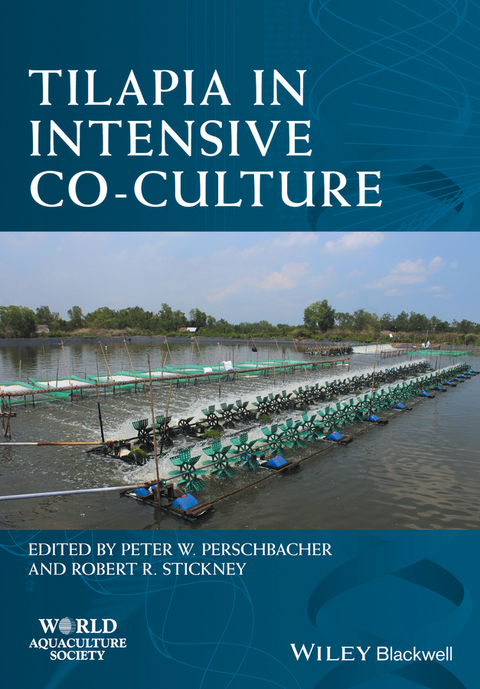
Tilapia in Intensive Co-culture (eBook)
John Wiley & Sons (Verlag)
978-1-118-97063-8 (ISBN)
Intensive tilapia co-culture is the commercial production of various species of tilapia in conjunction with one or more other marketable species. Tilapia are attractive as a co-cultured fish because of their potential to improve water quality, especially in penaeid shrimp ponds, by consuming plankton and detritus and by altering pathogenic bacterial populations while increasing marketable production.
Following introductory chapters covering ecological aspects of co-culture, tilapia feeding habits, historical use, and new models, Tilapia in Intensive Co-Culture is divided into co-culture in freshwater and marine environments. Co-culture core information is presented on Vibrio control, high-rate aquaculture processes, aquaponics, tilapia nutrient profile, and tilapia niche economics and marketing in the U.S, and with carp, catfish, freshwater and marine shrimp in the Americas, the Middle East, and Asia.
Tilapia in Intensive Co-Culture is the latest book in the prestigious World Aquaculture Society (WAS) Series, published for WAS by Wiley Blackwell. It will be of great use and interest to researchers, producers, investors and policy makers considering tilapia co-culture in terms of environmental and economic sustainability.
Peter W. Perschbacher is retired Associate Professor of Aquaculture and Fisheries at the University of Arkansas at Pine Bluff, USA.
Robert R. Stickney is Professor Emeritus Oceanography and former Sea Grant Director at Texas A & M University in College Station, USA.
Intensive tilapia co-culture is the commercial production of various species of tilapia in conjunction with one or more other marketable species. Tilapia are attractive as a co-cultured fish because of their potential to improve water quality, especially in penaeid shrimp ponds, by consuming plankton and detritus and by altering pathogenic bacterial populations while increasing marketable production. Following introductory chapters covering ecological aspects of co-culture, tilapia feeding habits, historical use, and new models, Tilapia in Intensive Co-Culture is divided into co-culture in freshwater and marine environments. Co-culture core information is presented on Vibrio control, high-rate aquaculture processes, aquaponics, tilapia nutrient profile, and tilapia niche economics and marketing in the U.S, and with carp, catfish, freshwater and marine shrimp in the Americas, the Middle East, and Asia. Tilapia in Intensive Co-Culture is the latest book in the prestigious World Aquaculture Society (WAS) Series, published for WAS by Wiley Blackwell. It will be of great use and interest to researchers, producers, investors and policy makers considering tilapia co-culture in terms of environmental and economic sustainability.
Peter W. Perschbacher is retired Associate Professor of Aquaculture and Fisheries at the University of Arkansas at Pine Bluff, USA. Robert R. Stickney is Professor Emeritus Oceanography and former Sea Grant Director at Texas A & M University in College Station, USA.
List of Contributors ix
Foreword xi
Randall Brummett
Preface xv
Chapter 1. Ecological Basis of Tilapia Co-culture Systems 1
Ana Milstein and Martha Hernández
Chapter 2. Tilapia Feeding Habits and Environmental Tolerances 25
Robert R. Stickney
Chapter 3. Historical Use of Tilapia in Intensive Co-culture 36
Peter W. Perschbacher
Chapter 4. New Models and Rationales 50
Robert R. Stickney, Peter W. Perschbacher, and Nick Parker
Chapter 5. Sustainability Needs and Challenges: Marine Systems 71
Robert R. Stickney and Robert W. Brick
Chapter 6. Luminous Vibrio and the Greenwater Culture of the Tiger Shrimp Penaeus monodon with Tilapia 81
Gilda D. Lio-Po
Chapter 7. Tilapia-Shrimp Polyculture 94
Kevin M. Fitzsimmons and Erfan Shahkar
Chapter 8. Sustainability Needs and Challenges: Freshwater Systems 114
Peter W. Perschbacher
Chapter 9. Pond Co-culture with Catfish Research in the Americas, with Emphasis on Cage-Confined Tilapia 129
Peter W. Perschbacher
Chapter 10. Tilapia Co-culture in Cages and In-pond Raceways 148
Michael Masser
Chapter 11. Tilapia-Macrobrachium Polyculture 156
Michael B. New and Wagner C. Valenti
Chapter 12. Tilapia in High-Rate Aquaculture Processes 186
David E. Brune
Chapter 13. Tilapia Co-culture in Egypt 211
Abdel-Fattah M. El-Sayed
Chapter 14. Tilapia Co-culture in Israeli Fishponds and Reservoirs 237
Ana Milstein
Chapter 15. Aquaponics 246
Rebecca L. Nelson
Chapter 16. Nutrient Profiles of Tilapia 261
Ioannis T. Karapanagiotidis
Chapter 17. The Economics of Small-Scale Tilapia Aquaculture in the United States 306
Siddhartha Dasgupta and Richard C. Bryant
Appendix 1. Field Key to the Commonly Cultured Tilapias, with Species Synopses 319
Peter W. Perschbacher
Appendix 2. World Hybrid Tilapia Literature 1980-2014* 324
Frank J. Schwartz
Scientific Names Index 333
Topical Index 335
Color Plates appear after page 318
| Erscheint lt. Verlag | 22.12.2016 |
|---|---|
| Reihe/Serie | World Aquaculture Society Book series | World Aquaculture Society Book Series |
| Sprache | englisch |
| Themenwelt | Naturwissenschaften ► Biologie |
| Technik | |
| Weitere Fachgebiete ► Land- / Forstwirtschaft / Fischerei | |
| Schlagworte | Aquaculture • Aquaculture, Fisheries & Fish Science • Aquakultur • Aquakultur, Fischereiwesen u. Fischforschung • Co-culture/polyculture, Vibrio diseases, Penaeid shrimp polyculture, Tilapia nutrient profiles, Tilapia niche economics/marketing in US, Egyptian production, Israeli production, Co-culture in aquaponics, Tilapia in high-rate systems, Tilapia in cage/raceway systems • Fischforschung • Fischzucht • Fish Science • Tilapia |
| ISBN-10 | 1-118-97063-2 / 1118970632 |
| ISBN-13 | 978-1-118-97063-8 / 9781118970638 |
| Informationen gemäß Produktsicherheitsverordnung (GPSR) | |
| Haben Sie eine Frage zum Produkt? |
 PDF (Adobe DRM)
Kopierschutz: Adobe-DRM
Adobe-DRM ist ein Kopierschutz, der das eBook vor Mißbrauch schützen soll. Dabei wird das eBook bereits beim Download auf Ihre persönliche Adobe-ID autorisiert. Lesen können Sie das eBook dann nur auf den Geräten, welche ebenfalls auf Ihre Adobe-ID registriert sind.
Details zum Adobe-DRM
Dateiformat: PDF (Portable Document Format)
Mit einem festen Seitenlayout eignet sich die PDF besonders für Fachbücher mit Spalten, Tabellen und Abbildungen. Eine PDF kann auf fast allen Geräten angezeigt werden, ist aber für kleine Displays (Smartphone, eReader) nur eingeschränkt geeignet.
Systemvoraussetzungen:
PC/Mac: Mit einem PC oder Mac können Sie dieses eBook lesen. Sie benötigen eine
eReader: Dieses eBook kann mit (fast) allen eBook-Readern gelesen werden. Mit dem amazon-Kindle ist es aber nicht kompatibel.
Smartphone/Tablet: Egal ob Apple oder Android, dieses eBook können Sie lesen. Sie benötigen eine
Geräteliste und zusätzliche Hinweise
Buying eBooks from abroad
For tax law reasons we can sell eBooks just within Germany and Switzerland. Regrettably we cannot fulfill eBook-orders from other countries.
aus dem Bereich