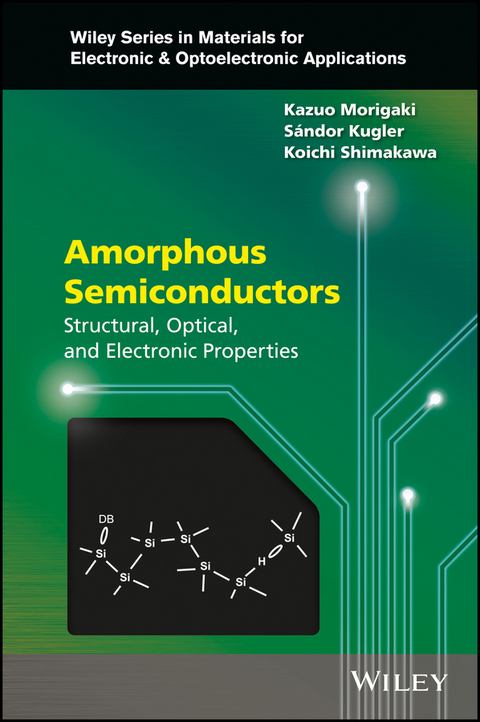
Amorphous Semiconductors (eBook)
288 Seiten
Wiley (Verlag)
978-1-118-75820-5 (ISBN)

Amorphous semiconductors are subtances in the amorphous solid state that have the properties of a semiconductor and which are either covalent or tetrahedrally bonded amorphous semiconductors or chelcogenide glasses.
- Developed from both a theoretical and experimental viewpoint
- Deals with, amongst others, preparation techniques, structural, optical and electronic properties, and light induced phenomena
- Explores different types of amorphous semiconductors including amorphous silicon, amorphous semiconducting oxides and chalcogenide glasses
- Applications include solar cells, thin film transistors, sensors, optical memory devices and flat screen devices including televisions
Kazuo Morigaki, Professor Emeritus, University of Tokyo. Morigaki received his Ph.D. degree in physics from Osaka University in 1959. Since then, he has joined Osaka University, Sony Corporation Research Laboratory, Centre d'Etudes Nuclèares de Saclay, University of Tokyo (Institute for Solid State Physics), Yamaguchi University and Hiroshima Institute of Technology. Sandor Kugler, Associate Professor, Department of Theoretical Physics, Budapest University of Technology and Economics, Hungary. Kugler received both his degree in and his PhD in physics from ELTE, Budapest. He joined the quantum theory group, Institute of Physics, Technical University of Budapest, during 1974-1993 as research associate. Since 1993, he has been Associate Professor. Koichi Shimakawa, Professor Emeritus and Fellow, Gifu University, Japan. Shimakawa received his PhD from Nagoya University in 1975. Since then, he has been at Gifu University, becoming Professor in the period 1989-2008. He retired from Gifu University in 2008, and is senior researcher, Nagoya Industrial Science Institute, Nagoya, and visiting Professor, Department of Chemistry, University of Pardubice, Czech Republic.
| Erscheint lt. Verlag | 20.12.2016 |
|---|---|
| Reihe/Serie | Wiley Series in Materials for Electronic & Optoelectronic Applications |
| Wiley Series in Materials for Electronic & Optoelectronic Applications | Wiley Series in Materials for Electronic & Optoelectronic Applications |
| Sprache | englisch |
| Themenwelt | Naturwissenschaften ► Chemie |
| Technik ► Elektrotechnik / Energietechnik | |
| Technik ► Maschinenbau | |
| Schlagworte | Amorpher Halbleiter • amorphous chalcogenide • Amorphous semiconductor • amorphous semiconductor device • band tail • Defect • disordered system • Electrical & Electronics Engineering • Electronic materials • electronic properties • Elektronische Materialien • Elektrotechnik u. Elektronik • Halbleiterphysik • hydrogenated amorphous silicon • Materials Science • Materialwissenschaften • optical properties • Physics • Physik • Semiconductor physics • Structural properties |
| ISBN-10 | 1-118-75820-X / 111875820X |
| ISBN-13 | 978-1-118-75820-5 / 9781118758205 |
| Informationen gemäß Produktsicherheitsverordnung (GPSR) | |
| Haben Sie eine Frage zum Produkt? |
 EPUB (Adobe DRM)
Kopierschutz: Adobe-DRM
Adobe-DRM ist ein Kopierschutz, der das eBook vor Mißbrauch schützen soll. Dabei wird das eBook bereits beim Download auf Ihre persönliche Adobe-ID autorisiert. Lesen können Sie das eBook dann nur auf den Geräten, welche ebenfalls auf Ihre Adobe-ID registriert sind.
Details zum Adobe-DRM
Dateiformat: EPUB (Electronic Publication)
EPUB ist ein offener Standard für eBooks und eignet sich besonders zur Darstellung von Belletristik und Sachbüchern. Der Fließtext wird dynamisch an die Display- und Schriftgröße angepasst. Auch für mobile Lesegeräte ist EPUB daher gut geeignet.
Systemvoraussetzungen:
PC/Mac: Mit einem PC oder Mac können Sie dieses eBook lesen. Sie benötigen eine
eReader: Dieses eBook kann mit (fast) allen eBook-Readern gelesen werden. Mit dem amazon-Kindle ist es aber nicht kompatibel.
Smartphone/Tablet: Egal ob Apple oder Android, dieses eBook können Sie lesen. Sie benötigen eine
Geräteliste und zusätzliche Hinweise
Buying eBooks from abroad
For tax law reasons we can sell eBooks just within Germany and Switzerland. Regrettably we cannot fulfill eBook-orders from other countries.
aus dem Bereich