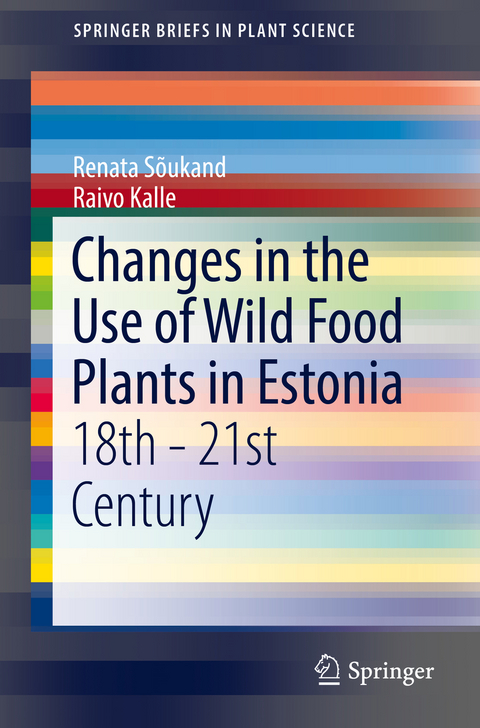
Changes in the Use of Wild Food Plants in Estonia (eBook)
172 Seiten
Springer International Publishing (Verlag)
978-3-319-33949-8 (ISBN)
Renata Sõukand, PhD is a researcher at the Estonian Literary Museum in Tartu, Estonia. Dr. Sõukand defended her PhD thesis on the historical perception of herbal landscapes in Semiotics and Cultural Theory at the University of Tartu in 2010. She won a 2016 European Research Council Starting Grant for her project "Ethnobotany of divided generations." Her main research interests are the popular perceptions and changes in plant use, the conceptualization of wild food and medicinal plants, herbal ethnomedicine and ethnocuisine, and the food-medicine continuum of the past and present. Starting from archival research and interpretation of folklore records, she moved on to research the popular use of wild food plants through contemporary surveys and sample field research all over Estonia and later conducted intensive fieldwork on Saaremaa Island on the use of wild food plants and ethnomedicine. Dr. Sõukand’s experience extends beyond Estonia; she also has fieldwork experience in Ukraine, Belarus, and Kosovo. She has co-authored over 40 peer-reviewed publications and a book on popular use of wild edible plants, written in Estonian. Raivo Kalle, MSc is a PhD student in botany at the University of Life Sciences, Tartu, Estonia. Since 2006 he has worked as a research assistant at the Estonian Literary Museum, digitizing and systematizing Estonian herbal lore. His main research interests are the use of wild food plants, especially changes in their use in Estonia through the last two centuries, use of alien plants in ethnomedicine, popular perceptions of changes in landscape and ecology, and history of ethnobotany in Estonia. Besides working in archives, he has intensive fieldwork experience all over Estonia, particularly on Saaremaa Island, in which he also adopted a survey on the use of wild edible plants to Estonian conditions. In addition, he conducted ethnobotanial fieldwork in Belarus and documented Estonian vegetation on a botanical expedition. He has co-authored over 30 peer-reviewed publications and has been the first author of a book on the popular use of wild edible plants, written in Estonian. Currently, he is preparing an anthology of the herbal ethnomedicine of Saaremaa Island.
1. Introduction.2. What Is Wild Food Plant.3. Estonia in the Context of Wild Food Plants.4. The Sources and Methods Used in the Book.5. Use of Wild Food Plants.6. Sources That Influenced the Use of Wild Food Plants in Estonia.7. Recent Changes in Use of and Perceptions on Wild Food Plants in Saaremaa. 8. Conclusions and Future Perspectives.
| Erscheint lt. Verlag | 7.11.2016 |
|---|---|
| Reihe/Serie | SpringerBriefs in Plant Science | SpringerBriefs in Plant Science |
| Zusatzinfo | VII, 172 p. 26 illus., 14 illus. in color. |
| Verlagsort | Cham |
| Sprache | englisch |
| Themenwelt | Naturwissenschaften ► Biologie ► Ökologie / Naturschutz |
| Technik | |
| Schlagworte | Estonian ethnobotany • Ethnomedicine • Food culture • Traditional Ecological Knowledge • wild food plants |
| ISBN-10 | 3-319-33949-4 / 3319339494 |
| ISBN-13 | 978-3-319-33949-8 / 9783319339498 |
| Informationen gemäß Produktsicherheitsverordnung (GPSR) | |
| Haben Sie eine Frage zum Produkt? |
 PDF (Wasserzeichen)
DRM: Digitales Wasserzeichen
Dieses eBook enthält ein digitales Wasserzeichen und ist damit für Sie personalisiert. Bei einer missbräuchlichen Weitergabe des eBooks an Dritte ist eine Rückverfolgung an die Quelle möglich.
Dateiformat: PDF (Portable Document Format)
Mit einem festen Seitenlayout eignet sich die PDF besonders für Fachbücher mit Spalten, Tabellen und Abbildungen. Eine PDF kann auf fast allen Geräten angezeigt werden, ist aber für kleine Displays (Smartphone, eReader) nur eingeschränkt geeignet.
Systemvoraussetzungen:
PC/Mac: Mit einem PC oder Mac können Sie dieses eBook lesen. Sie benötigen dafür einen PDF-Viewer - z.B. den Adobe Reader oder Adobe Digital Editions.
eReader: Dieses eBook kann mit (fast) allen eBook-Readern gelesen werden. Mit dem amazon-Kindle ist es aber nicht kompatibel.
Smartphone/Tablet: Egal ob Apple oder Android, dieses eBook können Sie lesen. Sie benötigen dafür einen PDF-Viewer - z.B. die kostenlose Adobe Digital Editions-App.
Buying eBooks from abroad
For tax law reasons we can sell eBooks just within Germany and Switzerland. Regrettably we cannot fulfill eBook-orders from other countries.
aus dem Bereich