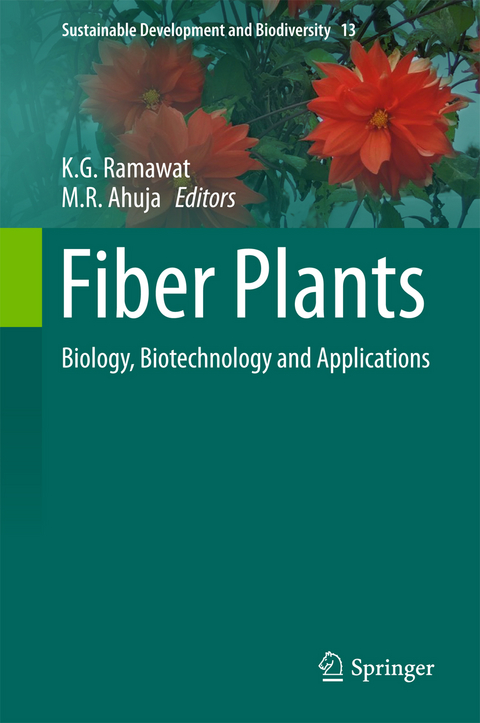
Fiber Plants (eBook)
258 Seiten
Springer International Publishing (Verlag)
978-3-319-44570-0 (ISBN)
Both editors have already published with Springer, the corresponding editor is the also the series editor.
Book Title: Fiber plants: Biology, Biotechnology and ApplicationsTable of contentPart I. Biology and Resources 1. Natural Cellulose Fiber from Mendong Grass (Fimbristylis globulosa)Heru Suryanto1Uun Yanuhar21Department of Mechanical Engineering, UniversitasNegeri Malang, Jl. Semarang 6 Malang, JawaTimur, Indonesia. E-mail:suryantoheru@yahoo.com2Laboratory of Biotechnology, Department of Fisheries and Marine Science, UniversitasBrawijaya, Jl. Veteran Malang, Indonesia. E-mail: uunyanuhar@yohoo.com. 2. Linen and its wet processingArun Kumar Patra. The Technological Institute of Textile & Sciences, Bhiwani , India 3. Cyperus canus -A traditional source of fiber, its uses, products and cultural significances among ethnic communities of Central AmericaEdgar Mó1,2, William Cetzal-Ix3*, Eliana Noguera-Savelli4&SaikatKumar Basu51 Orquideario Agronomía-CUNOR-USAC, Centro Universitario del Norte, Universidad de San Carlos de Guatemala, Cobán, Alta Verapaz, Guatemala; 2 Orquigonia, Centro de Rescate y Conservación de Orquídeas, Cobán, Alta Verapaz, Guatemala.3 Herbario CICY, Centro de Investigación Científica de Yucatán, A. C. (CICY), Calle 43. No. 130. Col. Chuburná de Hidalgo, Mérida 97200, Yucatán, México; 4 BIODIPROS AC, Biodiversidad y Producción Sustentable, Mérida, Yucatán, México; 5 Department of BiologicalSciences, University of Lethbridge, Lethbridge, Alberta, Canada; *e-mail: rolito22@hotmail.com Part II. Biotechnology and Genomics4. Importance of transgenic cottons on a global scaleRajasekaran, USDA, ARS, SRRC New Orleans, LA and D. Anderson, Dow AgroSciences, Indianapolis, IN (Rajah.Rajasekaran@ARS.USDA.GOV) 5. Cotton fibre biotechnology: Transgenic manipulation of elongation and cell wall thickeningMichael R. Stiff1, J. Rich Tuttle1, Benjamin P. Graham2, Candace H. Haigler1,21Department of Crop Science, North Carolina State University, Raleigh, North Carolina, 27695, USA2Department of Plant and Microbial Biology, North Carolina State University, Raleigh, North Carolina, 27695, USA 6. Regeneration and Somaclonal Variation and mutant in bamboo—Dendrocalamus farinosusShang-lian Hu1,2* Cao Ying1,2Lab of Plant Cell Engineering , Southwest University of Science and Technology;Engineering Research Center for Biomass Resource Utilization and Modification of Sichuan Province,Mian Yang, Sichuan Province 621010,China*Corresponding author ( Tel.: +86 816 6089526, Fax: +86 816 6089526, E-mail address: hushanglian@126.com) 7. Plant cell and organ culture approach for exploring functional cell differentiation in Phyllostachys and BambusabambooShinjiro Ogita a,b, Takao Kishimoto a, Taiji Nomura a, Yasuo Kato aa Biotechnology Research Center and Department of Biotechnology, Toyama Prefectural University, Imizu, Toyama, 939-0398, Japanb Faculty of Life and Environmental Sciences, Department of Life Sciences, Prefectural University of Hiroshima 727-0023 Shoubara, Japanogita@pu-hiroshima.ac.jp 8. Cotton In Vitro RegenerationH. F. Sakhanokho, USDA-ARS, Thad Cochran Southern Horticultural Laboratory, 810 Hwy 26 West, Poplarville, MS 39470K. RajasekaranUSDA-ARS-SRRC, 1100 Robert E. Lee Blvd, New Orleans, LA 70124(Rajah.Rajasekaran@ARS.USDA.GOV) 9. Jute Genomics: Emerging Resources and Tools for Molecular BreedingDebabrata Sarkar1· Pratik Satya1 ·Pran Gobinda Karmakar1 · Nagendra Kumar Singh21Biotechnology Unit, Division of Crop Improvement, ICAR-Central Research Institute for Jute and Allied Fibres (CRIJAF), Barrackpore, Kolkata 700 120, West Bengal, India2ICAR-National Research Centre on Plant Biotechnology (NRCPB), Pusa, New Delhi 110 012, India 10. Jute, the versatile golden fiber: Importance, impediments and improvementsPushyami Bharadwaj J, Department of Plant Sciences, University of Hyderabad, Hyderabad, India 500046. 11. Transgenic Cotton for Agronomical Useful TraitsChandrakanth Emani, Department of Biology, Western Kentucky University-Owensboro, 4821 New Hartford Road Owensboro, KY 42303, USA Part III. Application technology 12. BANANA FIBER REINFORCED COMPOSITEN. Venkateshwaran 13. Modification of cellulose acetate filmsFrancisco Rodríguez, María J. Galotto, Abel Guarda, Julio BrunaFood Packaging Laboratory.Department of Food Science and Technology, Faculty of Technology.Center for the Development of Nanoscience and Nanotechnology (CEDENNA).University of Santiago de Chile.Obispo Manuel Umaña 050. Estación Central.Santiago, Chile. 9170201. 14. Physicochemical, morphological and anatomical properties of plant fibres for pulping and papermakingKumar Anupam, Priti Shivhare Lal, Vimlesh BistPhysical Chemistry, Pulping and Bleaching Division, Central Pulp and Paper Research Institute, Himmat Nagar, Saharanpur 247001, Uttarpradesh, India 15. Sanseviera zeylanica (L.) Willd and its potential as a new natural source fiber: A case study from the Yucatan Peninsula, MexicoRodrigo Duno de Stefano1, William Cetzal-Ix1*& Saikat Kumar Basu21Herbario CICY, Centro de Investigación Científica de Yucatán, A. C. (CICY); 2 Department of Biological Sciences, University of Lethbridge, Lethbridge, AB Canada T1K 3M4;*e-mail: rolito22@hotmail.com.
| Erscheint lt. Verlag | 27.10.2016 |
|---|---|
| Reihe/Serie | Sustainable Development and Biodiversity | Sustainable Development and Biodiversity |
| Zusatzinfo | XI, 258 p. 61 illus., 39 illus. in color. |
| Verlagsort | Cham |
| Sprache | englisch |
| Themenwelt | Naturwissenschaften ► Biologie ► Botanik |
| Technik | |
| Schlagworte | Biodiversity Resource Utilization • Developmental Biology • Fiber Crops • Fiber plants • Textile material |
| ISBN-10 | 3-319-44570-7 / 3319445707 |
| ISBN-13 | 978-3-319-44570-0 / 9783319445700 |
| Informationen gemäß Produktsicherheitsverordnung (GPSR) | |
| Haben Sie eine Frage zum Produkt? |
 PDF (Wasserzeichen)
DRM: Digitales Wasserzeichen
Dieses eBook enthält ein digitales Wasserzeichen und ist damit für Sie personalisiert. Bei einer missbräuchlichen Weitergabe des eBooks an Dritte ist eine Rückverfolgung an die Quelle möglich.
Dateiformat: PDF (Portable Document Format)
Mit einem festen Seitenlayout eignet sich die PDF besonders für Fachbücher mit Spalten, Tabellen und Abbildungen. Eine PDF kann auf fast allen Geräten angezeigt werden, ist aber für kleine Displays (Smartphone, eReader) nur eingeschränkt geeignet.
Systemvoraussetzungen:
PC/Mac: Mit einem PC oder Mac können Sie dieses eBook lesen. Sie benötigen dafür einen PDF-Viewer - z.B. den Adobe Reader oder Adobe Digital Editions.
eReader: Dieses eBook kann mit (fast) allen eBook-Readern gelesen werden. Mit dem amazon-Kindle ist es aber nicht kompatibel.
Smartphone/Tablet: Egal ob Apple oder Android, dieses eBook können Sie lesen. Sie benötigen dafür einen PDF-Viewer - z.B. die kostenlose Adobe Digital Editions-App.
Buying eBooks from abroad
For tax law reasons we can sell eBooks just within Germany and Switzerland. Regrettably we cannot fulfill eBook-orders from other countries.
aus dem Bereich