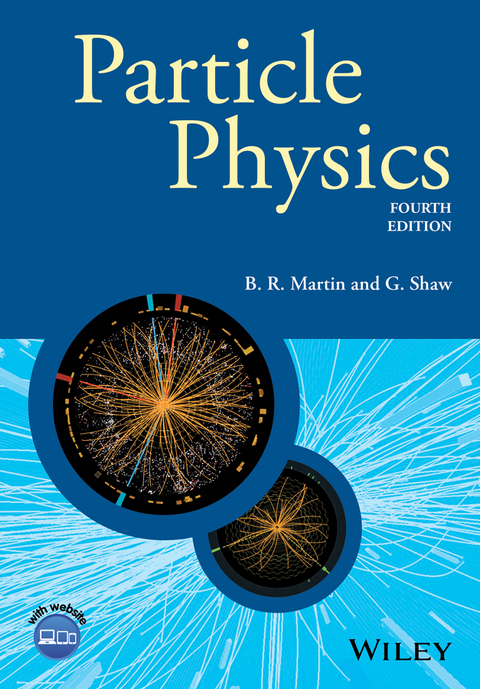
Particle Physics (eBook)
John Wiley & Sons (Verlag)
978-1-118-91221-8 (ISBN)
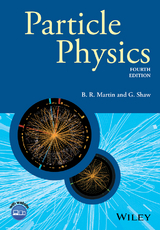
An accessible and carefully structured introduction to Particle Physics, including important coverage of the Higgs Boson and recent progress in neutrino physics.
- Fourth edition of this successful title in the Manchester Physics series
- Includes information on recent key discoveries including: An account of the discovery of exotic hadrons, byond the simple quark model; Expanded treatments of neutrino physics and CP violation in B-decays; An updated account of 'physics beyond the standard model', including the interaction of particle physics with cosmology
- Additional problems in all chapters, with solutions to selected problems available on the book's website
- Advanced material appears in optional starred sections
Professor Brian R Martin, Emeritus, Department of Physics & Astronomy, University College London, UK
Brian Martin was a full-time member of staff of the Department of Physics & Astronomy at UCL from 1968 to 1995, including a decade from 1994 to 2004 as Head of the Department. He retired in 2005 and now holds the title of Emeritus Professor of Physics. He has extensive experience of teaching undergraduate mathematics classes at all levels and experience of other universities via external examining for first degrees at Imperial College and Royal Holloway College London. He was also the external member of the General Board of the Department of Physics at Cambridge University that reviewed the whole academic programme of that department, including teaching.
Dr Graham Shaw, School of Physics & Astronomy, The University of Manchester, UK
Graham Shaw (http://www.hep.man.ac.uk/u/graham/) was a full-time member of staff of the School of Physics & Astronomy at Manchester University until September 2009. He continued to teach part-time until September 2012 and currently holds an honorary position in the department. He has extensive experience of teaching undergraduate physics and the associated mathematics and was a member of the school's Teaching Committee and Course Director of the Honours School of Mathematics and Physics for many years.
Professor Brian R Martin, Emeritus, Department of Physics & Astronomy, University College London, UK Brian Martin was a full-time member of staff of the Department of Physics & Astronomy at UCL from 1968 to 1995, including a decade from 1994 to 2004 as Head of the Department. He retired in 2005 and now holds the title of Emeritus Professor of Physics. He has extensive experience of teaching undergraduate mathematics classes at all levels and experience of other universities via external examining for first degrees at Imperial College and Royal Holloway College London. He was also the external member of the General Board of the Department of Physics at Cambridge University that reviewed the whole academic programme of that department, including teaching. Dr Graham Shaw, School of Physics & Astronomy, The University of Manchester, UK Graham Shaw (http://www.hep.man.ac.uk/u/graham/) was a full-time member of staff of the School of Physics & Astronomy at Manchester University until September 2009. He continued to teach part-time until September 2012 and currently holds an honorary position in the department. He has extensive experience of teaching undergraduate physics and the associated mathematics and was a member of the school's Teaching Committee and Course Director of the Honours School of Mathematics and Physics for many years.
1
Some basic concepts
1.1 Introduction
Particle physics is the study of the fundamental constituents of matter and their interactions. However, which particles are regarded as fundamental has changed with time as physicists' knowledge has improved. Modern theory – called the standard model – attempts to explain all the phenomena of particle physics in terms of the properties and interactions of a small number of particles of four distinct types: two spin-1/2 families of fermions called leptons and quarks; one family of spin-1 bosons – called gauge bosons – which act as ‘force carriers’ in the theory; and a spin-0 particle, called the Higgs boson, which explains the origin of mass within the theory, since without it, leptons, quarks and gauge bosons would all be massless. All the particles of the standard model are assumed to be elementary: that is they are treated as point particles, without internal structure or excited states.
The most familiar example of a lepton is the electron e− (the superscript denotes the electric charge), which is bound in atoms by the electromagnetic interaction, one of the four fundamental forces of nature. A second well-known lepton is the electron neutrino νe, which is a light, neutral particle observed in the decay products of some unstable nuclei (the so-called β decays). The force responsible for the β decay of nuclei is called the weak interaction.
Another class of particles called hadrons is also observed in nature. Familiar examples are the neutron n and proton p (collectively called nucleons) and the three pions (π+, π−, π0), where the superscripts again denote the electric charges. These are not elementary particles, but are made of quarks bound together by a third force of nature, the strong interaction. The theory is unusual in that the quarks themselves are not directly observable, only their bound states. Nevertheless, we shall see in later chapters that there is overwhelming evidence for the existence of quarks and we shall discuss the reason why they are unobservable as free particles. The strong interaction between quarks gives rise to the observed strong interaction between hadrons, such as the nuclear force that binds nucleons in nuclei. There is an analogy here with the fundamental electromagnetic interaction between electrons and nuclei that also gives rise to the more complicated forces between their bound states, that is between atoms.
In addition to the strong, weak, and electromagnetic interactions, there is a fourth force of nature – gravity. However, the gravitational interaction between elementary particles is so small compared to those from the other three interactions that it can be neglected at presently accessible energies. Because of this, we will often refer in practice to the three forces of nature.
The standard model also specifies the origin of these three forces. Consider firstly the electromagnetic interaction. In classical physics this is propagated by electromagnetic waves, which are continuously emitted and absorbed. While this is an adequate description at long distances, at short distances the quantum nature of the interaction must be taken into account. In quantum theory, the interaction is transmitted discontinuously by the exchange of spin-1 photons, which are the ‘force carriers’, or gauge bosons, of the electromagnetic interaction and, as we shall see presently, the long-range nature of the force is related to the fact that photons have zero mass. The use of the word ‘gauge’ refers to the fact that the electromagnetic interaction possesses a fundamental symmetry called gauge invariance. This property is common to all the three interactions of nature and has profound consequences, as we shall see.
The weak and strong interactions are also associated with the exchange of spin-1 particles. For the weak interaction, they are the charged W± and the neutral Z0 bosons, with masses about 80–90 times the mass of the proton. The resulting force is very short range, and in many applications may be approximated by an interaction at a point. The equivalent particles for the strong interaction are called gluons g. There are eight gluons, all of which have zero mass and are electrically neutral, like the photon. Thus, by analogy with electromagnetism, the basic strong interaction between quarks is long range. The ‘residual’ strong interaction between the quark bound states (hadrons) is not the same as the fundamental strong interaction between quarks (but is a consequence of it) and is short range, again as we shall see later.
In the standard model, which will play a central role in this book, the main actors are the leptons and quarks, which are the basic constituents of matter; the ‘force carriers’ (the photon, the W and Z bosons, and the gluons) that mediate the interactions between them; and the Higgs boson, which gives mass to the elementary particles of the standard model. In addition, because not all these particles are directly observable, quark bound states (i.e. hadrons) also play a very important role.
1.2 Antiparticles
In particle physics, high energies are needed both to create new particles and to explore the structure of hadrons. The latter requires projectiles whose wavelengths λ are at least as small as hadron radii, which are of order 10− 15 m. It follows that their momenta must be several hundred (1 MeV = 106 eV), and hence their energies E must be several hundred MeV. Because of this, any theory of elementary particles must combine the requirements of both special relativity and quantum theory. This has the startling consequence that for every charged particle of nature, whether it is one of the elementary particles of the standard model, or a hadron, there exists an associated particle of the same mass, but opposite charge, called its antiparticle. This important theoretical prediction was first made for spin- particles by Dirac in 1928, and follows from the solutions of the equation he first wrote down to describe relativistic electrons. We therefore start by considering how to construct a relativistic wave equation.
1.2.1 Relativistic wave equations
We start from the assumption that a particle moving with momentum p in free space is described by a de Broglie wave function1
with frequency and wavelength . Here p ≡ |p| and N is a normalisation constant that is irrelevant in what follows. The corresponding wave equation depends on the assumed relation between the energy E and momentum p. Non-relativistically,
and the wave function (1.1) obeys the non-relativistic Schrödinger equation
Relativistically, however,
where m is the rest mass,2 and the corresponding wave equation is
as is easily checked by substituting (1.1) into (1.5) and using (1.4). This equation was first proposed by de Broglie in 1924, but is now more usually called the Klein–Gordon equation.3 Its most striking feature is the existence of solutions with negative energy. For every plane wave solution of the form
with momentum p and positive energy
there is also a solution
corresponding to momentum –p and negative energy
Other problems also occur, indicating that the Klein–Gordon equation is not, in itself, a sufficient foundation for relativistic quantum mechanics. In particular, it does not guarantee the existence of a positive-definite probability density for position.4
The existence of negative energy solutions is a direct consequence of the quadratic nature of the mass–energy relation (1.4) and cannot be avoided in a relativistic theory. However, for spin-1/2 particles the other problems were resolved by Dirac in 1928, who looked for an equation of the familiar form
where H is the Hamiltonian and is the momentum operator. Since (1.7) is first order in , Lorentz invariance requires that it also be first order in spatial derivatives. Dirac therefore proposed a Hamiltonian of the general form
in which the coefficients β and αi(i = 1, 2, 3) are determined by requiring that solutions of the Dirac equation (1.8) are also solutions of the Klein–Gordon equation (1.5). Acting on (1.7) with and comparing with (1.5), leads to the conclusion that this is true if, and only if,
and
These relations cannot be satisfied by ordinary numbers, and the simplest assumption is that β and αi(i = 1, 2, 3) are matrices, which must be hermitian so that the Hamiltonian is hermitian. The smallest matrices satisfying these requirements have dimensions 4 × 4 and are given in many books,5 but are not required below. We...
| Erscheint lt. Verlag | 16.11.2016 |
|---|---|
| Reihe/Serie | Manchester Physics Series |
| The Manchester Physics Series | The Manchester Physics Series |
| Sprache | englisch |
| Themenwelt | Naturwissenschaften ► Physik / Astronomie ► Atom- / Kern- / Molekularphysik |
| Naturwissenschaften ► Physik / Astronomie ► Hochenergiephysik / Teilchenphysik | |
| Technik | |
| Schlagworte | Astronomie • Astronomie u. Astrophysik • Astronomy & Astrophysics • Elementarteilchenphysik • Exotic hadrons • Higgs-Boson • Kern- u. Hochenergiephysik • Matter and Forces • Neutrino Physics • Nuclear & High Energy Physics • Particle physics • Particle Physics and Cosmology • Physics • Physik • Teilchenphysik |
| ISBN-10 | 1-118-91221-7 / 1118912217 |
| ISBN-13 | 978-1-118-91221-8 / 9781118912218 |
| Informationen gemäß Produktsicherheitsverordnung (GPSR) | |
| Haben Sie eine Frage zum Produkt? |
 EPUB (Adobe DRM)
Kopierschutz: Adobe-DRM
Adobe-DRM ist ein Kopierschutz, der das eBook vor Mißbrauch schützen soll. Dabei wird das eBook bereits beim Download auf Ihre persönliche Adobe-ID autorisiert. Lesen können Sie das eBook dann nur auf den Geräten, welche ebenfalls auf Ihre Adobe-ID registriert sind.
Details zum Adobe-DRM
Dateiformat: EPUB (Electronic Publication)
EPUB ist ein offener Standard für eBooks und eignet sich besonders zur Darstellung von Belletristik und Sachbüchern. Der Fließtext wird dynamisch an die Display- und Schriftgröße angepasst. Auch für mobile Lesegeräte ist EPUB daher gut geeignet.
Systemvoraussetzungen:
PC/Mac: Mit einem PC oder Mac können Sie dieses eBook lesen. Sie benötigen eine
eReader: Dieses eBook kann mit (fast) allen eBook-Readern gelesen werden. Mit dem amazon-Kindle ist es aber nicht kompatibel.
Smartphone/Tablet: Egal ob Apple oder Android, dieses eBook können Sie lesen. Sie benötigen eine
Geräteliste und zusätzliche Hinweise
Buying eBooks from abroad
For tax law reasons we can sell eBooks just within Germany and Switzerland. Regrettably we cannot fulfill eBook-orders from other countries.
aus dem Bereich