


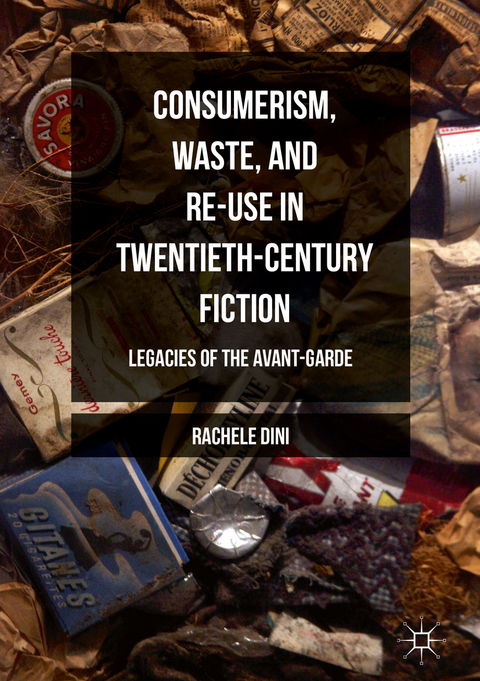
Consumerism, Waste, and Re-Use in Twentieth-Century Fiction (eBook)
253 Seiten
Palgrave Macmillan US (Verlag)
978-1-137-58165-5 (ISBN)
This book examines manufactured waste and remaindered humans in literary critiques of capitalism by twentieth-century writers associated with the historical avant-garde and their descendants. Building on recent work in new materialism and waste studies, Rachele Dini reads waste as a process or phase amenable to interruption. From an initial exploration of waste and re-use in three Surrealist texts by Giorgio de Chirico, André Breton, and Mina Loy, Dini traces the conceptualization of waste in the writing of Samuel Beckett, Donald Barthelme, J.G. Ballard, William Gaddis, and Don DeLillo. In exploring the relationship between waste, capitalism, and literary experimentation, this book shows that the legacy of the historical avant-garde is bound up with an enduring faith in the radical potential of waste. The first study to focus specifically on waste in the twentieth-century imagination, this is a valuable contribution to the expanding field of waste studies.
Rachele Dini teaches at the Foundation for International Education and in the English Department at University College London, UK. She has a BA Hons from Cambridge University, an MA from King's College London, and a PhD from University College London, UK.
This book examines manufactured waste and remaindered humans in literary critiques of capitalism by twentieth-century writers associated with the historical avant-garde and their descendants. Building on recent work in new materialism and waste studies, Rachele Dini reads waste as a process or phase amenable to interruption. From an initial exploration of waste and re-use in three Surrealist texts by Giorgio de Chirico, Andre Breton, and Mina Loy, Dini traces the conceptualization of waste in the writing of Samuel Beckett, Donald Barthelme, J.G. Ballard, William Gaddis, and Don DeLillo. In exploring the relationship between waste, capitalism, and literary experimentation, this book shows that the legacy of the historical avant-garde is bound up with an enduring faith in the radical potential of waste. The first study to focus specifically on waste in the twentieth-century imagination, this is a valuable contribution to the expanding field of waste studies.
Rachele Dini teaches at the Foundation for International Education and in the English Department at University College London, UK. She has a BA Hons from Cambridge University, an MA from King’s College London, and a PhD from University College London, UK.
Table of Contents
Acknowledgements
List of illustrations
Introduction
The commodity
Waste and recuperation
Human waste
Symbols of transience and change
The case for the novel, and for descendants of the avant-garde
From scavenging to window-shopping
Chapter overviews
The case for pursuing “this unattractive occupation”
Chapter One
In search of an epiphany: Redeeming waste and irrupting into the everyday
“The enigmatic side of beings and things”: Giorgio de Chirico’s Hebdomeros
“Quite unexpected, quite improbable”: André Breton’s Nadja
Human waste and the aesthetics of the “economically nude”: Mina Loy’s Insel
Chapter Two
Samuel Beckett’s : Human waste in
The Trilogy, Texts for Nothing, and How it I
“[A]ll these questions of worth and value”: Partial inventories, failing bodies
“[I]n the rubbish dump”: Figurations of human waste
“[S]omewhere someone is uttering”: Dwelling and speaking in waste
Chapter Three
Waste in Donald Barthelme, J.G Ballard, and William Gaddis
The writing of “dreck”: Donald Barthelme’s Snow White
“Things playing a more important part than people”: Ballard’s urban disaster trilogy
“What America’s all about, waste disposal and all”: William Gaddis’ JR
Chapter Four
“Most of our longings go unfulfilled”:
DeLillo’s historiographical readings of landfills and nuclear fallout
“Garbage for 20 years”
“Waste is the secret history”: Reading the past
“Longing on a large scale”: Nostalgia, collecting and waste
“The biggest secrets”: Fresh Kills, Consumerism and the Cold War
“ [A] form of counterhistory”: Waste and language
Conclusion
“There lies a darker narrative”: Pynchon’s Bleeding Edge
“The only truthful thing civilisation produced”: Jonathan Miles’ Want Not
“There’s always [an oil spill] happening”: Tom McCarthy’s Satin Island
The future of waste
Bibliography
| Erscheint lt. Verlag | 21.10.2016 |
|---|---|
| Zusatzinfo | XIV, 253 p. 15 illus. |
| Verlagsort | New York |
| Sprache | englisch |
| Themenwelt | Geisteswissenschaften ► Sprach- / Literaturwissenschaft ► Anglistik / Amerikanistik |
| Geisteswissenschaften ► Sprach- / Literaturwissenschaft ► Literaturwissenschaft | |
| Geisteswissenschaften ► Sprach- / Literaturwissenschaft ► Sprachwissenschaft | |
| Naturwissenschaften ► Biologie ► Ökologie / Naturschutz | |
| Sozialwissenschaften ► Soziologie | |
| Schlagworte | Avant-gardes • consumption • Desire • Twentieth century literature • Waste studies |
| ISBN-10 | 1-137-58165-4 / 1137581654 |
| ISBN-13 | 978-1-137-58165-5 / 9781137581655 |
| Informationen gemäß Produktsicherheitsverordnung (GPSR) | |
| Haben Sie eine Frage zum Produkt? |
 PDF (Wasserzeichen)
DRM: Digitales Wasserzeichen
Dieses eBook enthält ein digitales Wasserzeichen und ist damit für Sie personalisiert. Bei einer missbräuchlichen Weitergabe des eBooks an Dritte ist eine Rückverfolgung an die Quelle möglich.
Dateiformat: PDF (Portable Document Format)
Mit einem festen Seitenlayout eignet sich die PDF besonders für Fachbücher mit Spalten, Tabellen und Abbildungen. Eine PDF kann auf fast allen Geräten angezeigt werden, ist aber für kleine Displays (Smartphone, eReader) nur eingeschränkt geeignet.
Systemvoraussetzungen:
PC/Mac: Mit einem PC oder Mac können Sie dieses eBook lesen. Sie benötigen dafür einen PDF-Viewer - z.B. den Adobe Reader oder Adobe Digital Editions.
eReader: Dieses eBook kann mit (fast) allen eBook-Readern gelesen werden. Mit dem amazon-Kindle ist es aber nicht kompatibel.
Smartphone/Tablet: Egal ob Apple oder Android, dieses eBook können Sie lesen. Sie benötigen dafür einen PDF-Viewer - z.B. die kostenlose Adobe Digital Editions-App.
Buying eBooks from abroad
For tax law reasons we can sell eBooks just within Germany and Switzerland. Regrettably we cannot fulfill eBook-orders from other countries.
aus dem Bereich


