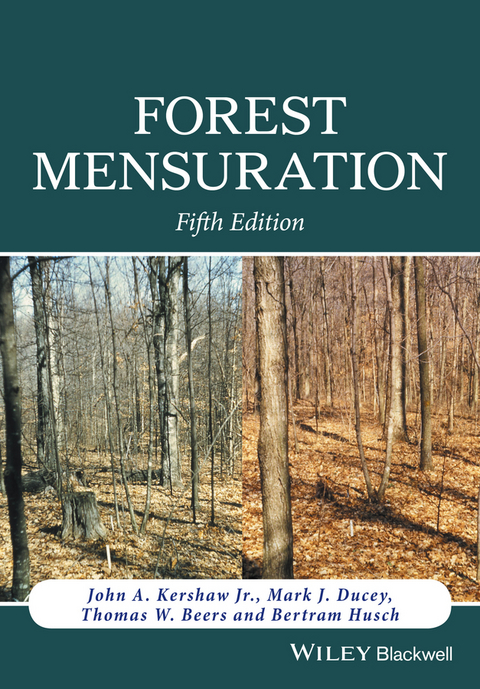
Forest Mensuration (eBook)
John Wiley & Sons (Verlag)
978-1-118-90201-1 (ISBN)
Forest mensuration - the science of measurement applied to forest vegetation and forest products - holds value for basic ecology as well as sustainable forest management. As demands on the world's forests have grown, scientists and professionals are increasingly called on to quantify forest composition, structure, and the goods and services forests provide. Grounded in geometry, sampling theory, and ecology as well as practical field experience, forest mensuration offers opportunities for creative problem solving and critical thinking.
This fifth edition of the classic volume, Forest Mensuration, includes coverage of traditional and emerging topics, with attention to SI and Imperial units throughout. The book has been reorganised from the fourth edition to better integrate non-timber and ecological aspects of forest mensuration at the tree, stand, forest, and landscape scales throughout. The new edition includes new chapters that specifically address the integration of remotely sensed data in the forest inventory process, and inventory methods for dead and downed wood. One unifying theme, not only for traditional forestry but for the non-timber inventory and for remote sensing, is the use of covariates to make sampling more efficient and spatially explicit. This is introduced in the introductory chapter on statistics and the chapter on sampling designs has been restructured to highlight this approach and lay the foundation for further learning. New examples will be developed throughout the textbook with an emphasis on current issues and international practice.
Students in applied forestry programs will find ample coverage of forest products and timber inventory, while expanded material on biodiversity, biomass and carbon inventory, downed dead wood, and the growing role of remote sensing in forest assessment will be valuable to a broader audience in applied ecology.
John A. Kershaw, Jr. Faculty of Forestry and Environmental Management, University of New Brunswick, New Brunswick, Canada.
Mark J. Ducey, Department of Natural Resources and the Environment, University of New Hampshire, USA.
Thomas W. Beers, Emeritus Professor of Forestry, Purdue University, USA.
Bertram Husch, former Forestry Consultant at INFORA Estudios Ltda. in Santiago, Chile, and former Forest Mensurationist, FAO.
Forest mensuration the science of measurement applied to forest vegetation and forest products holds value for basic ecology as well as sustainable forest management. As demands on the world s forests have grown, scientists and professionals are increasingly called on to quantify forest composition, structure, and the goods and services forests provide. Grounded in geometry, sampling theory, and ecology as well as practical field experience, forest mensuration offers opportunities for creative problem solving and critical thinking. This fifth edition of the classic volume, Forest Mensuration, includes coverage of traditional and emerging topics, with attention to SI and Imperial units throughout. The book has been reorganised from the fourth edition to better integrate non-timber and ecological aspects of forest mensuration at the tree, stand, forest, and landscape scales throughout. The new edition includes new chapters that specifically address the integration of remotely sensed data in the forest inventory process, and inventory methods for dead and downed wood. One unifying theme, not only for traditional forestry but for the non-timber inventory and for remote sensing, is the use of covariates to make sampling more efficient and spatially explicit. This is introduced in the introductory chapter on statistics and the chapter on sampling designs has been restructured to highlight this approach and lay the foundation for further learning. New examples will be developed throughout the textbook with an emphasis on current issues and international practice. Students in applied forestry programs will find ample coverage of forest products and timber inventory, while expanded material on biodiversity, biomass and carbon inventory, downed dead wood, and the growing role of remote sensing in forest assessment will be valuable to a broader audience in applied ecology.
John A. Kershaw, Jr. Faculty of Forestry and Environmental Management, University of New Brunswick, New Brunswick, Canada. Mark J. Ducey, Department of Natural Resources and the Environment, University of New Hampshire, USA. Thomas W. Beers, Emeritus Professor of Forestry, Purdue University, USA. Bertram Husch, former Forestry Consultant at INFORA Estudios Ltda. in Santiago, Chile, and former Forest Mensurationist, FAO.
Title Page 5
Copyright Page 6
Contents 7
Preface 16
Chapter 1 Introduction 19
1.1.Role of Forest Mensuration in Forest Management 20
1.2. Forest Mensuration as a Tool for Monitoring Forests 21
1.3. Relevance of Forest Mensuration for Ecology and Nontimber Resources 22
1.4. Design and Planning of Inventories 23
1.4.1. Timber Estimation 23
1.4.2. Nontimber Estimation 25
1.4.3. Inventory Planning 25
1.4.4. Forest Inventory Design 28
1.4.5. Inventory Fieldwork 29
Chapter 2 Principles of Measurement 31
2.1. Scales of Measurement 32
2.2. Units of Measurement 34
2.3. Systems of Measurement 34
2.3.1. International System of Units (Metric System) 34
2.3.2. Imperial System 36
2.3.3. Conversions Between Systems 38
2.4. Variables 39
2.5. Precision, Accuracy, and Bias 39
2.6. Significant Digits and Rounding Off 41
2.6.1. Significant Digits in Measurements 41
2.6.2. Rounding Off 42
2.6.3. Significant Digits in Arithmetic Operations 43
2.7. Data Summary and Presentation 45
2.7.1. Tables 46
2.7.2. Graphic Presentation 46
2.7.3. Class Limits 47
2.8. Fundamental Measurements 48
2.8.1. Linear Measurements 48
2.8.2. Time Measurements 49
2.8.3. Weight Measurements 49
2.8.4. Area Measurements 50
2.8.5. Volume Measurements 51
Chapter 3 Basic Statistical Concepts 52
3.1. Descriptive Statistics 52
3.1.1. Population 53
3.1.2. Sample 53
3.1.3. Statistics 56
3.2. Frequency Distributions 56
3.3. Measures of Central Tendency 58
3.3.1. Arithmetic Mean 58
3.3.2. Quadratic Mean 59
3.3.3. Harmonic and Geometric Means 60
3.3.4. Median and Mode 60
3.4. Measures of Dispersion 60
3.4.1. Variance and Standard Deviation 61
3.4.2. Coefficient of Variation 63
3.5. Sampling Error 63
3.5.1. Standard Error of the Mean 64
3.5.2. Confidence Interval 66
3.6. Sample Size Determination 68
3.7.Influence of Scalar Transformations and the Estimation of Totals 70
3.8. Correlation and Regression Estimation 71
3.8.1. Covariance and Correlation 71
3.8.2. Simple Linear Regression 74
3.8.3. Goodness-of-Fit and Regression Diagnostics 76
3.8.4. Multiple Regression and Transformations 79
3.8.5. Advanced Topics in Regression Analysis 81
3.9. Use of Covariates to Improve Estimation 81
3.9.1. Ratio Estimation 82
3.9.2. Regression Estimation 83
Chapter 4 Land Area Determination in Forest Mensuration 85
4.1. Land Distance and Area Units 86
4.2. Measuring Distances 86
4.2.1. Pacing 87
4.2.2. Distances with Chains and Tapes 87
4.2.3. Optical Rangefinders 89
4.2.4. Electronic Distance Measurement Devices 89
4.2.5. Maps and Photos 90
4.3. Measuring Area in the Field 91
4.4. Measuring Area Using Maps and Photos 91
4.4.1. Area by Coordinates 91
4.4.2. Area by Dot Grids and Line Transects 93
4.4.3. Area by Planimeters 94
4.5. Determination of Photo Scale 94
4.6.Determination of Direction Using a Compass 98
4.6.1. Magnetic Declination 98
4.7.The U.S. Public Land Surveys 100
4.8. Global Positioning Systems 104
4.8.1. Components of GPS 104
4.8.2. How GPS Works 104
4.8.3. Accuracy of GPS 105
4.8.4. GPS Receivers 106
4.8.5. Using GPS Data in Forest Mensuration 107
4.9. Geographic Information Systems 107
4.9.1. Applications of GIS to Forest Mensuration 108
Chapter 5 Individual Tree Parameters 110
5.1. Age 110
5.2. Tree Diameters and Cross-Sectional Areas 113
5.2.1. Instruments for Measuring Diameter 116
5.2.2. Measurement of Upper-Stem Diameters 121
5.2.3. Cross-Sectional Area 122
5.2.4. Surface Areas 124
5.2.5. Applications to Understory Plants 125
5.3. Height 126
5.3.1. Hypsometers Based on Similar Triangles 128
5.3.2. Hypsometers Based on Trigonometry 130
5.3.3. Special Considerations in Measuring Tree Heights 135
5.3.4. Use of LiDAR 138
5.4. Form 139
5.4.1. Form Factors 139
5.4.2. Form Quotients 140
5.4.3. Taper Tables, Curves, and Formulas 141
5.4.4. Slenderness 142
5.5. Crown Parameters 143
5.5.1. Crown Length 143
5.5.2. Crown Diameter and Area 144
5.5.3. Crown Surface Area and Volume 145
5.5.4. Foliage Area and Biomass 146
5.5.5. Other Crown Characteristics 147
5.6. Regression and Allometric Approaches 148
5.6.1. Allometry of Standing Trees 148
5.6.2. Applications to Seedlings, Saplings, and Understory Plants 150
Chapter 6 Determination of Tree Volume, Weight, and Biomass 153
6.1. Measurement of Individual Trees 155
6.1.1. Stem Dissection 155
6.1.2. Volume Determination by Displacement 156
6.1.3. Volume Determination by Formulas 157
6.1.4. Determination of Cubic Volume by Graphical Methods and Integration 162
6.1.5. Determination of Crown and Root Volumes 165
6.1.6. Determination of Bark Volume 166
6.1.7. Weight Determination 169
6.1.8. Biomass Determination 171
6.1.9. Carbon and Nutrient Content Determination 172
6.2. Allometric Equations for Volume, Weight, and Biomass 174
6.2.1. Standard and Form Class Functions 175
6.2.2. Local Functions 176
6.2.3. Volume Functions to Upper-Stem Diameter Limits 177
6.3. Tabular Estimation 178
6.3.1. Descriptive Information to Accompany Tables 183
6.3.2. Checking Applicability of Tables 184
6.3.3. Conversion of Volume Tables to Weight, Biomass, or Carbon and Nutrient Tables 184
6.4. Volume and Biomass Distribution in Trees 185
6.4.1. Methods for Estimating Stem Volume Distribution 185
6.4.2. Distribution of Weight and Biomass in Trees 188
6.5. Other Methods of Estimating Tree Content 191
6.5.1. Determination of Volume by Height Accumulation 191
6.5.2. Importance Sampling and Centroid Methods 194
6.6. Applications to Seedlings and Understory Vegetation 197
6.7. Applications to Snags and Down Woody Material 197
6.7.1. Standing Dead Trees 197
6.7.2. Downed Woody Material 199
Chapter 7 Measurement of Primary Forest Products 202
7.1. Units of Measurement of Forest Products 202
7.1.1. Board Foot 202
7.1.2. Volume Units for Stacked Wood 203
7.2. Log Rules 204
7.3. Board Foot Log Rules 204
7.3.1. Mill-Study Log Rules 205
7.3.2. Diagram Log Rules 205
7.3.3. Mathematical Log Rules 207
7.3.4. Combination Log Rules 209
7.3.5. Comparison of Log Rules 209
7.3.6. Tabular Presentation of Log Rules 210
7.4. Log Scaling 213
7.4.1. Board Foot Scaling 213
7.4.2. Cubic Volume Scaling 216
7.4.3. Unmerchantable Logs 216
7.4.4. Sample scaling 216
7.5. Scaling Stacked Volume 217
7.6. Volume Unit Conversion 218
7.6.1. Determination of Solid Cubic Contents of Stacked Wood 220
7.7. Scaling By Weight 222
7.7.1. Weight Measurement of Pulpwood 222
7.7.2. Weight Measurement of Sawlogs 225
7.7.3. Weight Measurement of Pulp 226
7.7.4. Weight Measurement of Other Forest Products 227
Chapter 8 Stand Parameters 228
8.1. Age 229
8.1.1. Even-Aged and Single-Cohort Stands 229
8.1.2. Uneven-Aged and Multicohort Stands 229
8.2. Species Composition 230
8.2.1. Describing Species Composition 231
8.2.2. Number and Diversity of Species 232
8.2.3. Assigning Stand Types 236
8.3. Diameter 237
8.3.1. Expressions of Mean Diameter 238
8.3.2. Basal Area 239
8.3.3. Diameter Distributions 239
8.4. Height 246
8.4.1. Expressions of Mean Height 247
8.4.2. Height–Diameter Curves 248
8.4.3. Height–Diameter Ratio 249
8.5. Volume, Weight, and Biomass 250
8.5.1. Volume 250
8.5.2. Weight, Biomass, and Carbon Content 252
8.5.3. Volume, Weight, and Biomass of Dead Wood 253
8.6. Crown and Canopy Measurements 254
8.6.1. Crown Closure and Canopy Cover 254
8.6.2. Leaf Area Index 255
8.7. Understory and Regeneration 257
8.7.1. Density and Frequency 258
8.7.2. Cover and Competition 259
8.7.3. Biomass and Forage 264
8.7.4. Regeneration Surveys 265
8.8. Site Quality 268
8.8.1. Geocentric Approaches 269
8.8.2. Phytocentric Approaches Using Vegetation Composition 271
8.8.3. Dendrocentric Approaches 272
8.8.4. Preparation of Site Index Curves 275
8.9. Density and Stocking 277
8.9.1. Relative Density Based on Volume 278
8.9.2. Stand Density Index 279
8.9.3. Tree–Area Ratio 281
8.9.4. Crown Competition Factor 282
8.9.5. Relative Spacing 284
8.9.6. Density of Mixed-Species and Complex-Structure Stands 284
8.9.7. Point Density and Competition Indices 284
8.9.8. Forest Stocking and Density Management Diagrams 287
Chapter 9 Sampling Units for Estimating Parameters 291
9.1. The Factor Concept 292
9.2. Fixed-Area Plots 294
9.2.1. Circular Plots 294
9.2.2. Square and Rectangular Plots 295
9.2.3. Subplots 296
9.2.4. Selection of Plots and Trees 297
9.2.5. Stand and Stock Tables 298
9.2.6. Boundary Slopover 302
9.3. Sampling Trees with Variable Probability 305
9.3.1. Horizontal Point Samples 305
9.3.2. Stand and Stock Tables 311
9.3.3 Boundary Slopover Bias 314
9.3.4. Other Forms of Sampling Proportional to Size 314
9.4. Other Examples of Variable Probability Sampling 316
9.4.1 Point Intercept Sampling 316
9.4.2. Line Intercept Sampling 317
9.5. Distance-Based Sampling Units 317
9.5.1. Nearest-Neighbor Methods 317
9.5.2. Distance Sampling 320
9.6. Selecting Appropriate Sampling Units 321
Chapter 10 Sampling Designs in Forest Inventories 323
10.1. Basic Considerations 323
10.1.1. Errors in Forest Inventories 324
10.1.2. Confidence Limits 326
10.1.3. Precision Level and Intensity 328
10.2. Simple Random Sampling (SRS) 329
10.2.1. Influence of Plot Size on Simple Random Sample Designs 333
10.3. Systematic Sampling (SYS) 336
10.3.1. Systematic Plot Sampling 336
10.3.2. Sampling Error for a SYS Inventory 340
10.3.3. Systematic Strip Sampling 342
10.4. Selective or Opportunistic Sampling 344
10.5. Stratified Sampling (STS) 345
10.5.1. Estimation of Number of Sampling Units 348
10.5.2. Sample Efficiency 350
10.6. Cluster Sampling 352
10.7.Multistage Sampling 356
10.8. Sampling with Covariates 361
10.8.1. Regression Sampling 362
10.8.2. Double Sampling 367
10.9. List Sampling 371
10.10. 3P Sampling 375
Chapter 11 Inventory of Standing Trees Using Sampling with Varying Probability 379
11.1. Horizontal Point Sampling (HPS) 380
11.1.1. Angle Gauges for HPS 380
11.1.2. Photographic Methods 385
11.1.3. Sample Size 386
11.1.4. Choosing a Suitable Gauge Constant 387
11.1.5. Proper Use of Gauges 389
11.1.6. Checking Questionable Trees 390
11.1.7. Slope Correction 392
11.1.8. Leaning and Hidden Trees 392
11.1.9. Volume Estimation 393
11.1.10. Special-Purpose Modifications of HPS 394
11.2. Subsampling in HPS 395
11.2.1. Big BAF Sampling 395
11.2.2. Point 3P Sampling 400
11.3. Other Variable Probability Sampling Techniques 404
11.3.1. Horizontal Line Sampling (HLS) 404
11.3.2. Vertical Point and Line Sampling 407
11.3.3. Critical Height Sampling 409
Chapter 12 Inventory of Downed Dead Material Using Sampling with Varying Probability 411
12.1. Fixed-Area Plots 412
12.2. Line Intersect Sampling 416
12.2.1. Assumptions of Line Intersect Sampling 417
12.2.2. Estimating Downed Wood Parameters 419
12.2.3. Choosing a Line Length and Design 422
12.2.4. Adaptation for Fine Fuels 424
12.3. Angle Gauge Methods 424
12.3.1. Transect Relascope Sampling 424
12.3.2. Point Relascope Sampling 428
12.3.3. Gauge Construction and Choice of Angle 429
12.3.4. Estimating Downed Wood Parameters 431
12.3.5. Practical Aspects 431
12.4. Perpendicular Distance Sampling (PDS) 432
12.4.1. PDS for Volume 433
12.4.2. Distance-Limited PDS 437
12.4.3. PDS for Other Attributes 438
12.4.4. Estimating Multiple Downed Wood Attributes 440
12.4.5. Choosing a Design and Factor 442
12.5. Other Methods 443
12.5.1. Diameter Relascope Sampling 443
12.5.2. Critical Length Sampling 444
12.5.3. Line Intersect Distance Sampling 444
12.6. Design Considerations and Selection of Methods 445
Chapter 13 Integrating Remote Sensing in Forest Inventory 447
13.1. Types of Remotely Sensed Data 447
13.1.1. Aerial Analog Photography 449
13.1.2. Moderate-Resolution Optical Data 451
13.1.3. High-Resolution Optical Data 453
13.1.4. LiDAR 454
13.1.5. Synthetic Aperture Radar 458
13.1.6. Hyperspectral Data 459
13.2. Remote Sensing for Stratification 460
13.2.1. Photo Interpretation and Stand Mapping 460
13.2.2. Pixel-Based Classification 462
13.2.3. Object-Oriented Classification 462
13.2.4. Effects of Misclassification on Estimation 463
13.3. Individual Tree Measurements 464
13.3.1. Crown Widths 465
13.3.2. Tree Heights 466
13.3.3. Estimating Stand Characteristics 466
13.4. Remote Sensing for Covariates 467
13.4.1. Tree and Stand Attributes and Sampling Covariates 467
13.4.2. Applications to Ratio and Regression Sampling 469
13.4.3. Imputation and Mapping 471
13.4.4. Areal Importance Sampling 472
Chapter 14 Measurement of Tree and Stand Growth 473
14.1. Individual Tree Growth 474
14.1.1. Tree Growth Curves 474
14.1.2. Growth Percent 476
14.2. Direct Measurement of Tree Growth 478
14.2.1. Diameter Growth Measurement 479
14.2.2. Height Growth Measurement 480
14.2.3. Crown Growth Measurements 481
14.2.4. Belowground Growth Measurements 481
14.3. Reconstructing Tree Growth 483
14.3.1. Stem Analysis 483
14.3.2. Estimating Diameter Growth from Increment Cores 484
14.3.3. Allometric Relationships 490
14.4. Stand and Forest Growth 492
14.4.1. Components of Stand Growth 492
14.4.2. Types of Stand Growth 493
14.5. Measurement of Stand and Forest Growth and Yield 497
14.5.1. Stand Reconstruction 497
14.5.2. Estimation of Stand Growth and Yield from Temporary Sample Plots 499
14.5.3. Estimation of Stand Growth and Yield from Fixed?Area Permanent Sample Plots 499
14.5.4. Estimation of Stand Growth and Yield from Permanent Variable Probability Sample Points 502
14.6. Considerations for the Design and Maintenance of Permanent Sample Plot Systems 512
14.6.1. Sampling Unit Type 515
14.6.2. Sampling Unit Size and Shape 516
14.6.3. Sampling Unit Layout 516
14.6.4. Measurement Protocols 517
14.7. Growth and Yield Models 521
14.7.1. Stand Table Projection 522
14.7.2. Yield Tables and Equations 527
14.7.3. Diameter Distribution Models 534
14.7.4. Individual Tree Growth and Yield Models 534
14.7.5. Other Types of Models 535
14.7.6. Feedbacks between Growth and Yield Models and Forest Mensuration 536
Appendix 537
References 568
Index 610
Supplemental Images 632
EULA 638
| Erscheint lt. Verlag | 4.11.2016 |
|---|---|
| Sprache | englisch |
| Themenwelt | Naturwissenschaften ► Biologie ► Botanik |
| Naturwissenschaften ► Geowissenschaften ► Geografie / Kartografie | |
| Technik | |
| Schlagworte | Agriculture • Biowissenschaften • Botanik • Continuous forest inventory • Down wood • Environmental Statistics & Environmetrics • Forest biomass • Forest biometrics • Forest inventory • Forest measurements • forestry • Forstwirtschaft • Landwirtschaft • Life Sciences • plant science • Remote Sensing • Sampling • Statistics • Statistik • Timber inventory • Umweltstatistik • Umweltstatistik u. Environmetrics • Variable probability sampling • Vermessung • Wald |
| ISBN-10 | 1-118-90201-7 / 1118902017 |
| ISBN-13 | 978-1-118-90201-1 / 9781118902011 |
| Informationen gemäß Produktsicherheitsverordnung (GPSR) | |
| Haben Sie eine Frage zum Produkt? |
 PDF (Adobe DRM)
Kopierschutz: Adobe-DRM
Adobe-DRM ist ein Kopierschutz, der das eBook vor Mißbrauch schützen soll. Dabei wird das eBook bereits beim Download auf Ihre persönliche Adobe-ID autorisiert. Lesen können Sie das eBook dann nur auf den Geräten, welche ebenfalls auf Ihre Adobe-ID registriert sind.
Details zum Adobe-DRM
Dateiformat: PDF (Portable Document Format)
Mit einem festen Seitenlayout eignet sich die PDF besonders für Fachbücher mit Spalten, Tabellen und Abbildungen. Eine PDF kann auf fast allen Geräten angezeigt werden, ist aber für kleine Displays (Smartphone, eReader) nur eingeschränkt geeignet.
Systemvoraussetzungen:
PC/Mac: Mit einem PC oder Mac können Sie dieses eBook lesen. Sie benötigen eine
eReader: Dieses eBook kann mit (fast) allen eBook-Readern gelesen werden. Mit dem amazon-Kindle ist es aber nicht kompatibel.
Smartphone/Tablet: Egal ob Apple oder Android, dieses eBook können Sie lesen. Sie benötigen eine
Geräteliste und zusätzliche Hinweise
Buying eBooks from abroad
For tax law reasons we can sell eBooks just within Germany and Switzerland. Regrettably we cannot fulfill eBook-orders from other countries.
aus dem Bereich