


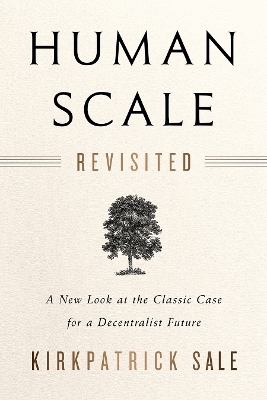
Human Scale Revisited
A New Look at the Classic Case for a Decentralist Future
Seiten
2017
Chelsea Green Publishing Co (Verlag)
978-1-60358-712-9 (ISBN)
Chelsea Green Publishing Co (Verlag)
978-1-60358-712-9 (ISBN)
- Titel z.Zt. nicht lieferbar
- Portofrei ab CHF 40
- Auch auf Rechnung
- Artikel merken
Big government, big business, big everything: Kirkpatrick Sale took giantism to task in his 1980 classic, Human Scale, and today takes a new look at how the crises that imperil modern America are the inevitable result of bigness grown out of control—and what can be done about it.
The result is a keenly updated, carefully argued case for bringing human endeavors back to scales we can comprehend and manage—whether in our built environments, our politics, our business endeavors, our energy plans, or our mobility.
Sale walks readers back through history to a time when buildings were scaled to the human figure (as was the Parthenon), democracies were scaled to the societies they served, and enterprise was scaled to communities. Against that backdrop, he dissects the bigger-is-better paradigm that has defined modern times and brought civilization to a crisis point. Says Sale, retreating from our calamity will take rebalancing our relationship to the environment; adopting more human-scale technologies; right-sizing our buildings, communities, and cities; and bringing our critical services—from energy, food, and garbage collection to transportation, health, and education—back to human scale as well.
Like Small is Beautiful by E. F. Schumacher, Human Scale has long been a classic of modern decentralist thought and communitarian values—a key tool in the kit of those trying to localize, create meaningful governance in bioregions, or rethink our reverence of and dependence on growth, financially and otherwise.
Rewritten to interpret the past few decades, Human Scale offers compelling new insights on how to turn away from the giantism that has caused escalating ecological distress and inequality, dysfunctional governments, and unending warfare and shines a light on many possible pathways that could allow us to scale down, survive, and thrive.
The result is a keenly updated, carefully argued case for bringing human endeavors back to scales we can comprehend and manage—whether in our built environments, our politics, our business endeavors, our energy plans, or our mobility.
Sale walks readers back through history to a time when buildings were scaled to the human figure (as was the Parthenon), democracies were scaled to the societies they served, and enterprise was scaled to communities. Against that backdrop, he dissects the bigger-is-better paradigm that has defined modern times and brought civilization to a crisis point. Says Sale, retreating from our calamity will take rebalancing our relationship to the environment; adopting more human-scale technologies; right-sizing our buildings, communities, and cities; and bringing our critical services—from energy, food, and garbage collection to transportation, health, and education—back to human scale as well.
Like Small is Beautiful by E. F. Schumacher, Human Scale has long been a classic of modern decentralist thought and communitarian values—a key tool in the kit of those trying to localize, create meaningful governance in bioregions, or rethink our reverence of and dependence on growth, financially and otherwise.
Rewritten to interpret the past few decades, Human Scale offers compelling new insights on how to turn away from the giantism that has caused escalating ecological distress and inequality, dysfunctional governments, and unending warfare and shines a light on many possible pathways that could allow us to scale down, survive, and thrive.
Kirkpatrick Sale is a prolific scholar and author of more than a dozen books—including Human Scale, Rebels Against the Future, and After Eden: The Evolution of Human Domination. He has been described as the “leader of the Neo-Luddites,” is one of the pioneers of the bioregional movement, and throughout his career has been a regular contributor to The Nation, The New York Times Magazine, CounterPunch, Lew Rockwell, The New York Review of Books, and The Utne Reader, which named him one of 100 living visionaries. Sale is currently the director of the political think tank the Middlebury Institute for the study of separatism, secession, and self-determination.
| Erscheinungsdatum | 17.05.2017 |
|---|---|
| Zusatzinfo | Black-and-white illustrations throughout |
| Verlagsort | White River Junction |
| Sprache | englisch |
| Maße | 153 x 229 mm |
| Gewicht | 590 g |
| Themenwelt | Naturwissenschaften ► Biologie ► Ökologie / Naturschutz |
| Sozialwissenschaften ► Politik / Verwaltung ► Politische Systeme | |
| Sozialwissenschaften ► Politik / Verwaltung ► Staat / Verwaltung | |
| Sozialwissenschaften ► Soziologie | |
| Technik ► Architektur | |
| Wirtschaft ► Betriebswirtschaft / Management | |
| Wirtschaft ► Volkswirtschaftslehre ► Wirtschaftspolitik | |
| ISBN-10 | 1-60358-712-8 / 1603587128 |
| ISBN-13 | 978-1-60358-712-9 / 9781603587129 |
| Zustand | Neuware |
| Informationen gemäß Produktsicherheitsverordnung (GPSR) | |
| Haben Sie eine Frage zum Produkt? |
Mehr entdecken
aus dem Bereich



aus dem Bereich
Methoden – Lösungen – Anwendungen
Buch | Hardcover (2025)
Hanser (Verlag)
CHF 69,95


