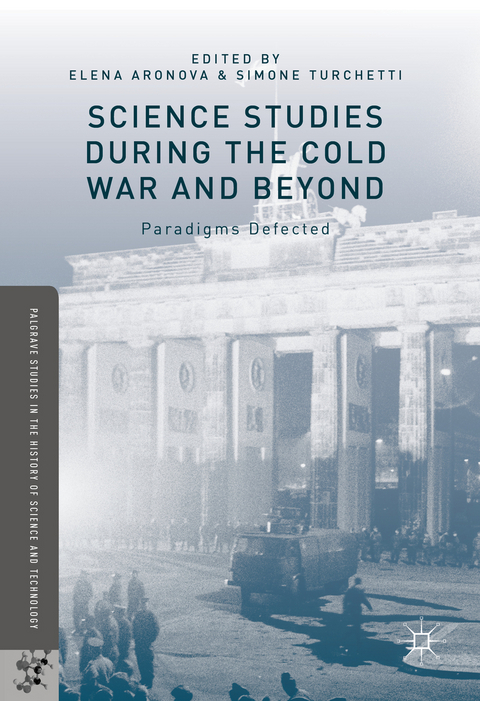
Science Studies during the Cold War and Beyond (eBook)
328 Seiten
Palgrave Macmillan US (Verlag)
978-1-137-55943-2 (ISBN)
This book examines the ways in which studies of science intertwined with Cold War politics, in both familiar and less familiar “battlefields” of the Cold War. Taken together, the essays highlight two primary roles for science studies as a new field of expertise institutionalized during the Cold War in different political regimes. Firstly, science studies played a political role in cultural Cold War in sustaining as well as destabilizing political ideologies in different political and national contexts. Secondly, it was an instrument of science policies in the early Cold War: the studies of science were promoted as the underpinning for the national policies framed with regard to both global geopolitics and local national priorities. As this book demonstrates, however, the wider we cast our net, extending our histories beyond the more researched developments in the Anglophone West, the more complex and ambivalent both the “science studies” and “the Cold War” become outside these more familiar spaces. The national stories collected in this book may appear incommensurable with what we know as science studies today, but these stories present a vantage point from which to pluralize some of the visions that were constitutive to the construction of “Cold War” as a juxtaposition of the liberal democracies in the “West” and the communist “East.”
This book examines the ways in which studies of science intertwined with Cold War politics, in both familiar and less familiar "e;battlefields"e; of the Cold War. Taken together, the essays highlight two primary roles for science studies as a new field of expertise institutionalized during the Cold War in different political regimes. Firstly, science studies played a political role in cultural Cold War in sustaining as well as destabilizing political ideologies in different political and national contexts. Secondly, it was an instrument of science policies in the early Cold War: the studies of science were promoted as the underpinning for the national policies framed with regard to both global geopolitics and local national priorities. As this book demonstrates, however, the wider we cast our net, extending our histories beyond the more researched developments in the Anglophone West, the more complex and ambivalent both the "e;science studies"e; and "e;the Cold War"e; become outside these more familiar spaces. The national stories collected in this book may appear incommensurable with what we know as science studies today, but these stories present a vantage point from which to pluralize some of the visions that were constitutive to the construction of "e;Cold War"e; as a juxtaposition of the liberal democracies in the "e;West"e; and the communist "e;East."e;
Elena Aronova is an Assistant Professor at the History Department of the University of California at Santa Barbara, USA. She is completing her book, which examines the ways in which ideas about science have become a sphere of Cold War competition, on both sides of the “iron curtain.” Her current project, Doing Things with Data, examines the politics of environmental data collection, archiving, and exchange during the Cold War. Simone Turchetti is Lecturer at the Centre for the History of Science, Technology and Medicine at the University of Manchester, UK. His research focuses on the interplay between scientists, intelligence officers and diplomats during the Cold War period. He is the author of The Pontecorvo Affair: A Cold War Defection and Nuclear Physics (2012), and more recently he has co-edited The Surveillance Imperative. Geosciences during the Cold War and Beyond.
. Section one. Science Studies in the “West”.- .Chapter 1. George Reisch, Telegrams and Paradigms: On Cold-War Geopolitics and The Structure of Scientific Revolutions.- “What’s So Great about Science?” Feyerabend on Science, Ideology, and the Cold War.- .Chapter 3. Simone Turchetti, Looking for the Bad Teachers. Radicalism and the history of science in Western countries.- .Chapter 4. Hans-Joachim Dahms, Kuhn’s “Structure”: An Exemplary Document of the Cold War Era?.- . Section two. Studies of Science Behind the ‘Curtain’.- .Chapter 5. Gabor Pallo, Blind Isolation: History of Science behind the Iron Curtain.- .Chapter 6. Michał Kokowski, The Science of Science (naukoznawstwo) in Poland. Defending and removing the past in the Cold War.- .Chapter 7. Vítězslav Sommer, Scientists of the World, Unite! Radovan Richta’s Theory of Scientific and Technological Revolution.- . Section three. National Agendas of the Studies of Science Beyond the ‘Two Blocs’.- .Chapter 8. Aant Elzinga, Cold War and Academic Boundaries: Imprints on the origins and early development of science studies in Sweden.- .Chapter 9. Federico Vasen, What Does a “National” Science Mean? Science policy, politics and philosophy in Latin America.- .Chapter 10. Lu Gao, From Natural Dialectics to STS: The Historical Evolution of Science Studies in China.-
| Erscheint lt. Verlag | 24.9.2016 |
|---|---|
| Reihe/Serie | Palgrave Studies in the History of Science and Technology | Palgrave Studies in the History of Science and Technology |
| Zusatzinfo | XIII, 328 p. |
| Verlagsort | New York |
| Sprache | englisch |
| Themenwelt | Geschichte ► Allgemeine Geschichte ► Neuzeit (bis 1918) |
| Geschichte ► Allgemeine Geschichte ► Zeitgeschichte | |
| Geisteswissenschaften ► Geschichte ► Regional- / Ländergeschichte | |
| Naturwissenschaften | |
| Sozialwissenschaften ► Politik / Verwaltung ► Politische Theorie | |
| Technik | |
| Schlagworte | China • Cold War • Latin America • National policy • Poland • Science Policy • Science Studies • Sweden |
| ISBN-10 | 1-137-55943-8 / 1137559438 |
| ISBN-13 | 978-1-137-55943-2 / 9781137559432 |
| Informationen gemäß Produktsicherheitsverordnung (GPSR) | |
| Haben Sie eine Frage zum Produkt? |
 PDF (Wasserzeichen)
DRM: Digitales Wasserzeichen
Dieses eBook enthält ein digitales Wasserzeichen und ist damit für Sie personalisiert. Bei einer missbräuchlichen Weitergabe des eBooks an Dritte ist eine Rückverfolgung an die Quelle möglich.
Dateiformat: PDF (Portable Document Format)
Mit einem festen Seitenlayout eignet sich die PDF besonders für Fachbücher mit Spalten, Tabellen und Abbildungen. Eine PDF kann auf fast allen Geräten angezeigt werden, ist aber für kleine Displays (Smartphone, eReader) nur eingeschränkt geeignet.
Systemvoraussetzungen:
PC/Mac: Mit einem PC oder Mac können Sie dieses eBook lesen. Sie benötigen dafür einen PDF-Viewer - z.B. den Adobe Reader oder Adobe Digital Editions.
eReader: Dieses eBook kann mit (fast) allen eBook-Readern gelesen werden. Mit dem amazon-Kindle ist es aber nicht kompatibel.
Smartphone/Tablet: Egal ob Apple oder Android, dieses eBook können Sie lesen. Sie benötigen dafür einen PDF-Viewer - z.B. die kostenlose Adobe Digital Editions-App.
Buying eBooks from abroad
For tax law reasons we can sell eBooks just within Germany and Switzerland. Regrettably we cannot fulfill eBook-orders from other countries.
aus dem Bereich