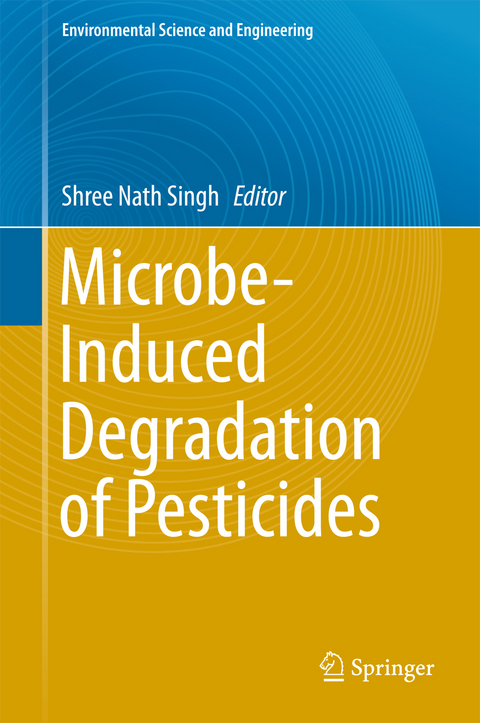
Microbe-Induced Degradation of Pesticides (eBook)
XII, 233 Seiten
Springer International Publishing (Verlag)
978-3-319-45156-5 (ISBN)
This book focuses on the microbial degradation of endosulfan, lindane, chlorophenols, organochlorine, aldrin, dieldrin, isoproturon and atrazine, etc. which are commonly used in crop fields to kill the pests. Further, it illustrates the role of degradative enzymes, metabolic pathways of degradation, toxicity of metabolites, and the factors regulating the pesticide degradation.
In view of persistence of synthetic pesticides, scientists have discovered suitable microbes, such as bacteria, fungi and algae (naturally occurring or genetically engineered) over the years. After successful trials under laboratory and field conditions, these microbes are being used to degrade chemical pesticides in agriculture. As of now 2.56 billion kg of chemical pesticides is used every year to protect agricultural fields against pest attack. These technologies have been found to be highly effective, eco-friendly and cost-effective without disturbing the agro-ecosystems.
As this book contains review articles contributed by various researchers from different countries whose work demonstrates recent advances in microbial degradation of pesticides, it will serve as a ready reckoner and also a valuable quick reference guide for scientists, academicians, cultivators and industrialists alike.
Chapter 1. Microbe-assisted Degradation of Aldrin and Dieldrin.- chapter 2. Microbe-induced Degradation of Chlorophenols.- Chapter 3. Remediation of Endosulfan Contaminated System by Microbes.- Chapter 4. Bioremediation of Isoproturon Herbicide in Agricultural Soils.- Chapter 5. Endosulfan a Cyclodiene Organochlorine Pesticide: Possible Pathways of its Biodegradation.- Chapter 6. Fungal Degradation of Organochlorine Pesticides.- Chapter 7.- Microbial Degradation of Endsulfan and Endsulfan Sulfate.- Chapter 8.- Microbe Induced Degradation of Pesticides in Agricultural Soils.- Chapter 9.- An Overview on Microbial Degradation of Lindane.- Chapter 10.- Degradation of Atrazine by Plants and Microbes
| Erscheint lt. Verlag | 12.9.2016 |
|---|---|
| Reihe/Serie | Environmental Science |
| Environmental Science | |
| Environmental Science and Engineering | Environmental Science and Engineering |
| Zusatzinfo | XII, 233 p. 43 illus., 3 illus. in color. |
| Verlagsort | Cham |
| Sprache | englisch |
| Themenwelt | Naturwissenschaften ► Biologie |
| Naturwissenschaften ► Geowissenschaften | |
| Technik | |
| Schlagworte | Degradation Pathways • Degradative Enzymes • microbes • mineralization • Pesticides |
| ISBN-10 | 3-319-45156-1 / 3319451561 |
| ISBN-13 | 978-3-319-45156-5 / 9783319451565 |
| Informationen gemäß Produktsicherheitsverordnung (GPSR) | |
| Haben Sie eine Frage zum Produkt? |
 PDF (Wasserzeichen)
DRM: Digitales Wasserzeichen
Dieses eBook enthält ein digitales Wasserzeichen und ist damit für Sie personalisiert. Bei einer missbräuchlichen Weitergabe des eBooks an Dritte ist eine Rückverfolgung an die Quelle möglich.
Dateiformat: PDF (Portable Document Format)
Mit einem festen Seitenlayout eignet sich die PDF besonders für Fachbücher mit Spalten, Tabellen und Abbildungen. Eine PDF kann auf fast allen Geräten angezeigt werden, ist aber für kleine Displays (Smartphone, eReader) nur eingeschränkt geeignet.
Systemvoraussetzungen:
PC/Mac: Mit einem PC oder Mac können Sie dieses eBook lesen. Sie benötigen dafür einen PDF-Viewer - z.B. den Adobe Reader oder Adobe Digital Editions.
eReader: Dieses eBook kann mit (fast) allen eBook-Readern gelesen werden. Mit dem amazon-Kindle ist es aber nicht kompatibel.
Smartphone/Tablet: Egal ob Apple oder Android, dieses eBook können Sie lesen. Sie benötigen dafür einen PDF-Viewer - z.B. die kostenlose Adobe Digital Editions-App.
Buying eBooks from abroad
For tax law reasons we can sell eBooks just within Germany and Switzerland. Regrettably we cannot fulfill eBook-orders from other countries.
aus dem Bereich